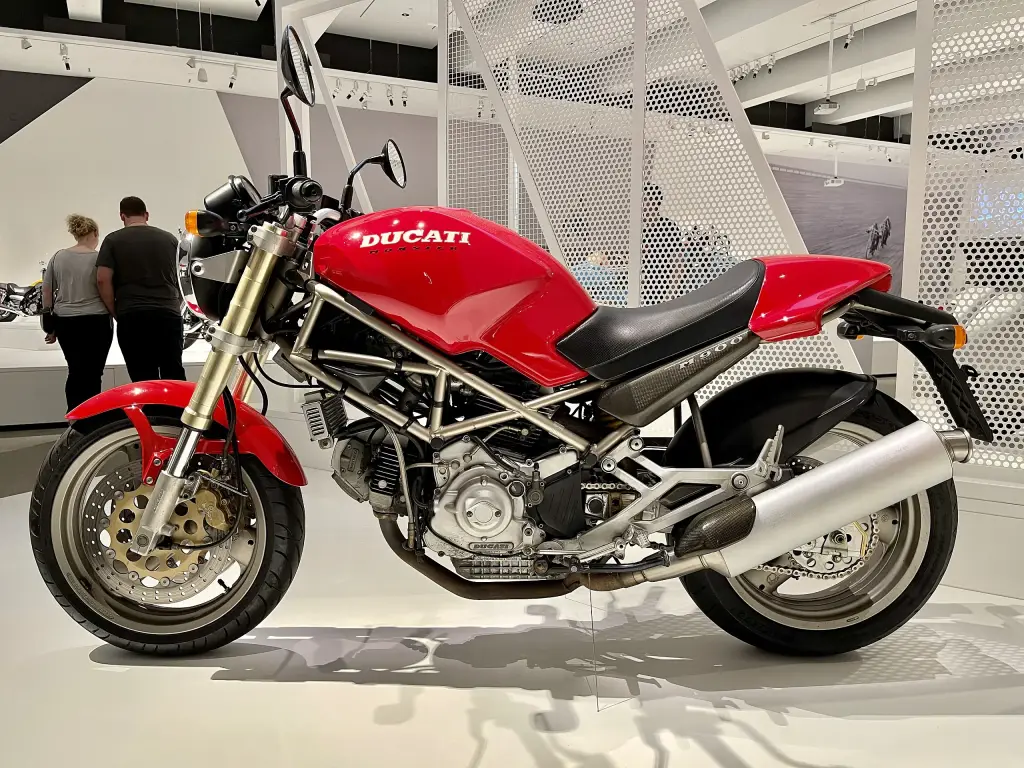
The Ducati Monster is a standard, or naked, motorcycle designed by Miguel Angel Galluzzi and produced by Ducati in Bologna since 1991. In 2005 Monster sales accounted for over half of Ducati’s worldwide sales, and Motorcycle News later called it the bike that saved Ducati.
Ducati Monster at a glance
| Maker | Ducati, Borgo Panigale |
|---|---|
| Production | since 1991 |
| Designer | Miguel Angel Galluzzi |
| Engine | 90° V-twin, L-twin in Ducati’s terms, desmodromic valves |
| Frame | tubular steel trellis designed by Fabio Taglioni |
| First models | M900 in 1991, M600 in 1994, M750 in 1996 |
| Parts sources | 900 Supersport engine, 851 frame, 750 Supersport fork |
| Share of sales, 2005 | over half of Ducati’s worldwide sales |
| Total produced | about 300,000 by 2016 |
History of the Ducati Monster
A styling exercise
The Monster began as a styling exercise in 1992. The concept was one Galluzzi had been thinking about for some time, and it took time to convince the management at Cagiva and Ducati to build it. Ducati technical director Massimo Bordi originated the idea of what the new bike should achieve and assigned the design to Galluzzi. Bordi said he asked for “something which displayed a strong Ducati heritage but which was easy to ride and not a sports bike”, and that Galluzzi’s proposal was “the bike Marlon Brando would be riding today in the film The Wild One”.
Built from the parts bin
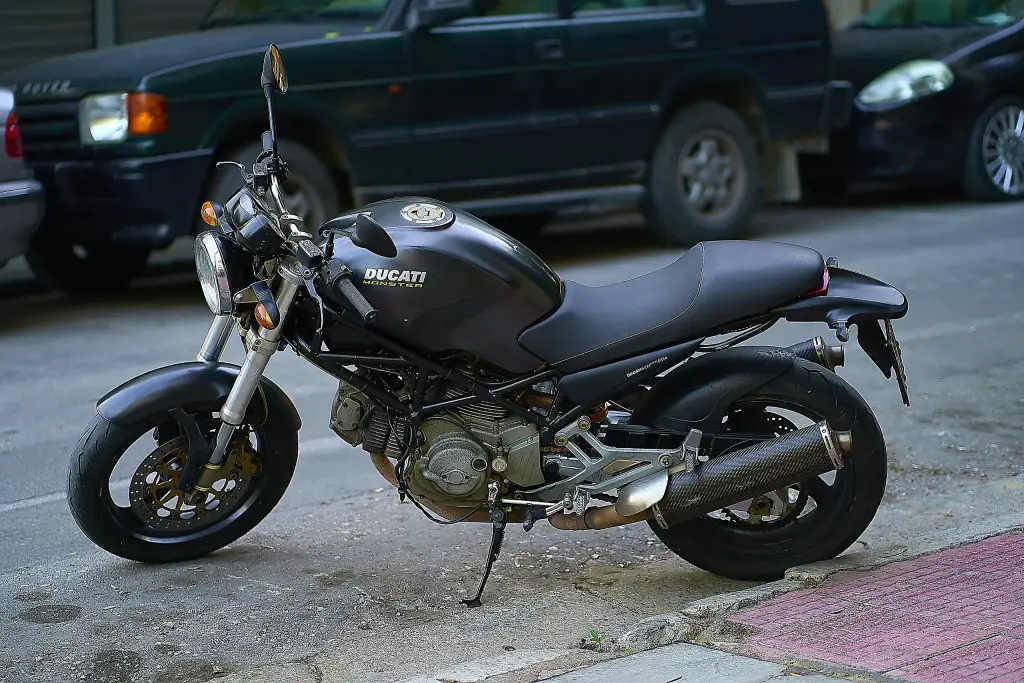
Bordi wanted costs kept low, so the Monster was a humble parts-bin special, built by mixing and matching components from existing models: the engine of a 900 Supersport, a frame descended from the 851 superbike and the fork of a 750 Supersport. Galluzzi drew a muscular fuel tank and minimalist bodywork that gave an impression of mass and strength on a motorcycle that turned out to be surprisingly small and agile. The design columnist Glynn Kerr described its statement as aggressive, “attributable to the head-down, charging bull stance”. The trellis frame is an integral part of the design, giving both the look and structural efficiency.
Not the first attempt
Bordi’s intent was to enter the cruiser market with a bike made to be modified and supported by a wealth of bolt-on accessories like those for Harley-Davidsons. Cagiva had already tried this with a cruiser, the Ducati Indiana of 1986–1990, which some sources said made poor use of Ducati’s desmodromic V-twin and used a full-cradle frame rather than the signature trellis; only 2,138 were made in four years. The Monster appealed to the same urban, style-conscious buyers but with a motorcycle they had not quite seen before, still unmistakably Italian.
The first generation
Ducati introduced three Monster models in its first generation: the M600, M750 and M900, the numbers giving engine size. The first M900 shipped in 1991, the M600 in 1994 and the M750 in 1996. In 1998 came the Monster Dark range with the M600 Dark. In 1999, to clear existing Monster parts, Ducati released several limited editions, the most notable being the Monster City in a unique blue with leather briefcase-style saddlebags and higher handlebars. From 1994 a smaller M400 was built for markets with harsh tax or licence rules, mainly Italy, Japan and Singapore but also Indonesia, the Philippines, Taiwan and Thailand; it was based on the M600 with a shorter-stroke crankshaft and smaller pistons.
The 2000s
Galluzzi began designing a second-generation Monster, but when Cagiva sold Ducati in 1998 he and the design stayed with Cagiva, since he never officially worked for Ducati; the company used the design with MV Agusta and Suzuki engines for the 2000 Cagiva Raptor, internally the M2, for Monster 2. Without that redesign the Monster frame stayed mostly unchanged until the Monster 696 of 2007. The bike changed little until 2000, when Ducati added fuel injection to the M900. In 2001 came the S4 with the liquid-cooled four-valve Superbike engine, semi-floating front discs with Brembo four-piston calipers, lighter Brembo wheels, 43 mm Showa inverted forks and a tachometer on all Monsters. In 2002 Ducati offered a limited 300-unit high-specification S4 named after the four-time Superbike champion Carl Fogarty.
Design and features
- Parts-bin engineering: 900 Supersport engine, 851-derived frame and 750 Supersport fork kept development cheap.
- Naked silhouette: a muscular tank and minimal bodywork around an exposed trellis frame.
- Commercial success: over half of Ducati’s sales in 2005 and roughly 300,000 built by 2016.
- Long life: from M900, M600 and M750 in the 1990s to the S4 and the 696 of 2007.
- Custom favourite: a popular platform for custom builders, with its own Monster Challenge.
Ducati Monster versions
- M900 (1991–): the first Monster, with the 900 Supersport engine.
- M600 (1994–): the smaller model, also offered as the M600 Dark from 1998.
- M750 (1996–): the middle model of the first generation.
- M400 (1994–): for markets with tax or licence limits.
- S4 (2001–): liquid-cooled four-valve Superbike engine, with a 300-unit Fogarty edition in 2002.
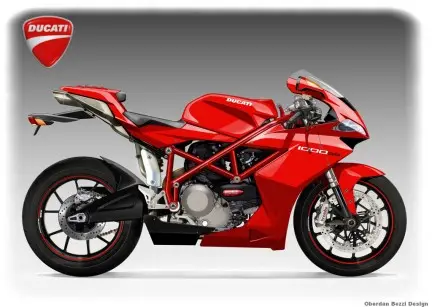
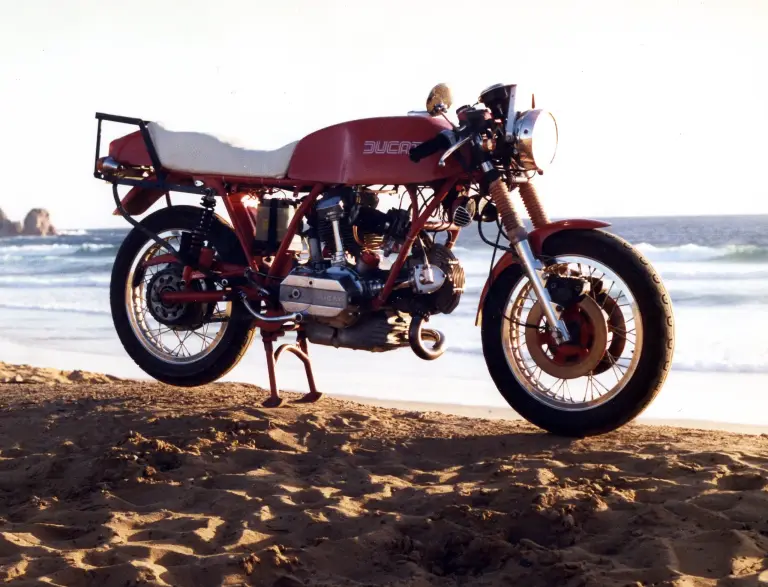
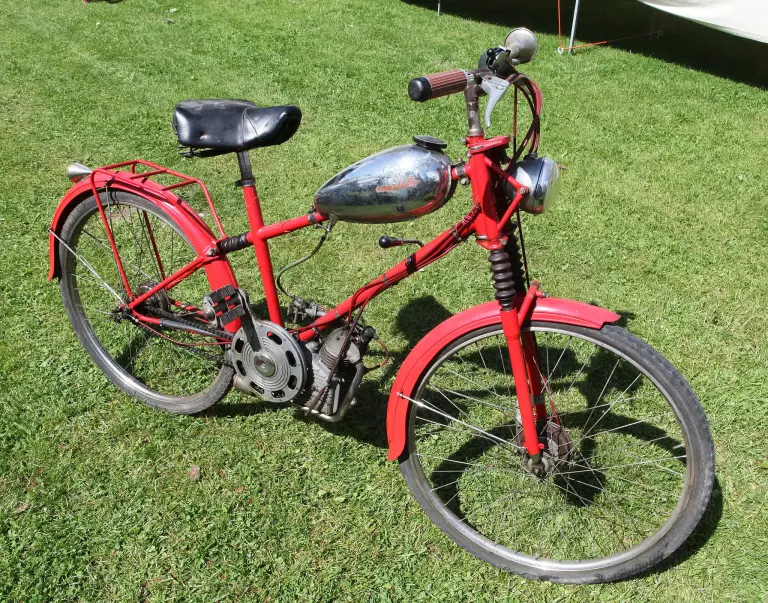
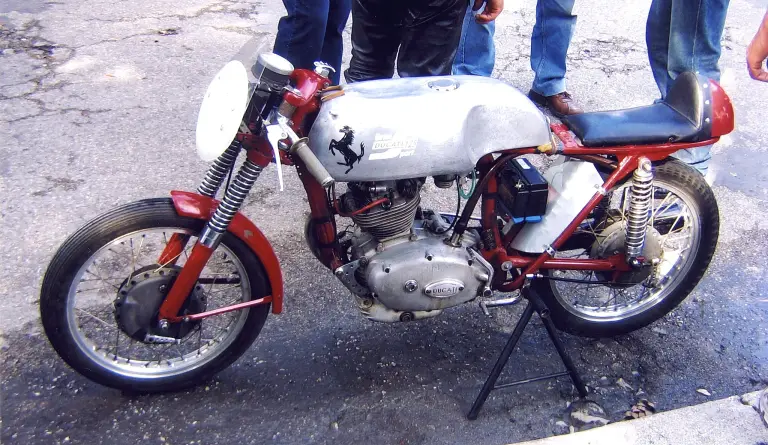
The Monster used the engine of the Ducati 900 Supersport and a frame descended from the Ducati 851. More Ducatis are in the Ducati collection.
Video: Ducati Monster 821 test 2014
Video by 1000PS on YouTube.
Sources
- Ducati Monster, English Wikipedia: design, parts sources, model history, sales