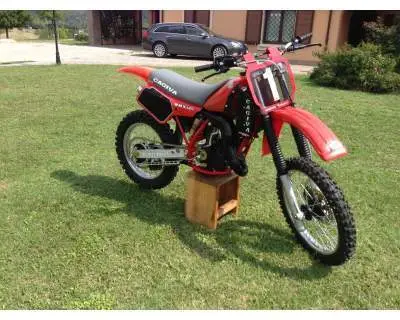
The Cagiva WMX, also known as the MXR, was a two-stroke competition motorcycle that took part in several motocross world championships and won some of them. It was built in several capacities and was accompanied in production by a directly derived enduro version, the WRX.
Cagiva WMX at a glance
| Maker | Cagiva, Varese |
|---|---|
| Type | two-stroke motocross competition bike |
| Also called | MXR |
| World championship entry | 1979, in the 125 cc class |
| 125 cc production | 1980–1991 |
| 190/200 cc production | 1982–1984 |
| 250 cc production | 1979–1991, with a gap from 1985 to 1987 |
| 500 cc production | 1984–1987 |
| Titles | 125 cc riders and constructors in 1985 and 1986, constructors in 1987 |
| Key technology | CTS exhaust control, disc brakes, upside-down forks |
There is no English Wikipedia article on the WMX and no free photographs of the model were found; this page is based on the Italian article.
History of the Cagiva WMX
The championship years
Cagiva entered the motocross world championship in 1979, intending to break the dominance of Suzuki in the smaller classes: the Japanese company had won every edition of the 125 cc championship since it was created in 1975. In the 125 class Cagiva came close to the riders’ title in 1984, when Corrado Maddii finished second, and then took both titles in the two following years, the riders’ with Pekka Vehkonen and Dave Strijbos and the constructors’; it repeated the constructors’ title in 1987. In the 250 class Vehkonen finished second in the 1987 and 1988 world championships on the WMX 250, but Cagiva withdrew from motocross racing at the end of 1988 to make room for the Husqvarna brand it had just acquired.
WMX 125
The 125 was produced from 1980 to 1991. In 1981 the mixed cooling of the year before — liquid cooling with the radiator behind the number plate, helped by air cooling through fins on the cylinder and head — became purely liquid, with the radiator still behind the number plate; in 1983 the radiator moved to the sides of the bike, covered by air deflectors. In 1983 the rear suspension changed from the doublecross system to a Monocross with linkages, after the swingarm had been updated the previous year to straight arms, and the graphics were revised. In 1985 came the CTS (Cagiva Torque System) exhaust valve and a front disc brake, which became a full integral system in 1989. In 1987 the bike adopted upside-down forks.
WMX 190, 250 and 500
The 190 was produced from 1982 to 1984 with the same characteristics as the 125 but a 190 cc engine and a front disc brake. The 250 had a more complicated history: it was built from 1979 to 1981 as the air-cooled MXR with a 72 x 61 mm engine, from 1982 to 1984 with 67 x 54 mm dimensions and liquid cooling on a 125-derived design, and from 1988 to 1991 with a 70 x 64.8 mm engine; there was no 250 model between 1985 and 1987 because the production engine was still being tested on the works bikes. Liquid cooling arrived in 1982, the Monocross with linkages in 1983, and in 1988 the CTS exhaust system, a front disc brake that became integral in 1989, and upside-down forks. The 500 was produced from 1984 to 1987 and was liquid-cooled from the start.
Design and features
- World titles: the 125 cc riders’ and constructors’ championships in 1985 and 1986, and the constructors’ title in 1987.
- CTS exhaust valve: the Cagiva Torque System, introduced on the 125 in 1985 and on the 250 in 1988.
- Monocross rear suspension: adopted in 1983 in place of the earlier doublecross layout.
- Upside-down forks: fitted to the 125 in 1987 and to the 250 in 1988.
- Enduro sister: the WRX enduro model was derived directly from the WMX.
Cagiva WMX versions
- WMX 125 (1980–1991): the mainstay of the range and the title-winning class.
- WMX 190 (1982–1984): 190 cc version of the 125.
- WMX 250 (1979–1984, 1988–1991): three different engine generations, with a gap in production.
- WMX 500 (1984–1987): the largest version, liquid-cooled from the start.
- WRX: the enduro model derived from the motocross bike.
Cagiva’s road-going two-strokes of the same years are described in the Cagiva Freccia and Cagiva Mito articles. More Cagivas are in the Cagiva collection.
Sources
- Cagiva WMX, Italian Wikipedia: racing history, capacity versions, technical changes