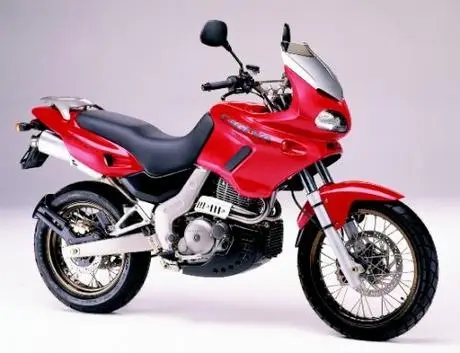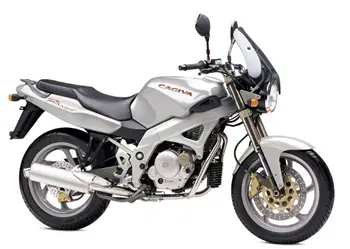
The Cagiva River was a naked motorcycle with a touring vocation, produced in 500 and 600 cc from 1995 until 2009. It was built for riders who were new to motorcycling or returning to it after a long break, and it was fitted with luggage as standard.
Cagiva River at a glance
| Maker | Cagiva, Varese |
|---|---|
| Production | 1995–2009 |
| Capacities | 500 and 600 cc |
| River 600 | 1995–1998, built at Schiranna |
| River 600 power | 34 CV, aimed at novice riders |
| River 500 | 2002–2009, about 40 CV |
| Frame | new straight twin-spar steel frame |
| Front end | Mito-derived upside-down fork and 320 mm Brembo disc |
| Wheels | three-spoke, derived from the Mito |
| Equipment | integrated colour-matched panniers with inner bags, windscreen |
There is no English Wikipedia article on the River; this page is based on the Italian article.
History of the Cagiva River
River 600
The 600 was in production from 1995 to 1998 and was built in the historic Schiranna factory. Its engine was derived from the W16 and was built entirely by Cagiva. The bike was aimed mainly at novice riders but also at those coming back to motorcycles after a long time, both of whom wanted something practical and easy to ride. That is why the panniers were integrated and supplied as standard, painted to match the bike and fitted with matching inner bags, and why a windscreen came already mounted. The instrument panel confirmed the calm, city-friendly nature of the machine: it had a large, clearly visible analogue clock but no tachometer. The front end was more sporting, however, derived from the Mito with an upside-down fork and a 320 mm Brembo disc, and the three-spoke wheels also came from the Mito. The frame was a new straight twin-spar in steel.
A good chassis, a weak engine
Carefully designed in styling and chassis, the River — like the Canyon enduro — was less convincing mechanically: its capacity was oversized for a crankcase that stayed the same as that of the 350 cc T4 and W12, and power was limited to 34 CV for novice riders, with no more powerful versions offered. It was replaced by the River 500.
River 500
The 500 was strictly derived from the 600 and produced from 2002 to 2009, keeping the lines of its larger sister. The only difference was that, in the last versions, the side panniers were no longer standard. The engine was reduced to 500 cc to improve its efficiency and power rose to about 40 CV. Adopted by several municipal police forces, the River had limited success with the general public.
After the end
When production finished, the moulds and tooling for the engine, frame and bodywork were sold to the Chinese company Asiawing, which restarted production. On the Argentine market the Chinese River is sold as the Galardi GL 500, and a fully restyled version was made as the Asiawing Spark 500, joined by a 250 with a Suzuki engine in the same frame.
Design and features
- Luggage as standard: colour-matched panniers with inner bags, plus a mounted windscreen.
- Easy to ride: designed for newcomers and returning riders, with a calm, practical character.
- Mito front end: an upside-down fork with a 320 mm Brembo disc and three-spoke wheels from the 125.
- New frame: a straight steel twin-spar instead of the older W-series chassis.
- Second life in China: the tooling was sold to Asiawing and the bike continued as the Galardi GL 500 and Asiawing Spark 500.
Cagiva River versions
- River 600 (1995–1998): 600 cc engine derived from the W16, 34 CV.
- River 500 (2002–2009): 500 cc engine, about 40 CV, later without standard panniers.
- Asiawing and Galardi versions: Chinese production after the Cagiva line ended.
The River shares its engine family with the Cagiva W16 and its front end with the Cagiva Mito. The Canyon used the same engine. More Cagivas are in the Cagiva collection.
Sources
- Cagiva River, Italian Wikipedia: 600 and 500 versions, equipment, engines, Chinese production