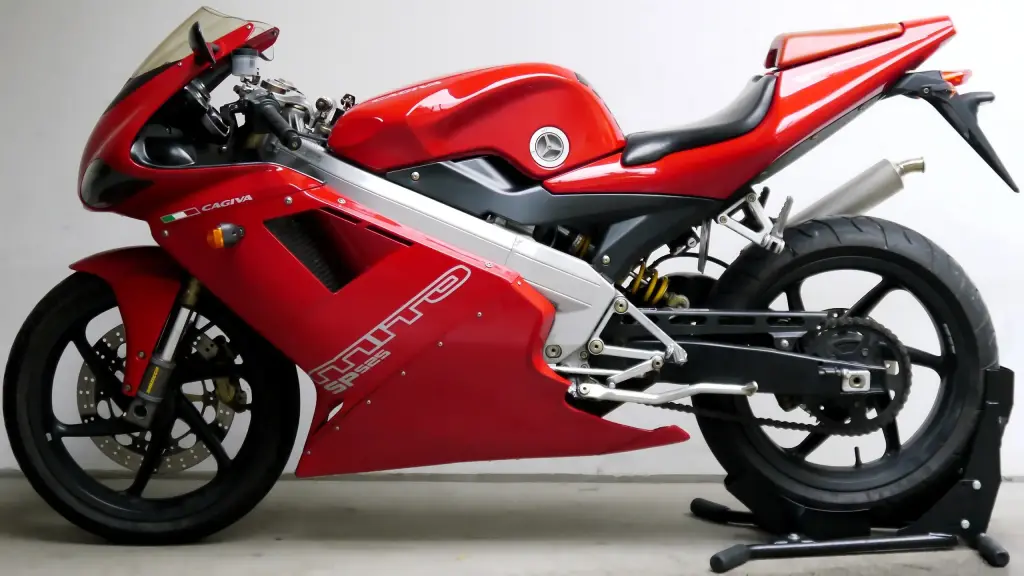
The Cagiva Mito, whose name means myth, was a small-capacity sports motorcycle built around a liquid-cooled two-stroke single, sold in 50 and 125 cc from 1990 to 2012. It replaced the Freccia in the Cagiva range and was meant to exploit the company’s presence in the 500 class of the world championship.
Cagiva Mito at a glance
| Maker | Cagiva, Varese |
|---|---|
| Production | 1990–2012 |
| Capacities | 50 and 125 cc |
| Engine | single-cylinder two-stroke, liquid-cooled, with a mixer |
| Mito 125 launched | 18 May 1990, as the successor of the Freccia |
| Mito 50 | 1997–2002, Derbi engine |
| Restyle | 1994, by Massimo Tamburini, along the lines of the Ducati 916 |
| Evolution power | 24.5 kW (33 hp) at 12,000 rpm |
| Top speed | about 173 km/h |
| Last model | Mito SP525, white and signed by Giovanni Castiglioni |
History of the Cagiva Mito
From Freccia to Mito
The Mito 125 was presented on 18 May 1990 as the evolution of the Freccia, with which the first series shared the seven-speed engine, revised and improved. The styling was very different: at first, because of a shortage of bodywork parts, the Mito was presented as a naked bike with the frame and engine in view and round mirrors on the handlebar, and a conversion kit was later offered to make it a race replica of the Cagiva C588. The earliest versions were red or sea green; from the middle of 1991 a fully faired version arrived, in line with the Aprilia AF1, Yamaha TZR, Gilera SP and Honda NSR 125. Black, Denim and a rare red with white checks were added.
Limited and racing versions
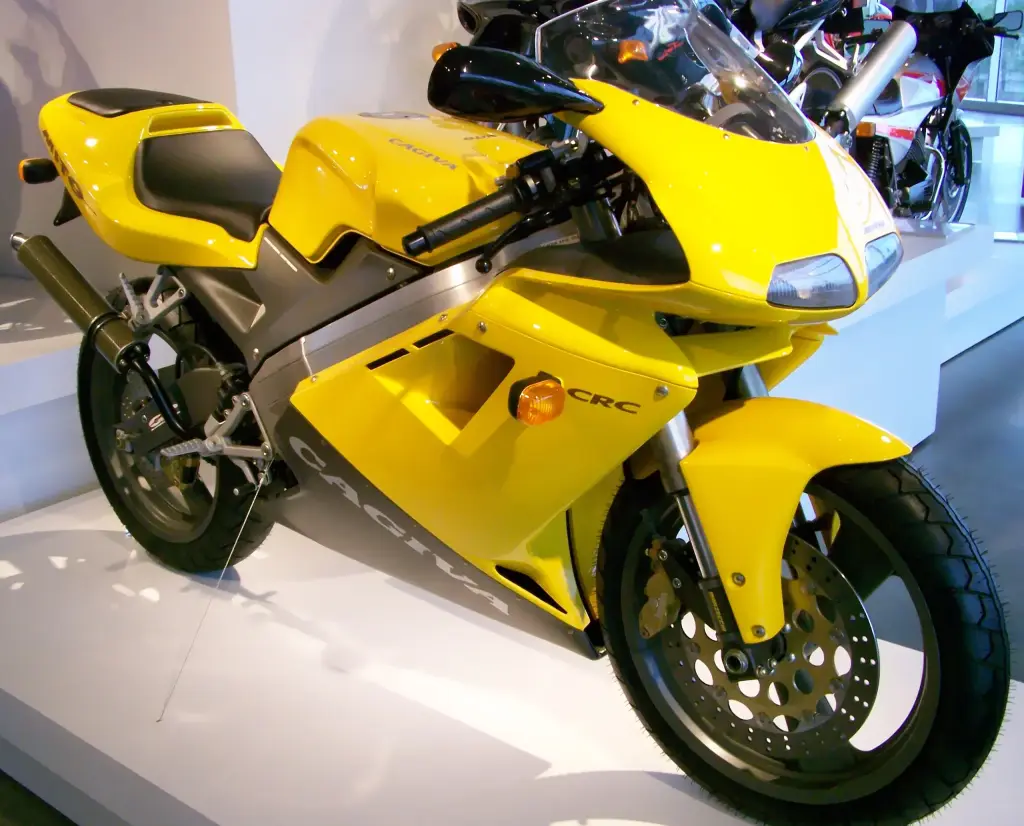
In 1991 Cagiva built the Mito Denim, a limited edition in white and blue made for a prize competition, of which 400 examples are known, each with a numbered plate riveted to the top yoke. Racing versions followed, among them one in 1991 in the white and red Lucky Explorer colours inspired by Edi Orioli’s Dakar-winning Elefant, and another with the livery of Eddie Lawson’s 500. These were the starting point for machines prepared for the Sport Production championship. A racing special of 1991 called the Mini moke was already race-ready and available to a few riders.
Mito II and Evolution
In 1992 the chassis was updated with Marzocchi 40 mm upside-down forks, a new four-piston front caliper of larger diameter and a bigger Brembo master cylinder, and from 1993 the Mito II Replica brought new bodywork. In 1994 Massimo Tamburini restyled the bike along the lines of the then new Ducati 916, which he had also designed — a resemblance particularly visible in the front and rear fairings. The Evo I is identified by Grimeca three-spoke cast aluminium wheels and a seven-speed gearbox, the Evo II by six-spoke Grimeca wheels and a six-speed gearbox. In 1998 a naked equivalent of the Evo appeared, the Planet, with a tank that hinged upwards to take an open-face helmet; in 2004 it was renamed the Raptor 125.
SP525 and the end
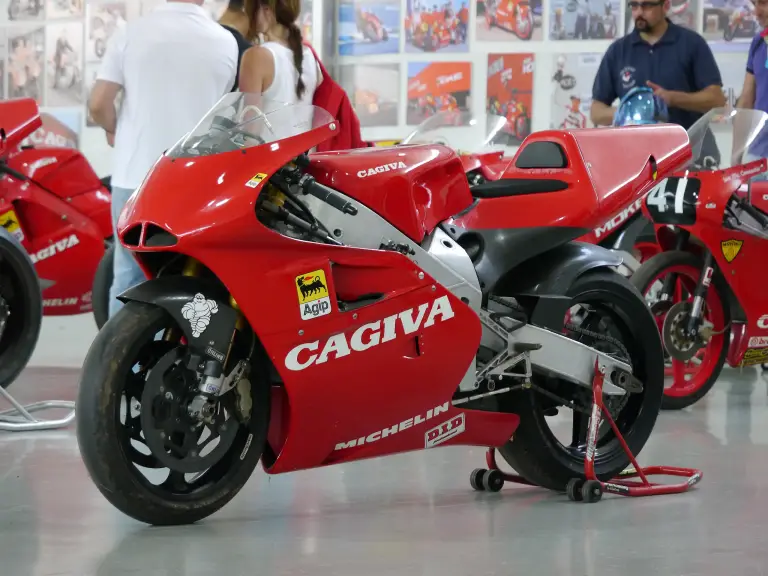
At the EICMA show of 2005 Cagiva launched the SP525, a limited production tuned competition version that paid homage to the GP500 (C594), with fairings modified to look like the racer’s, eight-spoke forged aluminium wheels and no speedometer, lights or mirrors; it produced more than 39 hp at the crankshaft and was not road legal. For 2008 a road-going Mito SP525 was added, with the same chassis and a 125 cc two-stroke fitted with a new Electronic Carburetion System developed with Dell’Orto, governing fuel, oil and ignition to meet Euro 3. The Mito 500 concept of 2006 replaced the two-stroke with a 500 cc four-stroke single from the Husqvarna TE510, 60 hp and 50 Nm, weighing 133 kg dry; despite interest it never entered production. Production of new Mitos was suspended in 2012, because of tighter emissions rules and the concentration of resources on the MV Agusta F3. The last few SP525s were white and personally signed by Giovanni Castiglioni.
The Mito was Valentino Rossi’s first racing motorcycle: in 1994 the Cagiva team manager Claudio Lusuardi gave him a factory Mito and he cruised to the Italian title. Through the 1990s the bike was the arch-rival of Aprilia’s AF1 125 Futura and later of the RS125.
Design and features
- Race replica: a 125 designed to look like a Grand Prix machine, with a stiff chassis and a top speed of about 173 km/h.
- Tamburini restyle: the 1994 Evolution copied the lines of the Ducati 916, also designed by Massimo Tamburini.
- Two-stroke single: liquid-cooled with separate lubrication and an exhaust valve through the generations.
- Rossi’s first bike: Valentino Rossi won the 1994 Italian title on a factory Mito.
- SP525: a homage to the C594 racer, both as a competition machine and as a road bike with electronic carburation.
Cagiva Mito versions
- Mito 125 Mk I and Mk II (from 1990): the original, with upside-down forks on the Mk II.
- Mito 50 (1997–2002): the small-capacity version with a Derbi engine.
- Mito II (1992–1993): updated chassis and Replica bodywork.
- Mito Evolution I and II (1994 onwards): the Tamburini-styled versions, seven- and six-speed.
- Planet and Raptor 125 (1998–2004): naked derivatives of the Mito.
- Mito SP525 (2005–2012): competition version and later road bike, the last Mito.
The Mito replaced the Cagiva Freccia, and its SP525 version was a homage to the Cagiva GP500. More Cagivas are in the Cagiva collection.
Sources
- Cagiva Mito, Italian Wikipedia: production years, versions, equipment, performance
- Cagiva Mito, English Wikipedia: Mk I and II, Evolution, SP525, Mito 500, Planet