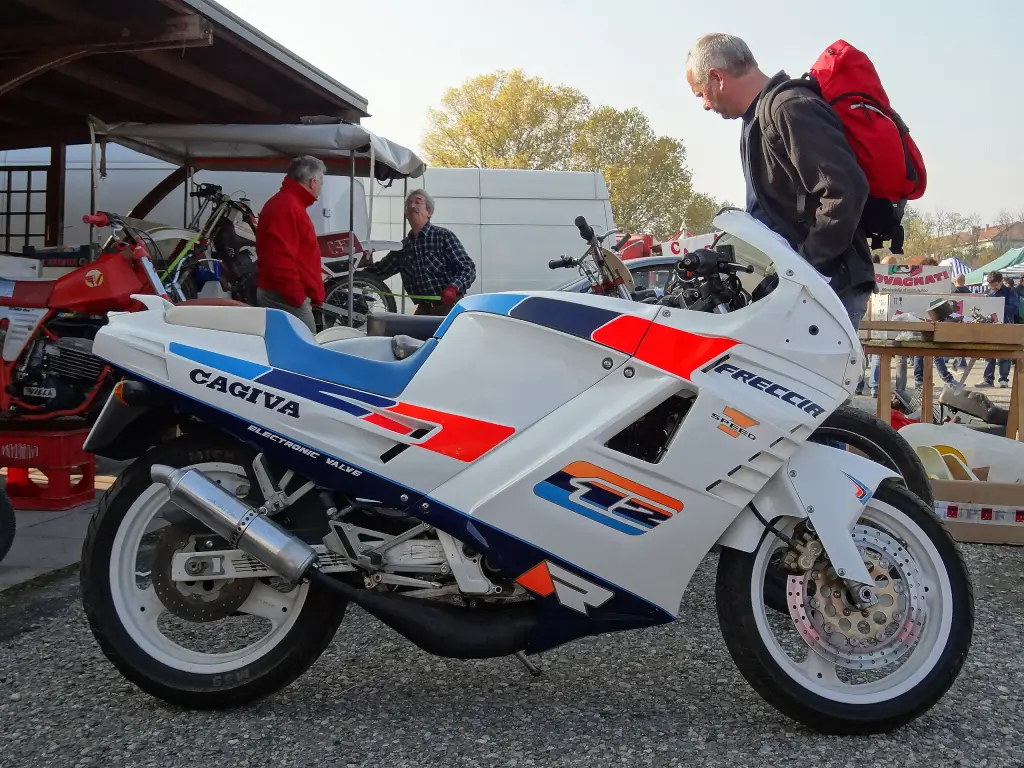
The Cagiva Freccia was a fully faired sports 125 with bodywork that emulated the Ducati Paso, built from 1987 to 1990. Its name changed suffix with every update — C9, C10R, C12R and C12SP — and each model also came as an SP racing version for the Sport Production class, not legal for the road.
Cagiva Freccia at a glance
| Maker | Cagiva, Varese |
|---|---|
| Production | 1987–1990 |
| Capacity | 125 cc two-stroke single |
| Models | Freccia C9, C10R, C12R, C12SP |
| Bodywork | full fairing in the style of the Ducati Paso; painted, not transparent, screen |
| Frame | steel twin-spar of rectangular tubes with an integrated square-tube subframe |
| Forks | 35 mm, 140 mm travel |
| Front brake | 260 mm Brembo cast-iron single disc |
| Rear brake | 240 mm Brembo disc |
| Gearbox | six speeds on the C9 and C10R, seven on the C12R |
| Rivals | Aprilia AF1 and Gilera SP |
There is no English Wikipedia article on the Freccia; this page is based on the Italian article.
History of the Cagiva Freccia
Freccia C9
The C9 was produced for one year only, 1987. It was heavily faired: the engine and frame were hidden, and so was the tank. The frame was a steel twin-spar of rectangular tubes with the square-tube subframe integrated in a single piece, the swingarm was steel with symmetric rectangular arms, the forks were 35 mm with 140 mm of travel, and the clip-on mounts were screwed to the top yoke and shaped to cover the fork caps as well. The two-stroke engine was completely redesigned and, for the first time on a road model of the marque, had an exhaust control system with two valves — one gate and one resonator — worked mechanically through the CTS (Cagiva Torque System) and CPC (Cagiva Power Chamber) with a centrifugal switch, together with a balancer shaft. The expansion chamber ran under the engine as usual but ended under the tail, splitting into two stubs that carried two slim conical silencers at the sides of the tail. The front brake was a 260 mm Brembo cast-iron disc under a wrap-around mudguard that left only half the wheel visible, the rear a 240 mm disc, and the gearbox had six speeds with a very short first. The fuel tap had three positions — ON, depression and OFF — with a reserve warning light. Three colour schemes were offered, one all red and two two-tone. The Moto Morini Dart 350 was created on the basis of this model.
Freccia C10R and Anniversary
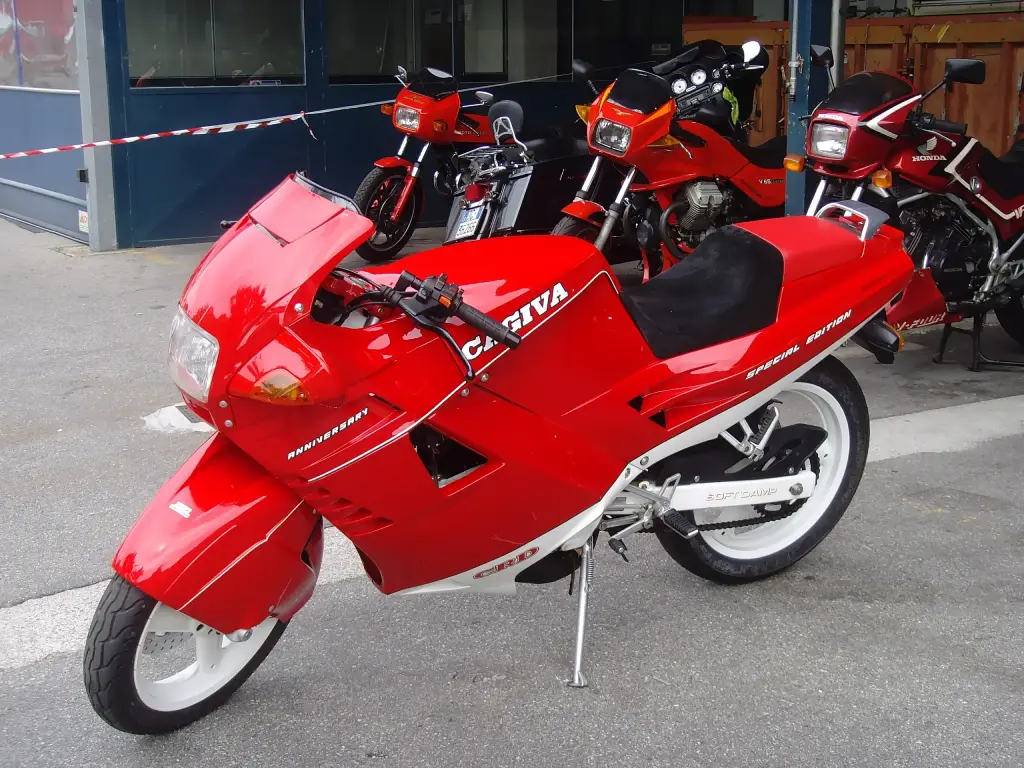
The C10R, an evolution of the C9, was also built for one year, 1988. It was distinguished by different bodywork with integrated indicators and mirrors, a new cylinder with an improved exhaust valve, still mechanical, and the abandonment of the CPC in favour of a more conventional expansion chamber ending at the side of the swingarm. A limited version of 1,000 machines called Anniversary added a revised first gear, a larger rear tyre of 130/70 17, electronic control of the exhaust valve opening at 7,250 rpm, an updated conrod and crankshaft and a new cylinder prepared for the mechanical valve drive, along with revised carburation. The model was sold mainly in solid red, with black and yellow also common.
Freccia C12R
The C12R was built in 1989 alone. Its main difference from the C10R and the Anniversary was a seven-speed gearbox, the extra gear having been added for the SP models; on road bikes the ratios had to be shortened to make use of it. The bodywork also changed, in colours, graphics and a new front mudguard. Every Freccia had, as a curious detail, a screen that was not transparent but painted in the colours of the bike.
Design and features
- Paso-style bodywork: a fully enclosing fairing in the style of the Ducati Paso, with the tank hidden as well.
- Exhaust valve: the first road-going Cagiva with a two-valve exhaust control, the CTS and CPC system.
- Unusual exhaust: the expansion chamber ended under the tail with two conical silencers at its sides.
- Painted screen: every Freccia had a screen painted in the colours of the machine instead of a transparent one.
- SP versions: racing versions for the Sport Production class, not homologated for the road.
Cagiva Freccia versions
- Freccia C9 (1987): the original fully faired model with the CPC system.
- Freccia C10R (1988): integrated indicators and mirrors, revised exhaust valve.
- Freccia C10 Anniversary (1988): 1,000 machines with electronic valve control and a 130/70 17 rear tyre.
- Freccia C12R (1989): seven-speed gearbox and revised bodywork.
- SP versions: competition machines for the Sport Production championship.
The Freccia was replaced by the Cagiva Mito, and the road-going Aletta Oro had been its predecessor in the range. More Cagivas are in the Cagiva collection.
Sources
- Cagiva Freccia, Italian Wikipedia: models, engineering, equipment, colours