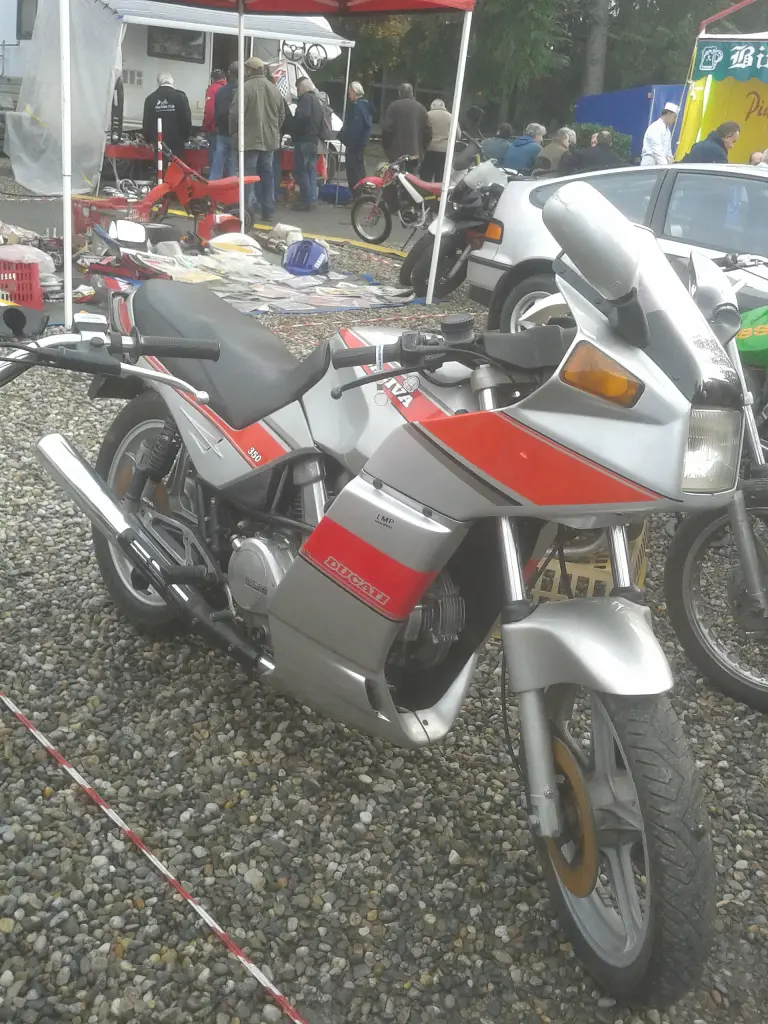
The Cagiva Alazzurra was the first four-stroke motorcycle built by the Varese company. It came out of the supply agreement with Ducati, which provided the engines and the rolling chassis of the TL, and it went on sale in September 1984. The English-language Cagiva article calls the same machine the Ala Azzurra, or Bluewing, and lists it together with the Elefant as the two Ducati-engined Cagivas of the period.
Cagiva Alazzurra at a glance
| Maker | Cagiva, Varese |
|---|---|
| Production | 1984–1986 |
| Presented | Milan motorcycle show, 1983, together with the Elefant |
| On sale | from September 1984 |
| Engine | Ducati four-stroke V-twin, detuned compared with the Ducati original |
| Mechanical base | Ducati TL, the touring version of the Pantah |
| Body | half-fairing with the engine left visible; full fairing from 1985, GT version from 1986 |
| Brakes | two front discs with opposed twin-piston calipers, one rear disc of the same type |
| Wheels | five-spoke cast wheels |
| Instruments | tachometer to 11,000 rpm with the red zone at 9,000, speedometer in km/h and mph |
| Known weak point | electrical trouble, especially the clock draining the battery |
There is no English Wikipedia article on the Alazzurra; this page is based on the Italian article, with the model’s place in the range taken from the English article on Cagiva.
History of the Cagiva Alazzurra
The Alazzurra was the result of an agreement between Cagiva and Ducati, which supplied the engines and the chassis before Cagiva eventually bought the Bologna company. Its mechanical base was the Ducati TL, the touring version of the Pantah that had been on sale since 1982 and had proved a commercial failure because of its styling. Cagiva presented its own machine at the Milan show in 1983 alongside the Elefant enduro, and it reached dealers in September 1984.
A Ducati underneath, a different motorcycle on top
The styling was completely revised. A half-fairing left the engine in view — on the Ducati it sat half-hidden behind clumsy bodywork — and gave the Alazzurra the look of a sport-tourer rather than a tourer. Compared with the Ducati the engine was detuned, which made its character gentler, and the steering head angle was reduced by half a degree. The suspension was given more travel, and Cagiva improved the quality of the details and of the assembly.
Comfort and instruments
The passenger seat was made in one piece with the rider’s, the passenger footrests were large and placed at the flanks behind the seat, the indicators were square and the headlight rectangular, under a very large screen. Up front there were two discs with opposed twin-piston calipers, and at the back a disc and caliper identical to the front ones. The instrument panel closed the top of the fairing: the large tachometer sat at the top left with a scale to 11,000 rpm and the red zone at 9,000, the speedometer and odometer were on the right, the odometer reading in kilometres only, and an analogue clock sat below the speedometer with the warning lights in a row under the tachometer. The instruments suffered from electrical problems, and the clock in particular could drain the battery in a short time.
In 1985 a fully enclosing fairing became available, though customers did not much appreciate it. The following year Cagiva launched the GT version, which was distinguished by a redesigned full fairing that covered the engine as well.
Design and features
- First four-stroke Cagiva: the Varese firm’s entry into bigger four-stroke machines, built with Ducati engines.
- Half-fairing: the engine stayed visible, which gave the bike a sport-touring look instead of the Ducati’s heavy bodywork.
- Softer engine: the Ducati twin was detuned for a gentler power delivery.
- Comfort details: a one-piece rider and passenger seat, large passenger footrests and a very large screen.
- Rectangular headlight and square indicators: the face that set the Alazzurra apart from the Pantah family.
Cagiva Alazzurra versions
- Alazzurra (1984): the original half-faired machine with five-spoke wheels.
- Full-fairing option (1985): an enclosing fairing that found few buyers.
- Alazzurra GT (1986): a redesigned full fairing covering the engine.
- Alazzurra 350: the small-capacity version of the same model, shown in the photograph with the optional full fairing.
The Alazzurra was presented at the same 1983 Milan show as the Cagiva Elefant, the other Ducati-engined model of the period. More machines from Varese are in the Cagiva collection.
Sources
- Cagiva Alazzurra, Italian Wikipedia: design, equipment, instruments, production years
- Cagiva, English Wikipedia: place in the Cagiva range, Ducati engines