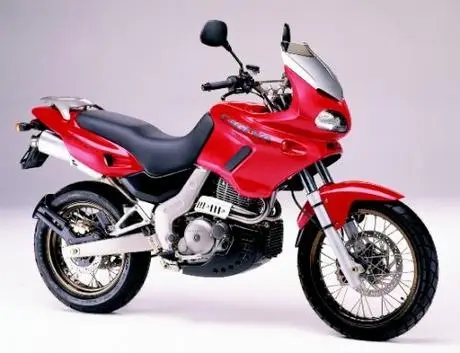
The Gran Canyon, often simply called Canyon, was the touring enduro that Cagiva produced from 1995 to 2002 in 500, 600 and 900 cc. It grew out of the Elefant but was meant for the road and for touring rather than for the desert, and the 500 was the version that lasted longest.
Cagiva Canyon at a glance
| Maker | Cagiva, Varese |
|---|---|
| Family production | 1995–2002 |
| Canyon 600 | 1995–1998, 600 cc engine derived from the W16 |
| Canyon 500 | 1997–2002, derived from the 600 |
| Canyon 500 power | about 40 CV |
| Canyon 600 power | 34 CV, aimed at novice riders |
| Gran Canyon 900 | 904 cc Ducati engine, out of production in 2000 |
| Designer | Pierre Terblanche |
| Type | enduro-derived motorcycle with a touring vocation |
There is no English Wikipedia article on the Canyon; this page is based on the Italian article on the Gran Canyon. The article deals mainly with the Canyon 500, the version of the record.
History of the Cagiva Canyon
Canyon 600
The 600 was built from 1995 to 1998 with a 600 cc engine derived from the W16. Its lines, drawn by Pierre Terblanche — the designer also responsible for the Ducati Multistrada, 999 and Hypermotard — were carried over to the larger Gran Canyon. The design and the chassis were carefully done, but the engine was not: its capacity was oversized for a crankcase that stayed the same as that of the 350 cc T4 and W12, and power was limited to 34 CV for novice riders, with no more powerful versions offered. The Canyon 500 replaced it.
Canyon 500
The 500 was strictly derived from the 600 and was produced from 1997 to 2002. The lines were unchanged but made heavier by less elegant colour schemes and a larger windscreen. The engine was reduced to 500 cc to improve its efficiency, and power rose to about 40 CV. Like the 600 it had only limited success against the competition of the time.
Gran Canyon 900
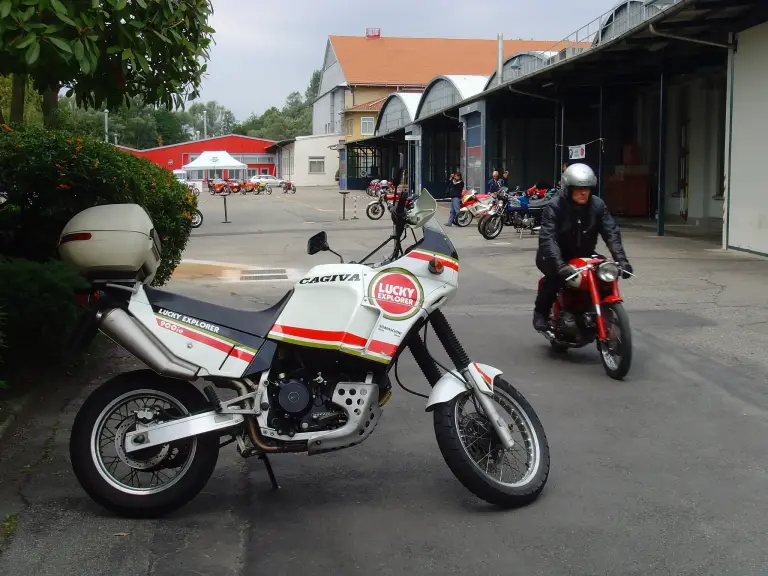
The 900 was the road-going evolution of the Elefant, whose main features it took over with a changed fairing and screen, a bag added above the seat and modified side bags; the tank was made smaller, because the Elefant was a desert-and-road machine while the Gran Canyon was a tourer. Its 904 cc engine came from Ducati. It left production in 2000, when Ducati stopped supplying engines, and was replaced by the Cagiva Navigator with a Suzuki engine. The Ducati Multistrada, built years later, took a free interpretation from this model.
Design and features
- Touring enduro: an Elefant-derived machine made for road touring rather than the desert.
- Terblanche styling: the lines of the 600 were reused on the bigger Gran Canyon 900.
- Good chassis, weak engine: the 600 was well built around an engine limited to 34 CV.
- The 500 as the sweet spot: a smaller capacity gave better efficiency and about 40 CV.
- Three capacities, one body: 500, 600 and 900 shared the same family look.
Cagiva Canyon versions
- Gran Canyon 900 (to 2000): 904 cc Ducati engine, the touring evolution of the Elefant.
- Canyon 600 (1995–1998): 600 cc W16-derived engine, 34 CV.
- Canyon 500 (1997–2002): 500 cc engine, about 40 CV, larger windscreen.
The Gran Canyon grew out of the Cagiva Elefant and was replaced by the Cagiva Navigator. More Cagivas are in the Cagiva collection.
Sources
- Cagiva Gran Canyon, Italian Wikipedia: 500, 600 and 900 versions, designer, production years