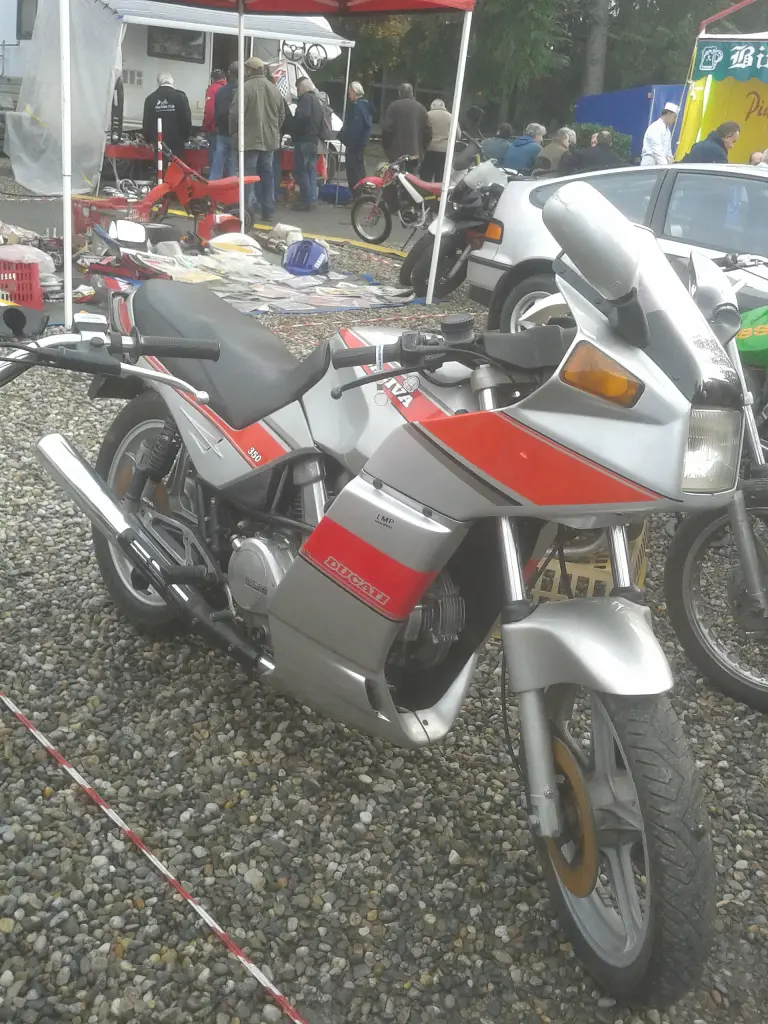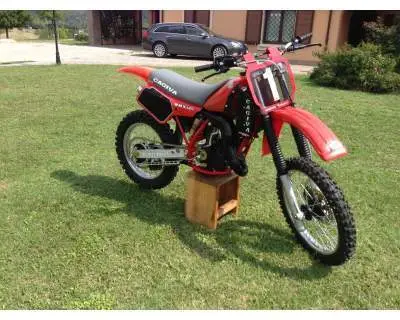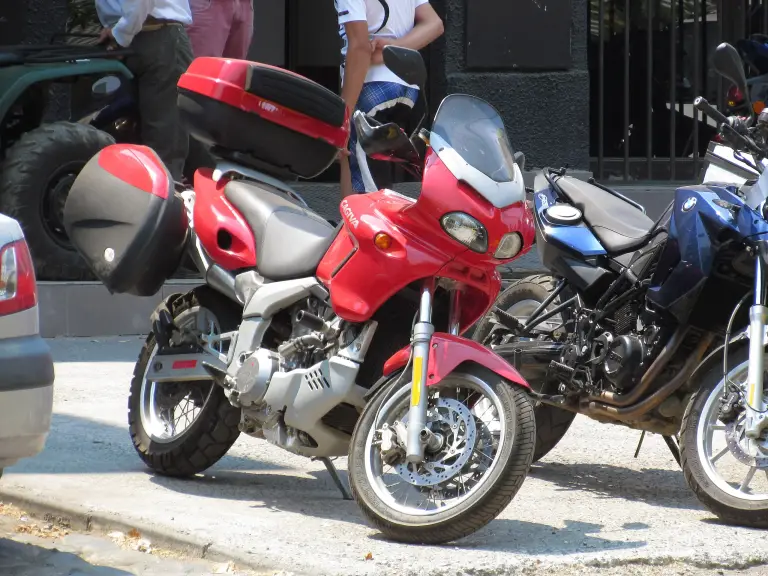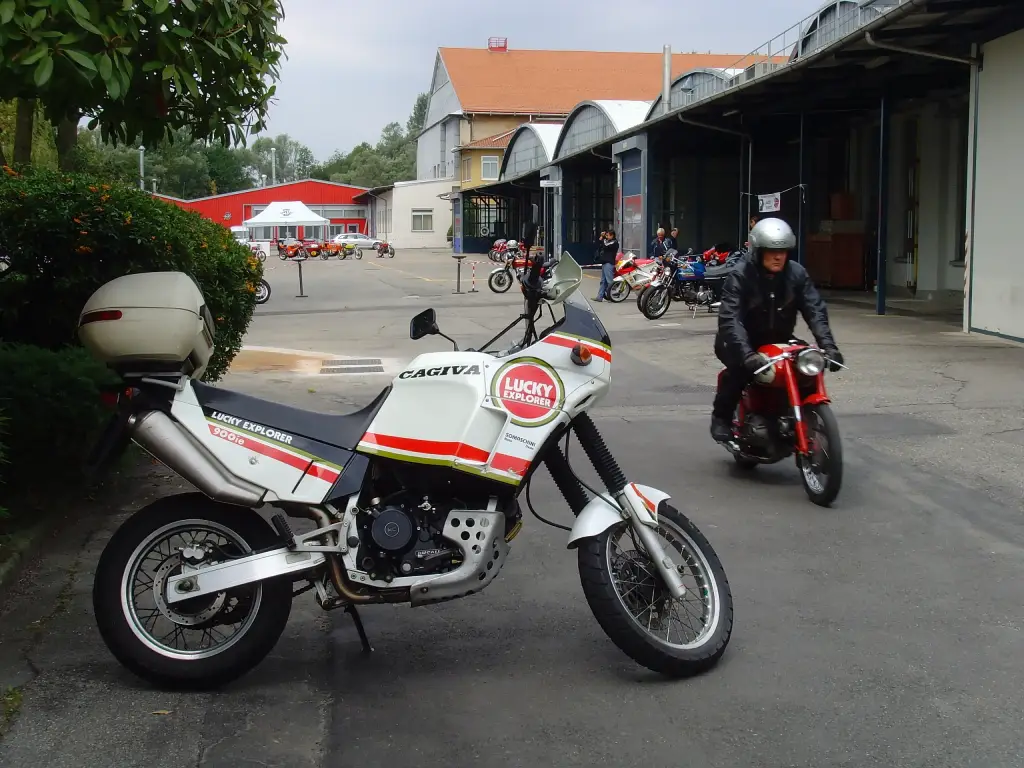
The Cagiva Elefant was a desert-and-road motorcycle built in capacities from 125 to 900 cc. The two smallest used two-stroke engines, the others Ducati four-stroke V-twins, and the Ducati-powered factory bikes won the Dakar Rally with Edi Orioli in 1990 and 1994.
Cagiva Elefant at a glance
| Maker | Cagiva, Varese |
|---|---|
| Capacities | 125, 200, 350, 650, 750 and 900 cc |
| Engines | two-stroke for the 125 and 200, Ducati four-stroke V-twins above |
| Elefant 125 | 1984–1990 |
| Elefant 200 | 1985–1986, 15.5-litre tank |
| Elefant 350 | 1985–1989 |
| Elefant 650 | 1985–1989, rear cylinder turned through 180 degrees |
| Elefant 750 | 1987–1990 and 1994–1997, twin headlight from 1988 |
| Elefant 900 | 1990–1992 and 1993–1996 |
| Elefant 900 IE Lucky Explorer | 1990, limited to 1,000 units, 904 cc |
| Dakar wins | 1990 and 1994, Edi Orioli |
There is no English Wikipedia article on the Elefant; this page is based on the Italian article, with the Dakar results from the English article on Cagiva.
History of the Cagiva Elefant
Elefant 125 and 200
The 125 was born in 1984 and built until 1990 in several variants. The first series, Elefant and Elefant 2 of 1984 and 1985, used the Aletta Rossa as its base but, being a Dakar model, copied the lines of the Elefant 750 that raced in the desert; it had a larger tank and different colours and, like the Aletta Rossa, liquid cooling, a rear mono-shock, a mixer, reed-valve intake and a front disc with a single-piston caliper. The Elefantre of 1986 to 1988 replaced it with new forks carrying the wheel axle ahead of the legs, a larger screen with a visor, bigger radiator shrouds and a shorter seat. The 200 of 1985 and 1986 was not much liked for its unusual capacity and its near-identity to the 125; it had a liquid-cooled two-stroke with reed-valve intake and a Dell’Orto carburettor, six gears, electric and kick starting, a 15.5-litre tank, a front disc and a rear drum.
Elefant 350 and 650
The 350 was produced from 1985 to 1989 and was rather better received, though many found it heavy and not very quick; it started on the kick or on an electric motor, and carried a high cross-style front mudguard that few liked. Its parts were taken from the 650 and 750: the Ducati desmo twin, an Öhlins mono-shock, Marzocchi forks and Brembo brakes. The 650, also built from 1985 to 1989, had the same problems, though its reduced power was less noticeable. To fit the twin into the enduro layout, its rear cylinder was turned through 180 degrees so that both carburettors sat inside the 90-degree V, and the 650 had a small oil radiator. In 1986 Cagiva built nine Frecce Tricolori examples for the 25th anniversary of the Italian aerobatic team, marked with a “25° Frecce Tricolori” logo on the tank.
Elefant 750 and 900
The 750 came in a first series from 1987 to 1990 and a second from 1994 to 1997, and was among the best liked for its power-to-weight balance; from 1988 it had a twin headlight and a low road-style front mudguard. The 900 was a completely new project, built in a first series from 1990 to 1992 and a second from 1993 to 1996. In 1990 came the Elefant 900 IE in a limited series of 1,000 in Lucky Explorer colours: a 904 cc engine derived from the Ducati 900SS, a five-speed gearbox and Weber-Marelli electronic injection, with Öhlins suspension and Nissin brakes, and a silver keyring tag with the sequential number signed by Edi Orioli. In 1992 the bike was adapted for touring as the GT, with a sober grey metallic livery and a traditional Marzocchi Magnum fork of 45 mm instead of the 42.7 mm unit, and a sixth gear. In 1993 the project was revised again with the 900 AC on carburettors, cheaper to build and to buy, with the new 904 engine and a different clutch; it sold better than the injected versions.
Design and features
- Dakar pedigree: the factory Elefant won the Dakar Rally in 1990 and 1994 with Edi Orioli.
- Ducati V-twins: the bigger versions used desmodromic Ducati engines; the 650 had its rear cylinder turned 180 degrees to fit both carburettors inside the V.
- Quality components: Öhlins mono-shock, Marzocchi forks and Brembo brakes on the 350 and 650.
- Lucky Explorer: the 1990 900 IE was limited to 1,000 numbered machines.
- From desert to touring: the 1992 GT and 1993 AC versions moved the Elefant towards road use.
Cagiva Elefant versions
- Elefant 125 (1984–1990): two-stroke, with the Elefantre update of 1986.
- Elefant 200 (1985–1986): short-lived two-stroke with a 15.5-litre tank.
- Elefant 350 and 650 (1985–1989): Ducati desmo twins with Öhlins and Marzocchi suspension.
- Elefant 750 (1987–1990, 1994–1997): the best-balanced version, twin headlight from 1988.
- Elefant 900 IE Lucky Explorer (1990): 1,000 numbered machines with injection.
- Elefant 900 GT and 900 AC (1992–1996): touring version and cheaper carburettor model.
The Elefant 125 was built on the base of the Cagiva Aletta Rossa, and the 900 was developed into the Cagiva Canyon. More Cagivas are in the Cagiva collection.
Sources
- Cagiva Elefant, Italian Wikipedia: all versions, engines, equipment, production years
- Cagiva, English Wikipedia: Dakar victories of 1990 and 1994