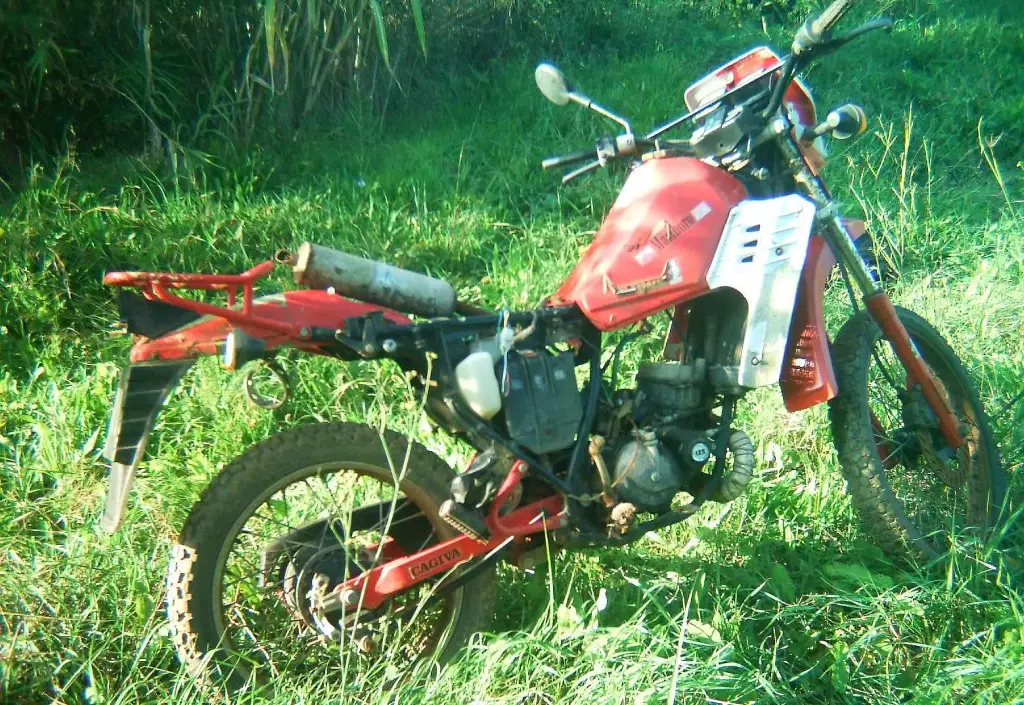
The Cagiva Aletta Rossa, also known as the WSXT, was an off-road motorcycle built from 1983 to 1988 in 125, 200 and 350 cc. Its road-going relative, the Aletta Oro, arrived in 1985 with a 125 cc engine and lasted until 1987, when the sportier Freccia took its place.
Cagiva Aletta at a glance
| Maker | Cagiva, Varese |
|---|---|
| Aletta Rossa production | 1983–1988 |
| Aletta Rossa capacities | 125, 200 and 350 cc |
| Aletta Rossa 125 | from July 1983 to 1987 |
| Aletta Rossa 200 | 1984–1986 |
| Ala Rossa 350 | 1983–1987, four-stroke with a two-valve head, 27 CV |
| Aletta Rossa 125 layout | liquid cooling, rear mono-shock, mixer, reed-valve intake, front disc brake |
| Aletta Oro production | 1985–1987, 125 cc only |
| Aletta Oro versions | S1 in 1985, S2 from 1986 with electric start |
| Aletta Oro wheels | three-spoke cast wheels, later shared with the Freccia |
There is no English Wikipedia article on the Aletta; this page is based on the two Italian articles on the Aletta Rossa and the Aletta Oro.
History of the Cagiva Aletta
Aletta Rossa 125 and 200
The Aletta Rossa 125 reached the market in July 1983 as the natural development of the SXT; Cagiva’s advertisement took the whole back page of the Gazzetta dello Sport the following August. The new bike had liquid cooling and a rear mono-shock, while from its parent it inherited most of the chassis and bodywork, the mixer, the reed-valve intake and the front disc brake. It was built until 1987, and after a pause the project came back to life as the Cagiva W8, which introduced an exhaust valve. Colours were red, white and black, each with a contrasting seat and frame. The 125 was a favourite of tuners: a Polini cylinder took it to about 160 cc, often together with a Dell’Orto carburettor of 24 mm replaced by one of up to 34 mm. Cagiva also gave Aletta Rossas to the Italian national football team when it won the 1982 World Cup. The Elefant 125 was built on the same base. The 200 version was less liked because of its unusual capacity and because it was almost identical to the 125 — the two differed only in capacity and fork, with the axle in line on the 125 and set back on the 200 — so it was made only from 1984 to 1986.
Ala Rossa 350
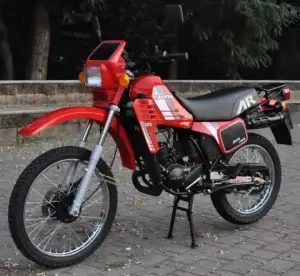
The 350 was produced from 1983 to 1987 with a simple four-stroke engine, especially simple next to Japanese machines of the same size. It had a two-valve head and almost twice the power of the 125 two-stroke, at a higher weight. It sold reasonably well and was developed into the four-valve T4. It was one of the first enduro bikes with a 27 CV four-stroke engine.
Aletta Oro
The Aletta Oro was a road motorcycle presented as the S1 and developed into the S2, with a mixer and a 125 cc engine, built from 1985 to 1987; the Sportier Freccia replaced it. Its rivals were the Honda NS 125, the Aprilia AS 125 R, the Garelli GTA, the HRD 125 Silver Horse and Red Horse and the faired Gilera KZ and KK. The bike used three-spoke wheels, later shared with the Freccia, and a top yoke with mounts for clip-ons and the ignition switch. The fairings left part of the engine, frame and expansion chamber in view, had a small flap for topping up the radiator and small air intakes for it. The passenger seat was one piece with the rider’s, the indicators were square and the headlight rectangular under a very large screen, with two front discs on single-piston calipers. The instrument panel carried the tachometer, the speedometer in km/h and mph, a coolant temperature gauge, a five-LED fuel gauge and a row of warning lights including a side-stand light, with an LED gear indicator in the centre.
The differences between the two Aletta Oro versions were small. The S1 was built in 1985, and the S2 from 1986 to 1987 added electric starting, a new cylinder — still without an exhaust valve — and a recovery chamber to improve the delivery and the power.
Design and features
- Shared 125 platform: the Aletta Rossa was the base for the Elefant 125, and the Aletta Oro lent its three-spoke wheels to the Freccia.
- Liquid cooling and mono-shock: modern equipment for a 125 of 1983.
- Three capacities: two-stroke 125 and 200, plus a four-stroke 350 with a two-valve head.
- Tuner’s favourite: Polini big-bore cylinders and larger Dell’Orto carburettors were a common conversion.
- Road-going sister: the Aletta Oro brought the same mechanical package to the street with a full set of instruments.
Cagiva Aletta versions
- Aletta Rossa 125 (1983–1987): liquid-cooled two-stroke off-roader.
- Aletta Rossa 200 (1984–1986): larger two-stroke with a set-back front axle.
- Ala Rossa 350 (1983–1987): four-stroke enduro with 27 CV, developed into the T4.
- Aletta Oro S1 (1985): the first road version.
- Aletta Oro S2 (1986–1987): electric start, new cylinder and a recovery chamber.
The Aletta Rossa was the base of the Cagiva Elefant 125, and its project returned as the Cagiva W8. More small Cagivas are in the Cagiva collection.
Sources
- Cagiva Aletta Rossa, Italian Wikipedia: 125, 200 and 350 versions, colours, production years
- Cagiva Aletta Oro, Italian Wikipedia: road version, equipment, S1 and S2