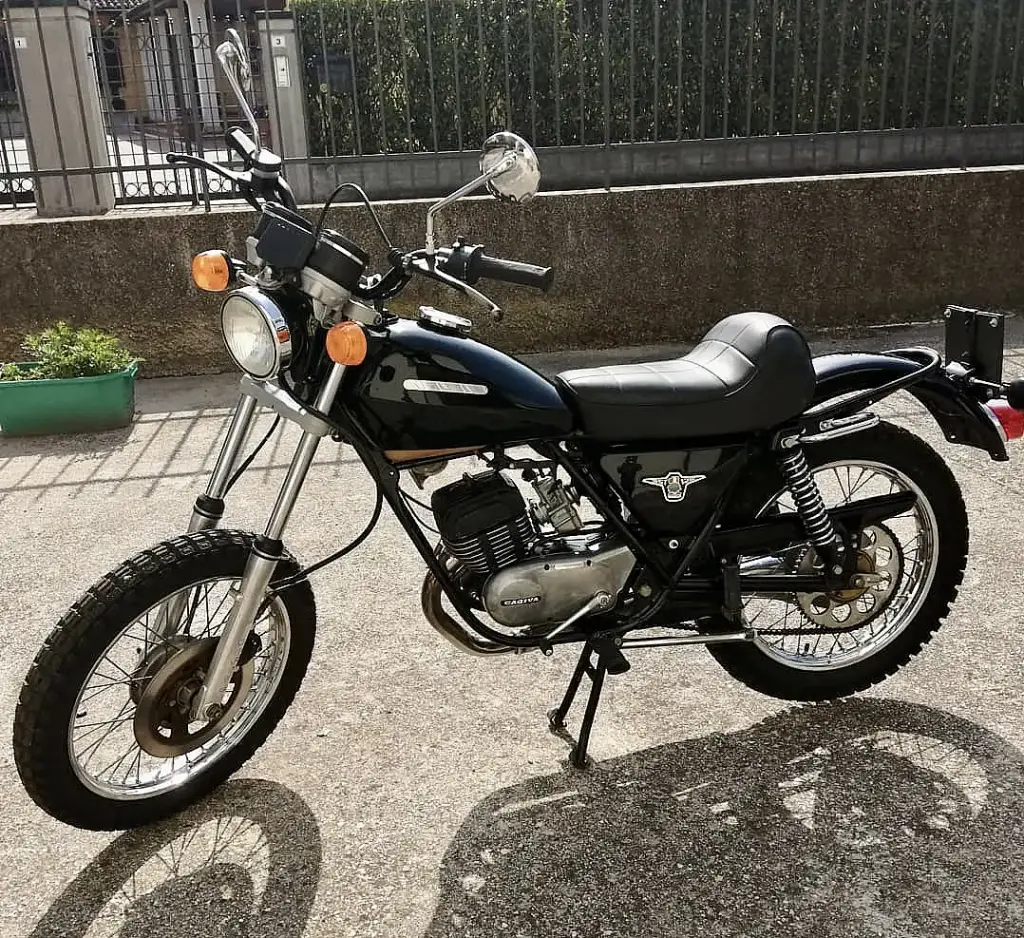
The Cagiva SST, together with its off-road sister the SXT, was the last motorcycle model produced by AMF-Harley Davidson and the first produced by Cagiva after it took over the factory and the brand. It was a simple road-going two-stroke with styling that recalled the Sportster, and its 125 version carried the young company through the first years of its life.
Cagiva SST at a glance
| Factory | Schiranna, Varese |
|---|---|
| First built as | AMF-Harley Davidson |
| Capacities | 125, 175 and 250 from 1975, 350 from 1978 |
| Engines | single-cylinder two-stroke throughout |
| Badges | Harley-Davidson, then HD-Cagiva, Cagiva only from 1980 |
| SST 125 production | to 1978 as AMF-Harley Davidson, 1978–1980 as HD-Cagiva, 1980–1985 as Cagiva |
| SST 250 production | 1975–1985, unchanged |
| SST 350 production | 1978–1986 |
| Type | road tourer without aerodynamic protection, a naked in modern terms |
| Equipment | automatic mixer, front disc brake on later versions |
There is no English Wikipedia article on the SST; this page is based on the Italian article.
History of the Cagiva SST
A Harley that became a Cagiva
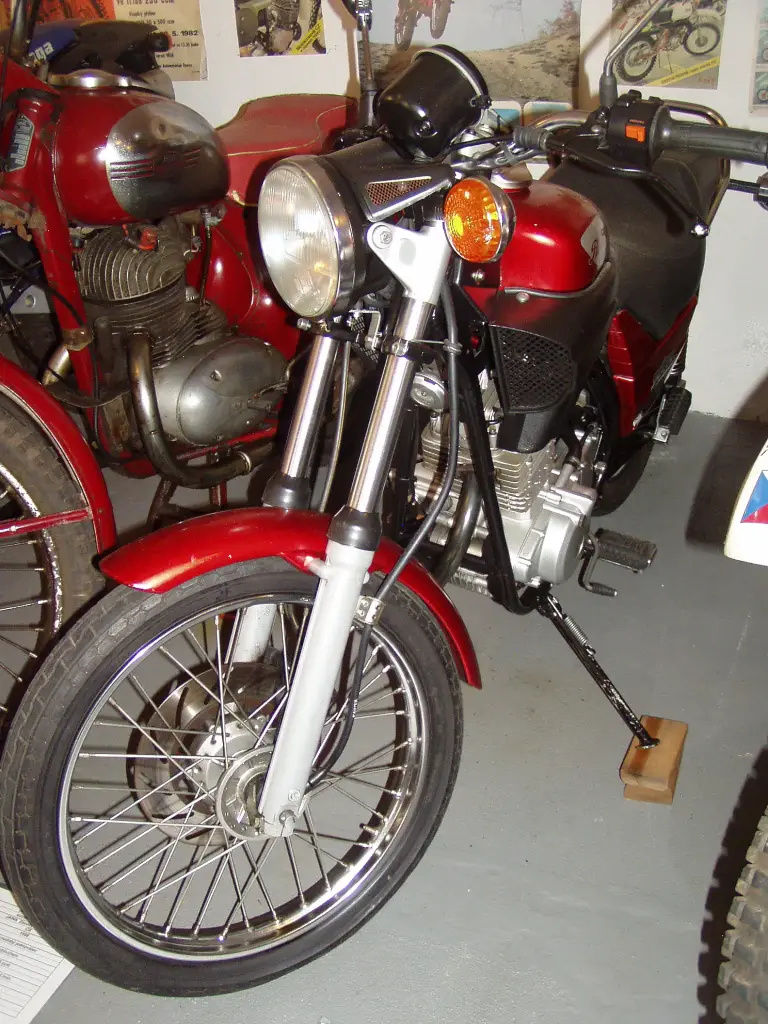
For a time after the new management took over, the bikes carried “HD CAGIVA” on the tank, and later the “HD” was dropped. The SST was a typical touring road bike without aerodynamic protection — what would now be called a naked — with lines recalling Harley-Davidson’s Sportster, but with a single-cylinder two-stroke engine instead of the monumental 900 or 1200 cc V-twin. Production began in 1975 with the 125, 175 and 250, and the 350 joined in 1978. From the same family came the American-styled Lowrider versions, which looked to the choppers.
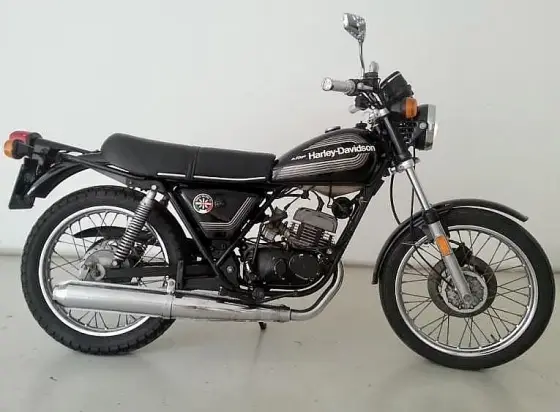
SST 125
The 125 was the most successful version. Aimed at sixteen-year-olds who had just passed their test, it was very popular and became the mainstay of the Varese company, rivalling in sales the ubiquitous Piaggio scooters. Its success came from pleasant lines, simple construction and simple handling, together with low purchase and running costs, low oil consumption — it had an automatic mixer — and low fuel consumption, while the gears were widely spaced and long so that the rider did not have to change constantly. The model was built until 1978 as an AMF-Harley Davidson, from 1978 to 1980 as an HD-Cagiva and from 1980 to 1985 under the Cagiva name. Through all those years the changes were slight and concerned mainly the brakes and the electrics. The 1980 model, the first to carry only the Cagiva badge, had a front disc instead of the old drum, a tachometer in the housing that had held the ignition switch and two warning lights, a charging light, new black Larghi indicators, black instead of chrome fork legs, new handlebar switchgear and octagonal grips, and a new seat. The 1981 model brought a two-place seat in a typical 1980s design, black CEV indicators with rubber stems, the option of alloy wheels — later the only version sold, giving the RR suffix for spoked and RL for alloy wheels — and ball bearings instead of bushings in the gearbox shafts. In 1982 came Dansi CDI electronic ignition with a Motoplat alternator.
SST 175, 250 and 350
The 175 was not very different from the 125, whose design it followed in every respect, but it was sturdier and heavier. Its capacity was not appreciated in Italy and it did not sell widely, though sales abroad were better. The 250 was well liked and was one of the best sellers in the category for eighteen-year-olds, at the time limited to 350 cc and 150 km/h; it was produced from 1975 to 1985, ten years without changes. The 350 entered production in 1978 and left it in 1986; it was very similar to the 250, with the main differences in engine capacity and in the size and shape of the tank.
Design and features
- Bridge between two makers: the last AMF-Harley Davidson and the first Cagiva, sold with both badges.
- Sportster look: road-going lines in the American style, on a single-cylinder two-stroke.
- Automatic mixer: separate lubrication made the SST cheap and easy to live with.
- Sales success: the 125 rivalled the Piaggio scooters of the day among sixteen-year-olds.
- Long-lived design: the 250 stayed in production for ten years without changes.
Cagiva SST versions
- SST 125 (to 1985): the best seller, in AMF, HD-Cagiva and Cagiva versions.
- SST 175: heavier version of the 125, more popular abroad than in Italy.
- SST 250 (1975–1985): one of the best sellers of its class, never updated.
- SST 350 (1978–1986): larger version with a different tank.
- Lowrider versions: chopper-styled machines from the same family.
The SST was replaced at the top of the small-capacity range by the Cagiva Aletta, and the marque’s later 125s are described in the Cagiva Freccia article. More Cagivas are in the Cagiva collection.
Sources
- Cagiva SST, Italian Wikipedia: history, badges, 125, 175, 250 and 350 versions