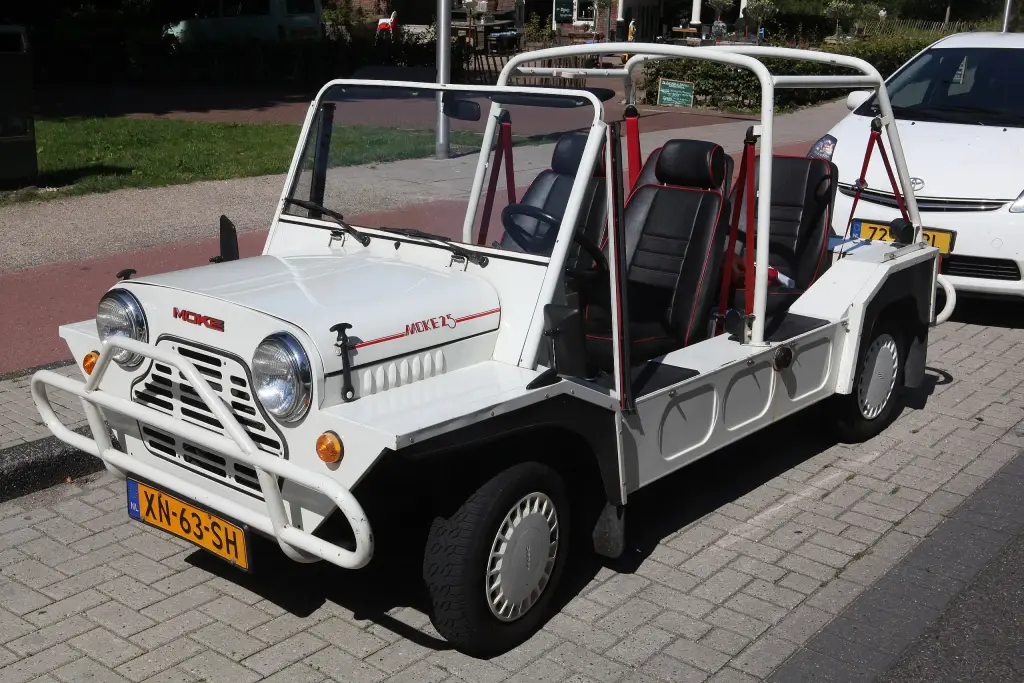
The Mini Moke was a small, front-wheel-drive utility and recreational convertible conceived as a lightweight military vehicle by the British Motor Corporation and later sold to civilians. Cagiva bought the design and built the Moke in Portugal in the early 1990s, which makes the little doorless car the odd one out among the motorcycles on this site.
Cagiva Moke at a glance
| Maker of the original | British Motor Corporation, designed by Alec Issigonis and John Sheppard |
|---|---|
| Layout | front-wheel drive, doorless, open body |
| British Mokes | 14,518 built at Cowley between 1964 and 1968 |
| Australian Mokes | 26,000 built between 1966 and 1981 |
| Portuguese Mokes | 10,000 built between 1980 and 1993 |
| Cagiva production | Portugal, 1990–1993, with British-built engines |
| Tooling moved | to Bologna late in 1993, production never restarted |
| Later Italian account | rights ceded in 1992, about 1,500 further cars built |
There is no separate article on the Cagiva Moke; the Cagiva period is a short section of the Mini Moke articles, and this page concentrates on it while giving the background of the model.
History of the Cagiva Moke
A military idea that became a beach car
The original Moke was designed by Sir Alec Issigonis and John Sheppard. When Issigonis designed the Mini he planned another vehicle to share its mechanical parts but with a more rugged body, as an attempt to take part of the military vehicle business from Land Rover. By 1959 BMC had prototypes codenamed “The Buckboard”, shown to the British Army as a parachute-droppable vehicle; poor ground clearance and a low-powered engine meant they did not meet even the basic requirements of an off-road vehicle, and only the Royal Navy showed interest, as a vehicle for aircraft carrier decks. The design was then adapted and sold worldwide as a low-cost, easily maintained lightweight recreational and utility vehicle.
Britain, Australia and Portugal
British Mokes were built at Cowley from January 1964 with an 848 cc transverse four detuned for low-octane fuel, the same suspension, gearbox and 10-inch wheels as the Mini; passenger seats, grab handles, a heater, a windscreen washer and a removable canvas top were originally optional and fitted by the owner. 14,518 were made in Britain between 1964 and 1968. From 1966 the Moke was built in Australia, at first as the Morris Mini Moke and from 1973 as the Leyland Moke, with 13-inch wheels from 1968 and tubular-framed seats; 26,000 were built there between 1966 and 1981. Production in Portugal began in 1980 with parts from Australia under British Leyland, and 10,000 cars were made there between 1980 and 1993, including the Moke 25 anniversary edition that marked 25 years of production.
The Cagiva years
According to the English article, Cagiva bought BMC’s design for the Mini Moke and manufactured the cars in Portugal using British-built engines from 1990 until 1993. The intention was to transfer production to the Bologna factory early in 1995; the tooling for the Moke was moved to Italy late in 1993, but production never restarted. The Italian account puts the transfer of the rights in 1992 and the number of cars built by Cagiva at about 1,500, on top of the Portuguese production that had already passed 10,000. Either way the Moke ended with Cagiva, after a run of nearly thirty years.
In 2013 a new Chinese-built car called Moke appeared from Chery, and later electric versions followed in several countries, but that car is a completely new design and shares nothing with the original British Mini Moke.
Design and features
- Doorless body: a simple open shell on Mini mechanicals, famous for its adaptability.
- British engine: an 848 cc four in the British cars, with 10-inch wheels.
- Australian changes: 13-inch wheels, wider arches and tubular-framed seats for beach use.
- Moke 25: an anniversary edition built in Portugal for 25 years of production.
- The Cagiva chapter: the last Mokes were assembled in Portugal with British engines, under Cagiva ownership.
Cagiva Moke versions
- British Moke (1964–1968): Mk I and Mk II with 848 cc engine and 10-inch wheels.
- Australian Moke (1966–1981): Morris, BMC and Leyland versions with 13-inch wheels.
- Portuguese Moke (1980–1993): built from Australian parts, including the Moke 25.
- Cagiva Moke (1990–1993): the final production run, with British-built engines.
The Moke is the only four-wheeled machine in this part of the site; the rest of the marque’s history is in the Cagiva collection.
Sources
- Mini Moke, English Wikipedia: origins, British and Australian production, Cagiva period
- Mini Moke, Italian Wikipedia: Portuguese production, Moke 25, transfer of rights