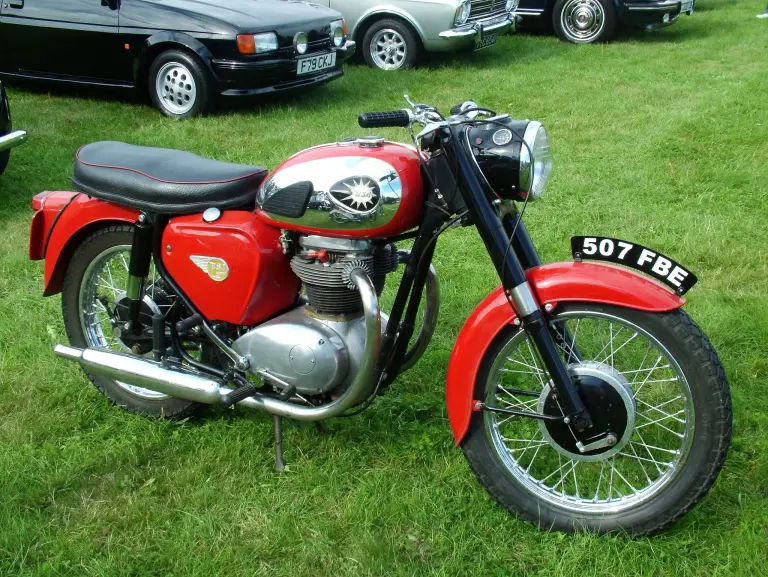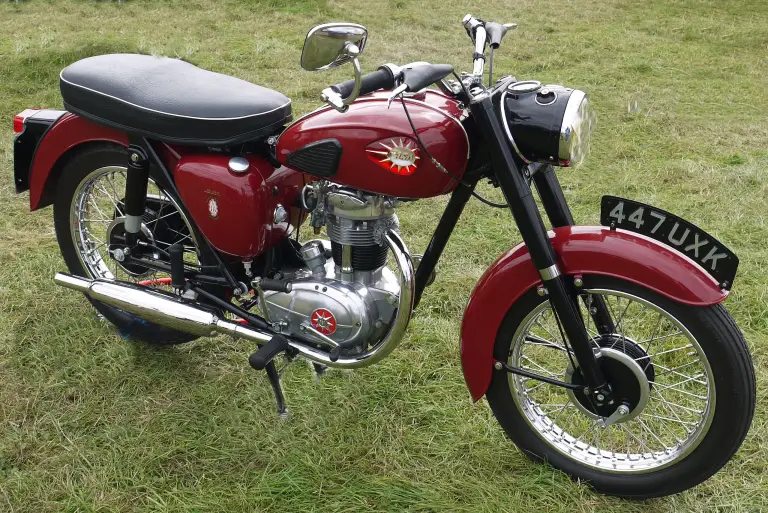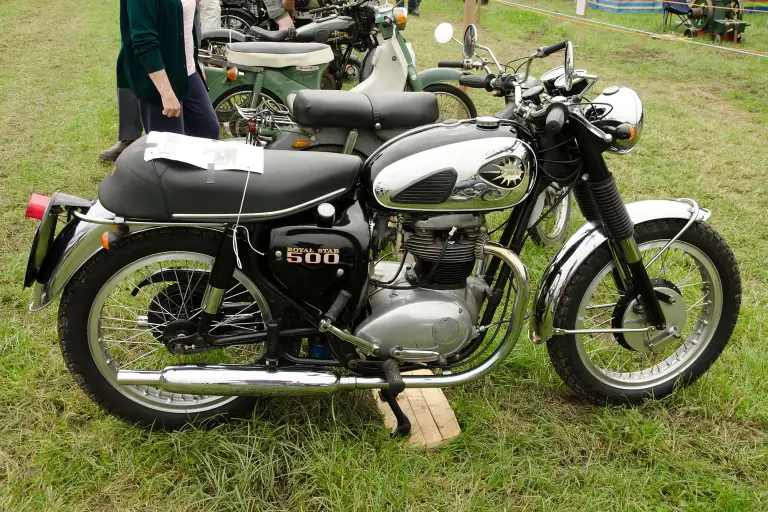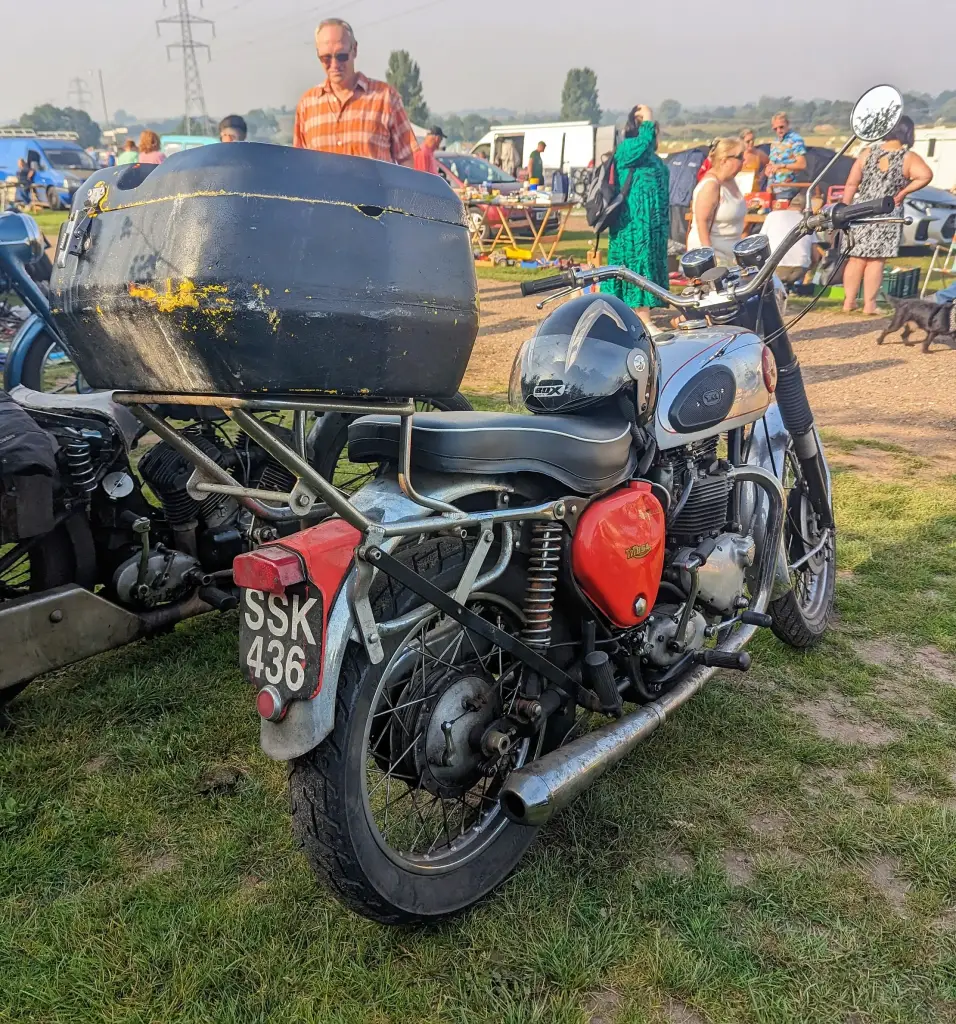
The BSA Gold Star is a motorcycle made by BSA from 1938 to 1963. The 350 cc and 500 cc single-cylinder four-strokes were among the fastest bikes of the 1950s, and because they were hand-built with many optional performance parts, each one left the factory with documented dynamometer test results showing its power output.
BSA Gold Star at a glance
| Maker | Birmingham Small Arms Company |
|---|---|
| Production | 1938–1963 |
| Capacities | 350 cc and 500 cc singles |
| First model | M24, 496 cc, 82 mm × 94 mm |
| Pre-war variants | JM24 (1938), KM24 (1939) |
| Pre-war output | around 30 bhp |
| JM24 built | 266 |
| KM24 built | 298, of which 120 exported |
| Post-war 350 | ZB32GS, 348 cc, 71 mm × 88 mm |
| Post-war output | around 25 bhp depending on specification |
Based on one source, the English Wikipedia article on the Gold Star.
History of the BSA Gold Star
The Gold Star name came from racing. In 1937 Wal Handley lapped the Brooklands circuit at over 100 mph on a BSA Empire Star and was awarded one of the traditional Gold Star badges, which inspired BSA to put a Gold Star into production. In BSA’s numbering, the year letter came first and the range letter second, so YB is 1948 and ZB is 1949; genuine bench-tested Gold Stars carried “GS” after those letters, as in ZB32GS, followed by the engine number. A standard YB32 or later competition machine was not a Gold Star, because it had neither a bench-tested engine nor the full GS engine number.
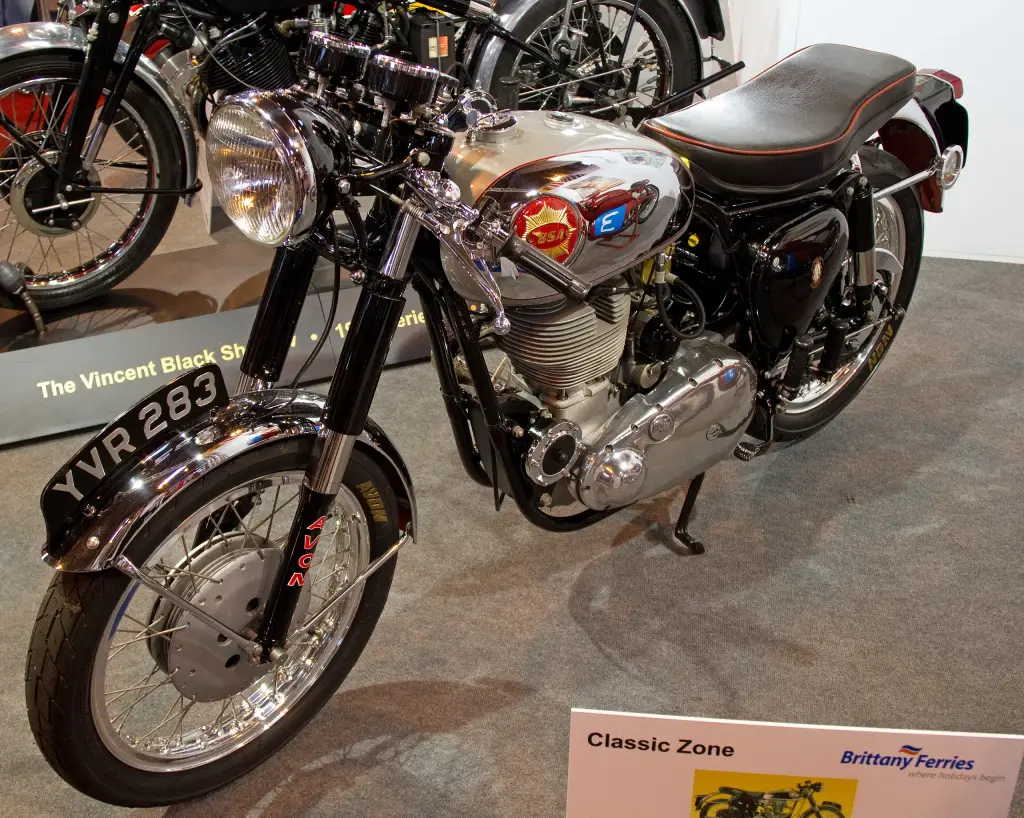
The first Gold Star was the M24. It had an all-alloy 82 mm by 94 mm bore and stroke for 496 cc, a separate rocker box bolted to the aluminium head, pushrod valve actuation, an Elektron magnesium-alloy gearbox with a close-ratio option, and a rigid frame with girder forks made of Reynolds 531 light tubing without sidecar lugs. The model continued to the start of the Second World War in two variants: the 1938 JM24 and the 1939 KM24. The 1939 KM used a redesigned crank and crankcase with the timing gears on fixed shafts supported by a strong steel outrigger plate, a feature that stayed on the Gold Star throughout its production, because the earlier JM had camshafts running directly in the timing cover with the risk of premature wear. Power was around 30 bhp. The cast Elektron gearbox was dropped in 1939 in favour of the side-valve M20’s cast aluminium shell with close ratios as an option, and some KMs served with the military at the start of the war. BSA built 266 JM24s and 298 KM24s, 120 of the latter going abroad, and over 100 survivors are recorded.
After the war BSA brought out the iron-engined 348 cc B31 in 1945–46 and the 499 cc B33 that followed. For the 1949 season, and to attract sporting buyers, the all-alloy 348 cc ZB32 Gold Star was shown at the Earls Court show at the end of 1948, with a long list of optional components. Unlike the pre-war M24 engine, its cylinder head was a strong one-piece casting with the rockers built into the unit. The new spring frame used so-called plunger suspension, halfway between the rigid and swingarm types: undamped springs on shafts and forgings either side of the rear wheel spindle, more comfortable on the road than a rigid frame but eventually regarded by competition riders as heavy and difficult to handle.
Each Gold Star was assembled by hand once ordered, and the engine was bench tested and not released unless it made an acceptable output, around 25 bhp depending on specification. They were 20 lb lighter than the comparable 17 bhp cast-iron B-series single. Success came almost immediately: the Gold Star won the Manx Grand Prix Clubmans 350 class from 1949 and kept winning until the class was discontinued in 1956. Buyers could order tourer, trials, ISDT, scrambles, racing or Clubman trim, and racing models used the established Amal TT carburettor. The rest of the 1948 BSA OHV B range, the YB models, kept heavy but reliable cast-iron heads and barrels, and any YB32 competition engines with aluminium ZB32-type top ends would have been works prototypes rather than production Gold Stars.
In 1949 the B32 Gold Star was in full production and the 499 cc B34 Gold Star arrived with a modified heavier crankshaft, a stronger drive-side crankcase, a larger-diameter drive-side main shaft and a different main bearing design. The 350 continued as before. Plunger frames were most commonly used, with the standard rigid B-type frame as an option for trials work. Both models received larger 8-inch front brakes in 1950, and in late 1951 the 500 gained a new barrel and a Bert Hopwood-designed head with a separate rocker box while the 350 received a new barrel and head.
Design and features
- Bench-tested engines: every genuine Gold Star was run on the dynamometer and delivered with its own power figures.
- Clubman’s choice: tourer, trials, ISDT, scrambles, racing and Clubman specifications were all available to order.
- Outrigger timing plate: the 1939 KM24’s steel plate supporting the timing gears stayed on the model for its whole life.
- Light where it mattered: the alloy-engined 350 weighed some 20 lb less than the iron B-series single.
BSA Gold Star versions
- M24 (1938–1939): the pre-war 496 cc Gold Star, in JM24 and KM24 form.
- ZB32GS (1949): the post-war 348 cc all-alloy Gold Star with a one-piece head.
- ZB34GS (1949): the 499 cc version with a heavier crankshaft and stronger drive-side crankcase.
- Trim options: tourer, trials, ISDT, scrambles, racing and Clubman specifications built to order.
The Gold Star grew out of the Blue Star line and stood above the A10 twins in the range, sharing its frame ideas with the B31. More models are in the BSA collection.
Video: BSA Gold Star cafe racer 500cc
Video by TheClassicMotorcycle on YouTube.
Sources
- BSA Gold Star, English Wikipedia: origin, M24, post-war ZB models