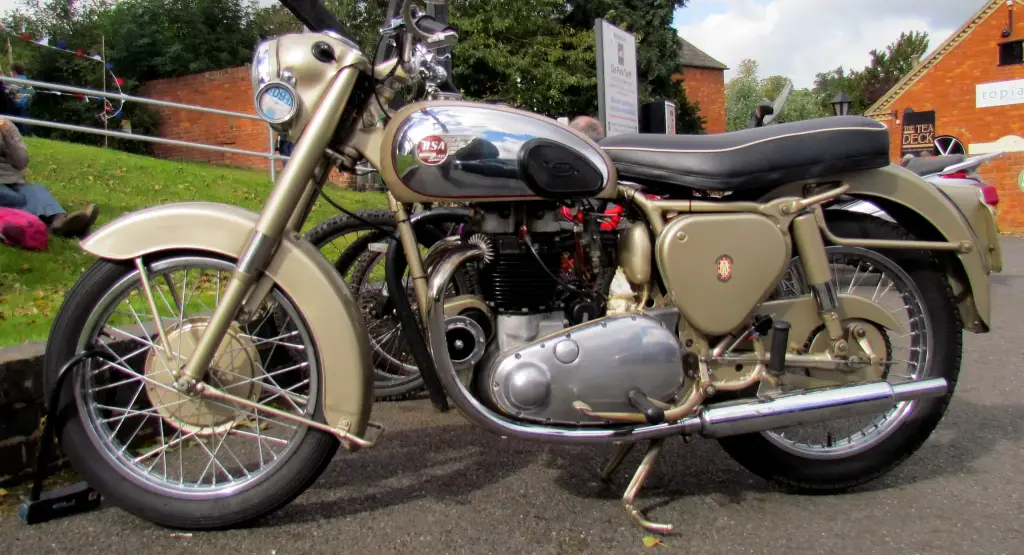
The BSA A10 series was a range of 646 cc air-cooled parallel-twin motorcycles designed by Bert Hopwood and produced by Birmingham Small Arms at Small Heath, Birmingham, from 1950 to 1963. The series was succeeded by the unit-construction A65 models.
BSA A10 at a glance
| Maker | Birmingham Small Arms Company, Small Heath, Birmingham |
|---|---|
| Production | 1950–1963 |
| Designer | Bert Hopwood |
| Engine | 646 cc air-cooled parallel twin, OHV |
| Bore × stroke | 70 mm × 84 mm |
| Carburettor | single Amal, five types used across the range |
| Ignition | magneto behind the cylinders, dynamo in front |
| Frame | rigid, plunger (export) or swinging arm from 1954 |
| First model | Golden Flash, launched October 1949 |
| Sporting models | Road Rocket, Super Rocket, Rocket Gold Star, Spitfire Scrambler |
| Successor | BSA A65 |
Based on one source, the English Wikipedia article on the A10 series.
History of the BSA A10
BSA was the largest British motorcycle manufacturer of the day, but it was falling behind in the parallel-twin race after the arrival of the 650 cc Triumph Thunderbird. BSA already had a 500 cc twin, the A7, and needed a 650 to stay competitive. Bert Hopwood had served his apprenticeship under Val Page at Ariel, worked at Triumph under Edward Turner on the 1937 Speed Twin and joined Norton in April 1947 to design the Dominator engine. In May 1948 the BSA factory lured him away after only a year and commissioned a competitive 650 cc parallel twin.
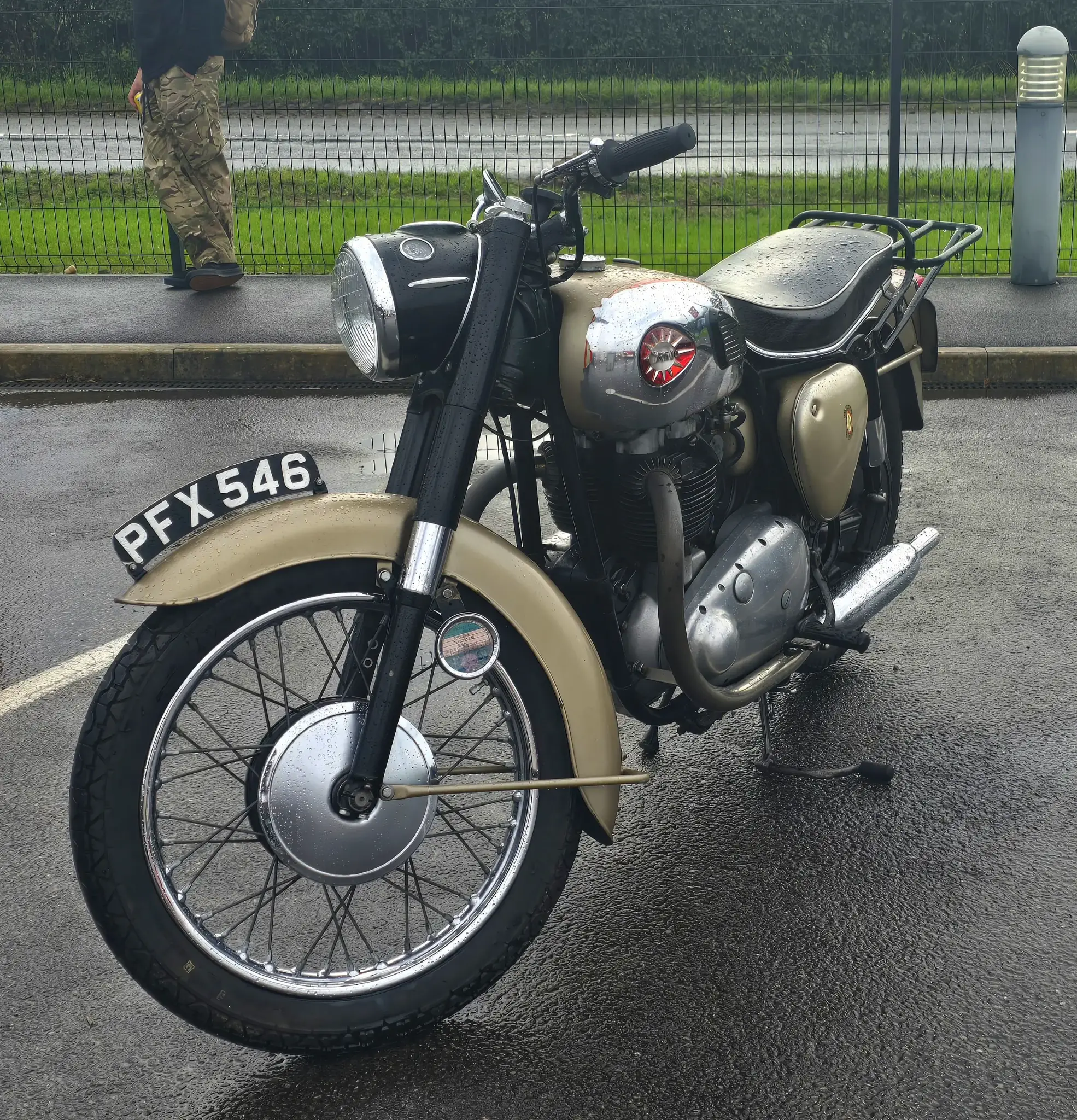
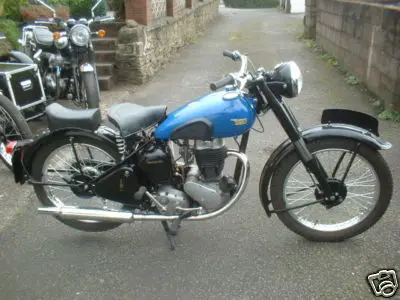
The A10 Golden Flash was launched in October 1949 and drew heavily on Val Page’s and Bert Perkins’ A7. Capacity rose to 646 cc with a 70 mm bore and 84 mm stroke. The engine had a revised alloy rocker box and a cast-iron cylinder head with an integral manifold for the single Amal carburettor, a single camshaft behind the cylinders operating the valves through pushrods in a tunnel cast into the block, a magneto behind the cylinders and a dynamo in front. Lubrication was dry sump. The crankshaft was a bolt-up 360-degree item, the crankcases split vertically, and a semi-unit gearbox let the duplex primary chain be adjusted by a slipper tensioner inside the primary case. Because so much came straight from the A7, the new model promised reliability with little risk of fresh technical trouble.
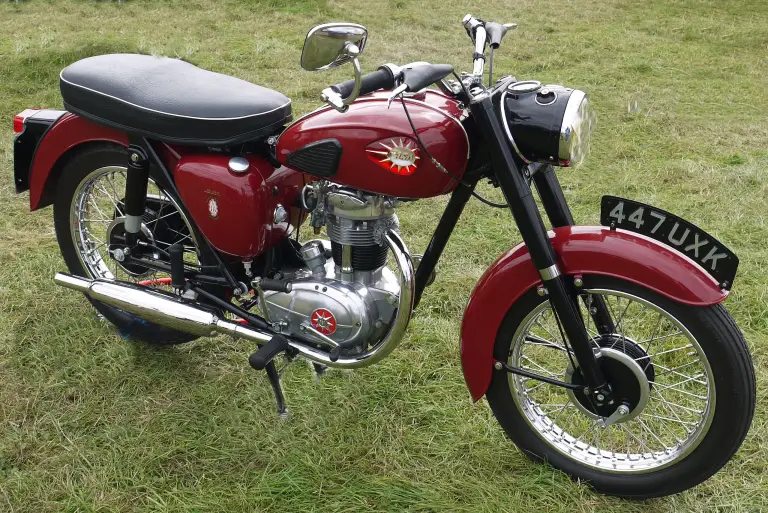
In 1954, with the arrival of the swinging-arm frame, the semi-unit gearbox gave way to a separate pre-unit item with a modified clutch, new internals and a single-row primary chain adjusted by moving the gearbox. An alloy head arrived with the Road Rocket in 1955, along with a thicker cylinder base flange — the “thick flange” cylinders — and big ends enlarged from 1.46 to 1.68 inches, the “big journal” crankshafts and rods. Both changes passed to later sports models, and thick-flange cylinders and big-journal big ends reached the Gold Flash in 1958. A four-spring clutch replaced the six-spring item across the range in 1957.
The frame was offered rigid, but plunger suspension was the more common choice, adopted for export; a hinged rear mudguard eased wheel removal. Worries about wear in the plunger suspension leading to uncertain handling brought the swinging arm in 1954 and the end of the hinged mudguard, though plunger frames remained an option on the Gold Flash until 1957. Brakes began as an 8-inch single-sided front and 7-inch rear, with full-width brakes of the same size on the higher-performance models from 1958; some Spitfire Scramblers and the Rocket Gold Star used the 190 mm Gold Star front brake. The Rocket Gold Star used Gold Star cycle parts, and its frame numbers began with A10 where all other A10 frames began with A7.
Three camshafts were used in production: the 334 “standard” in the Golden Flash from 1950 to 1959, the 356 “sports” in the Road Rocket and the Super Rocket until 1959 and in the Golden Flash from 1960, and the 357 “race” cam, also called the Spitfire cam, in the Super Flash, Spitfire Scrambler and Rocket Gold Star and in the Super Rocket from 1960. A fourth, the 358 “acceleration” cam, was offered for racing only.
Design and features
- Carry-over engineering: the A10 shared so many proven A7 parts that BSA could promise reliability with little risk of new faults.
- Thick-flange cylinders: the Road Rocket of 1955 brought a half-inch base flange and larger big ends, later fitted to the Gold Flash too.
- Three camshafts: standard, sports and race profiles let one engine serve touring, sport and competition models.
- Progressive cycle parts: rigid, plunger and swinging-arm frames, then full-width brakes from 1958.
BSA A10 versions
- Golden Flash: the first model, launched in 1950 and painted gold; about 80 per cent of production went to the United States.
- Road Rocket: the 1955 sports version that introduced the alloy head and thick-flange cylinders.
- Super Rocket: a further development of the sports twin, using the race cam from 1960.
- Rocket Gold Star: the hottest A10, built with Gold Star cycle parts and the largest Amal carburettor.
- Spitfire Scrambler: an off-road oriented model, some with Gold Star Catalina cycle parts in 1957 and 1963.
The A10 grew out of the BSA A7 and was replaced by the unit-construction BSA A65; the sporting Gold Star sat above it in the range. More models are in the BSA collection.
Video: BSA A10 Short run to test GoPro sound
Video by Roy Johnstone on YouTube.
Sources
- BSA A10 series, English Wikipedia: design, engine, cycle parts, models