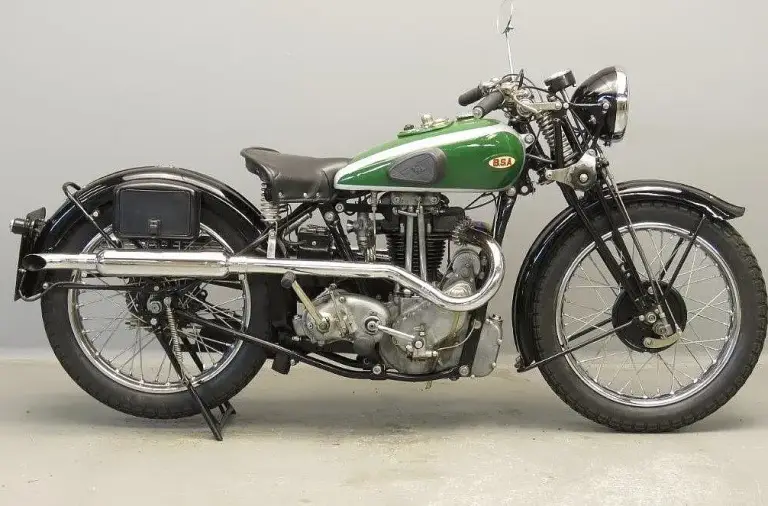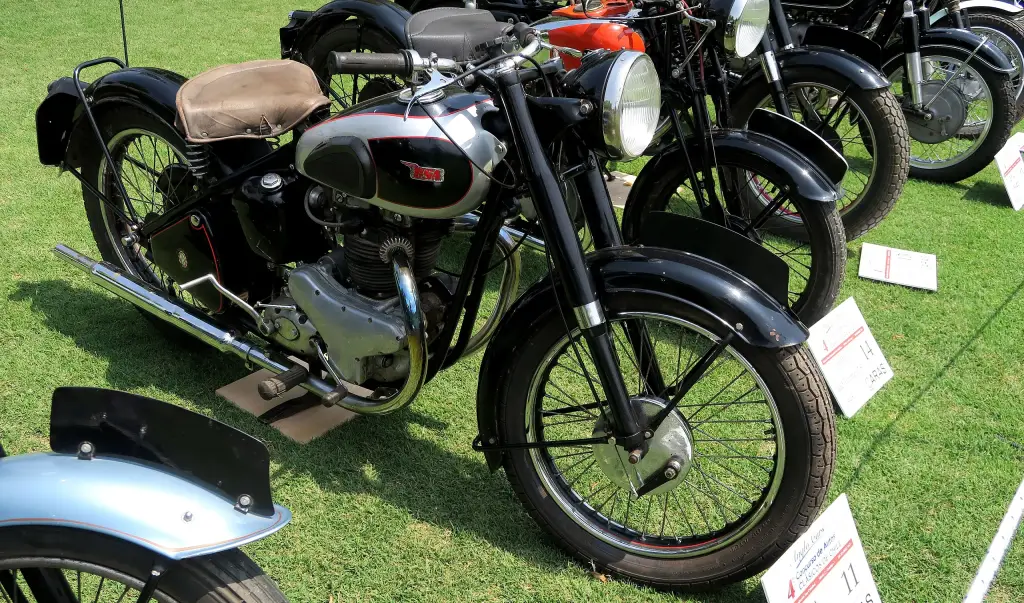
The BSA A7 is a range of 500 cc parallel-twin motorcycles made by Birmingham Small Arms at its factory in Armoury Road, Small Heath, Birmingham. The range was launched in 1946 with a 495 cc long-stroke engine; an improved 497 cc version based on the BSA A10 engine followed in 1950, and various A7 models stayed in production with minor changes until 1961–62, when the unit-construction A50 superseded them.
BSA A7 at a glance
| Maker | Birmingham Small Arms Company, Armoury Road, Small Heath |
|---|---|
| Launched | September 1946 |
| Production ended | 1961–62 |
| Engine | 495 cc air-cooled parallel twin, OHV |
| Bore × stroke | 62 mm × 82 mm |
| Power | 26 bhp |
| Top speed | 85 mph |
| Revised engine | 497 cc from 1950, 66 mm × 72.6 mm |
| Frame | rigid at launch, plunger option from 1949, swinging arm from 1954 |
| Sporting models | A7S Star Twin, A7SS Shooting Star |
| Successor | BSA A50 |
Based on one source, the English Wikipedia article on the A7.
History of the BSA A7
After the 1938 launch of the Triumph Speed Twin designed by Edward Turner, BSA needed a 500 cc parallel twin to compete with it. Designed by Herbert Parker, David Munro and BSA’s chief designer Val Page, the A7 was BSA’s first parallel twin. The Second World War delayed the launch, though several prototypes were built during the war, and the model finally appeared in September 1946, after hostilities had ended.
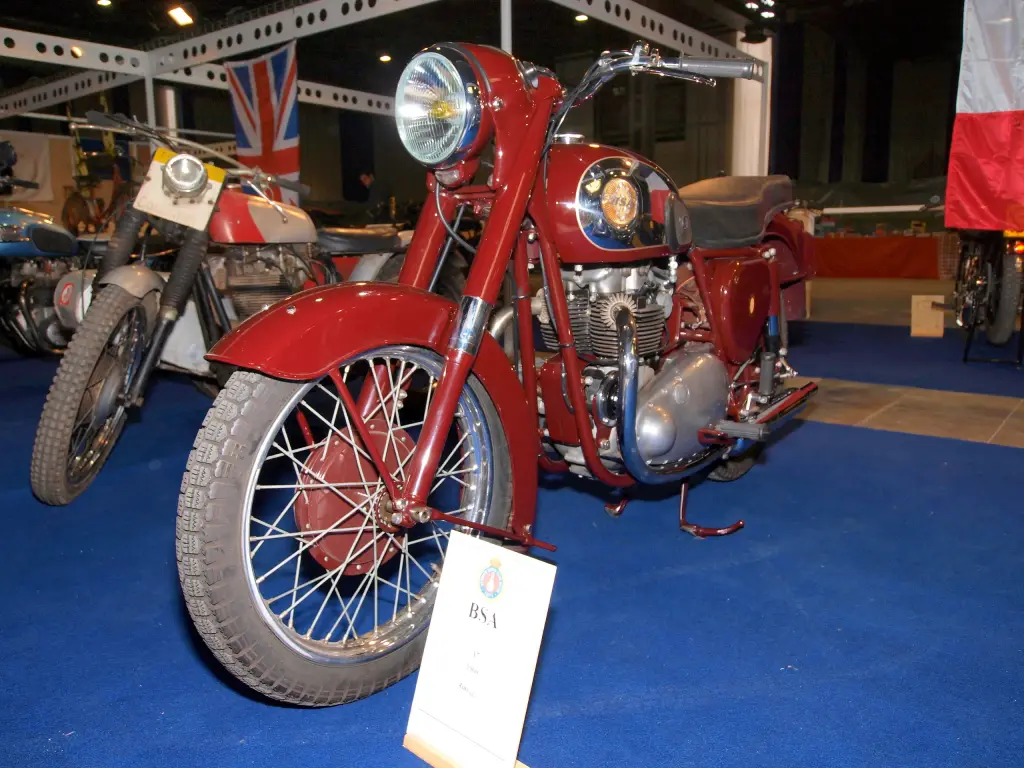
The very first A7 off the production line was flown to Paris for the first motorcycle show after the end of the war. There was huge demand for affordable transport, and the simplicity of the A7 twin was helped along by the slogan “It’s time YOU had a BSA!”.
The 495 cc twin produced 26 bhp and was capable of 85 mph. It was long-stroke, 62 mm by 82 mm, with a single camshaft behind the cylinders operating the valves through long pushrods passing through a tunnel in the cast-iron block. That layout needed numerous studs and nuts to secure the iron cylinder head and rocker boxes, many of them deeply recessed and calling for good box spanners or the then uncommon socket spanners; as on other British motorcycles of the era, it often led to oil leaks. The gearbox of the first A7s was bolted to the back of the crankcase with an internal tensioner for the duplex primary chain. Electrics were two independent Lucas systems, a magneto for ignition and a dynamo to charge the battery for lights and horn. The first A7s had a single Amal Type 6 carburettor; later machines used Amal TT and then Amal 376 Monobloc carburettors.
In October 1949 BSA launched the 650 cc A10, designed by Bert Hopwood; its engine was a redesigned and improved version of the A7 engine, and a 497 cc version of it was produced for the A7 with a shorter stroke of 66 mm by 72.6 mm. It was first fitted to the higher-performance A7S Star Twin and reached the base A7 in 1951.
The A7 was launched with a rigid frame and telescopic forks, with a hinged rear mudguard that lifted for easier wheel removal. Plunger rear suspension became an option in 1949, but BSA was worried by the rate of wear in the plunger units and the poor handling it caused, so a new frame with swinging-arm rear suspension arrived in 1954 and the rigid and plunger frames were dropped. That 1954 redesign also brought the less modern pre-unit construction and a single-row primary chain.
The A7S Star Twin was launched to compete with the Triumph Tiger 100: it had a higher compression ratio, the later A10-based engine, austenitic steel valves and an inlet manifold separate from the head so twin carburettors could be fitted as an option, all in a plunger frame with extra chrome. In 1953 it gained an alloy head and an Amal Monobloc, and it was dropped in 1954 in favour of the Shooting Star. The A7SS Shooting Star arrived in 1954 with the swinging-arm frame, a higher-performance cam, compression raised from 6.6:1 to 7:1, 30 bhp at 5800 rpm and a top speed just short of 90 mph. It kept a dark green frame at first, and by the end of production in 1962 it had come to a black frame with a metallic light green tank, mudguards and side panels, an alloy head, a duplex cradle frame, full-width cast-iron hubs and 8-inch front and 7-inch rear drum brakes.
In 1952 three BSA A7s were entered for the Maudes Trophy and the International Six Days Trial, covering 4,500 miles.
Design and features
- BSA’s first twin: the A7 brought BSA into the parallel-twin market that the Triumph Speed Twin had opened in 1938.
- Long-stroke engine: 62 mm by 82 mm gave 495 cc, 26 bhp and 85 mph in 1946.
- Hinged rear mudguard: a practical touch that made removing the rear wheel much easier.
- Developed into sports models: the Star Twin and Shooting Star turned the tourer into a 30 bhp, 90 mph machine.
BSA A7 versions
- A7 (1946): rigid frame, long-stroke 495 cc iron engine, later with plunger suspension as an option.
- A7 with the 497 cc engine: the shorter-stroke A10-based unit, standard from 1951.
- A7S Star Twin: high-compression sports version with a separate inlet manifold for optional twin carburettors.
- A7SS Shooting Star: the 1954 swinging-arm flagship with 30 bhp and a top speed near 90 mph.
- Flash: the name the A7 carried in the United States from 1954.
The A7 was developed into the 650 cc BSA A10 and replaced by the unit-construction A50 Royal Star. More models are in the BSA collection.
Video: BSA A7 1955
Video by Neil Vickers on YouTube.
Sources
- BSA A7, English Wikipedia: development, engine, models, competition