The BSA Bantam is a two-stroke unit-construction motorcycle produced by Birmingham Small Arms from 1948, when it was a 123 cc machine, until 1971, by which time it had grown to 173 cc. Exact production figures are unknown, but somewhere between 350,000 and 500,000 were built.
BSA Bantam at a glance
| Maker | Birmingham Small Arms Company, Redditch |
|---|---|
| Production | 1948–1971 |
| Built | between 350,000 and 500,000 |
| Engine | unit-construction single-cylinder two-stroke |
| Capacity | 123 cc at launch, 173 cc at the end |
| Barrel and head | cast-iron barrel, alloy head |
| Gearbox | three speeds to 1968, four speeds 1968–1971 |
| Clutch | wet |
| Ignition | Lucas battery coil or Wipac magneto |
| Original design | DKW RT 125, received as war reparations |
Based on one source, the English Wikipedia article on the Bantam.
History of the BSA Bantam
The Bantam was based on a German design, the DKW RT 125, which the Allies received as war reparations. BSA built it at Redditch as a mirror image of the RT 125, so that the gearchange sat on the right in the British fashion, and converted the measurements from metric to inches. The first model, the D1, was launched in 1948 outside Britain and in 1949 at home, and stayed in production until 1963.
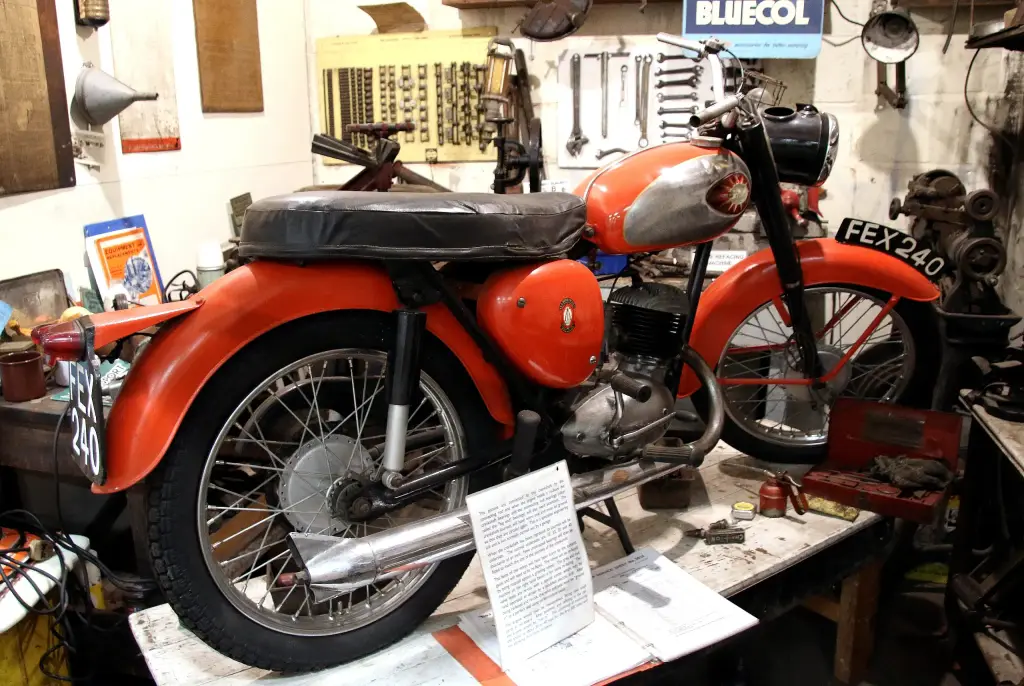
The D1 had a three-speed gearbox and a telescopic front fork with undamped springs. In its original form it had no rear suspension, direct electrics and a fishtail silencer. Its front mudguard was deeply valanced because it was fixed to the unsprung part of the fork, so the wheel moved up and down inside it. The D1 came in one colour, Mist Green, with an ivory panel on each side of the fuel tank, at £60 plus purchase tax.
The same DKW design went into production in several countries. The DKW factory at Zschopau in the Soviet zone was dismantled, and in about 1946 the Soviet Union launched the Moskva M1A built in Moscow. Harley-Davidson brought out its Model 125 late in 1947. Auto Union, DKW’s parent, was refounded at Ingolstadt in the American zone and started production in 1949 with the DKW RT 125 W, while the former Zschopau works became IFA — later MZ — and resumed with the IFA-DKW RT 125 in 1949. Yamaha’s first production motorcycle, the YA-1 of 1955, followed the same pattern.
Over the years BSA developed the Bantam with battery electrics, damped front suspension and rear suspension first on plungers and then on a swinging arm, along with larger engines, a steel silencer that could be dismantled for cleaning and, from 1968, a four-speed gearbox. Bantams from 1959 have a swinging-arm frame with little in common with the rigid, plunger and first swinging-arm versions, though the shape of the original engine stayed recognisable throughout the 23 years of production.
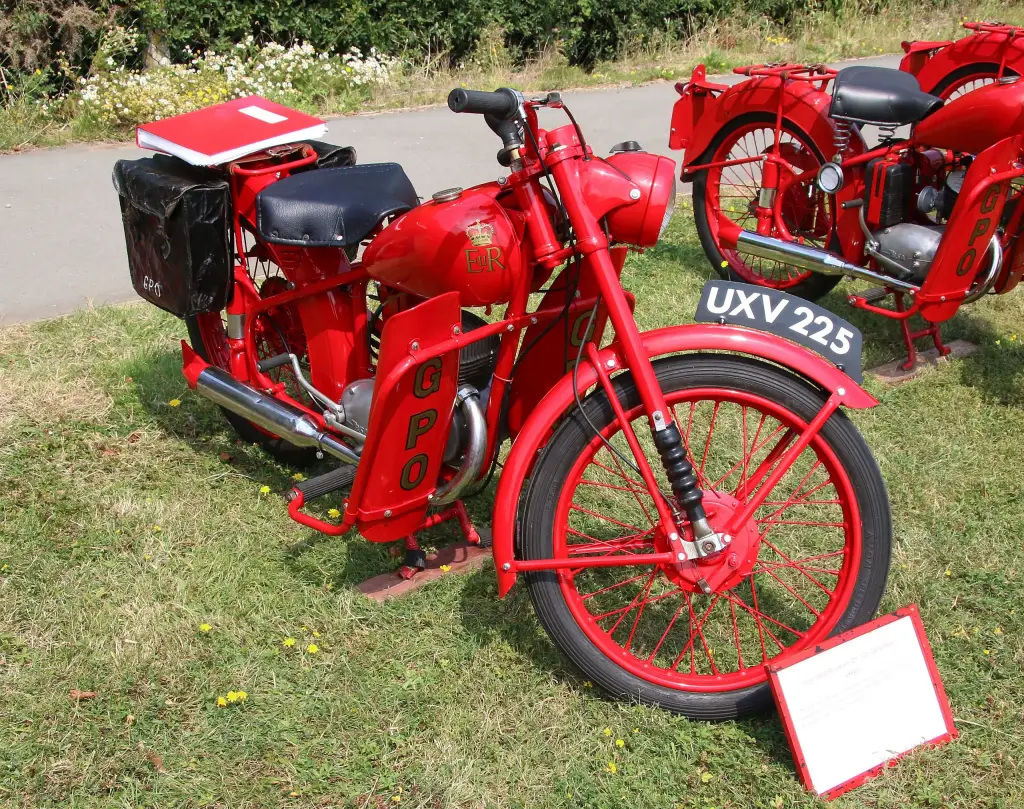
The D1 was offered at first only with a rigid rear end; plunger suspension became an option in 1950 and the rigid frame was dropped in 1956. All D1s had undamped front suspension, which gave a bouncy ride. Wipac lighting came in 6-volt AC, known as direct lighting, or DC: the AC system used a disposable dry torch cell to light the pilot bulb in the headlamp shell and left the rest of the lighting working only with the engine running, while the DC system had a lead-acid battery like a conventional machine. For a short period some D1s used Lucas lighting on similar lines. A foam-upholstered dualseat became an option in 1953, the year BSA built its 100,000th D1, and from 1958 the D1 was also offered in maroon; it remained on sale until 1963 and was still made for the General Post Office for at least two more years. A Deluxe or BD1 version, with a black tank and chromium strip, cream side panels, chromium rims, crash bars, legshields and a larger rack, was available to special order from 1949 to 1953.
Wheels and brakes changed with the models: pre-1958 machines from D1 to D3 had 19-inch wheels and 4.5-inch brakes, the 1958 D5 had 18-inch wheels and 4.5-inch brakes, and the 1959 D7 and later models had 18-inch wheels with 5-inch brakes at both ends. The D175 was sold as the B175 as BSA struggled against imports in the late 1960s, before the company closed in 1972.
Design and features
- Wartime origins: the Bantam was a re-engineered DKW RT 125 taken as war reparations and adapted to British habits and imperial measurements.
- Simple two-stroke: a cast-iron barrel, alloy head and wet clutch kept the machine cheap to run and easy to repair.
- Long development: plunger and swinging-arm suspension, battery electrics, a four-speed gearbox and bigger engines arrived over 23 years.
- Learner-friendly: a 123 cc two-stroke that put thousands of riders on two wheels after the war.
BSA Bantam versions
- D1 (1948–1963): the original 123 cc rigid-framed Bantam, with plunger suspension as an option from 1950.
- Deluxe / BD1 (1949–1953): a special-order version with chromium trim, crash bars, legshields and a luggage rack.
- D5 (1958): 18-inch wheels with 4.5-inch brakes.
- D7 (1959 onwards): the new swinging-arm frame, 18-inch wheels and 5-inch brakes.
- B175 (late 1960s): the 175 cc model sold under the B prefix as imports squeezed BSA.
The Bantam was the small two-stroke in a range of four-strokes such as the C15 and the B25. More models are in the BSA collection.
Video: BSA Bantam 1951 D1 125cc
Video by FiercePython on YouTube.
Sources
- BSA Bantam, English Wikipedia: history, engine, models