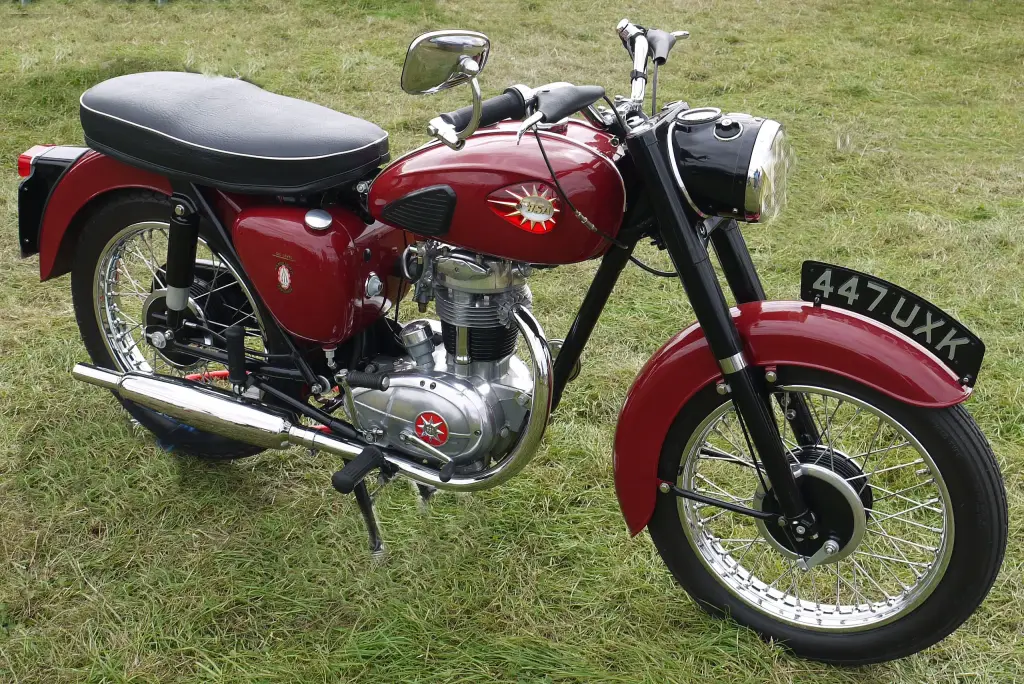
The BSA C15 was a 250 cc single-cylinder overhead-valve motorcycle made by BSA from September 1958 until 1967, and it was the company’s first four-stroke unit-construction bike. For most of that period, after the Learner Laws of 1961, a 250 was the largest machine a learner could ride unaccompanied on L-plates in Britain.
BSA C15 at a glance
| Maker | Birmingham Small Arms Company, Small Heath |
|---|---|
| Production | September 1958 – 1967 |
| Engine | 249 cc single-cylinder overhead valve, unit construction |
| Power | 15 bhp |
| Gearbox | four speeds, at the rear of a vertically split crankcase |
| Primary drive | duplex chain to a multi-plate clutch |
| Frame | single loop with twin rails under the engine |
| Wheels | 17 inch, full-width cast iron hubs |
| Derived from | 200 cc Triumph Tiger Cub |
| Successor | BSA B25 Starfire and C25 Barracuda |
Based on one source, the English Wikipedia article on the C15. No free photographs of the C15 were found, so the page runs without pictures.
History of the BSA C15
BSA acquired the Triumph marque in 1951, and the C15 250 cc four-stroke was derived from the 200 cc Triumph Tiger Cub, itself developed from the 150 cc Terrier. Edward Turner became head of the BSA automotive division, and in 1958 BSA introduced unit construction, with engine and gearbox combined in one piece rather than made as separate components. The C15 Star was the first unit-construction model and proved more reliable and more economical than its predecessor, the pre-unit BSA C11.
The C11 engine had an iron barrel and an alloy head with pushrods running in a separate tube to fully enclosed rockers. The C15 followed that layout, with a camshaft geared directly from the crankshaft, skew gears driving the oil pump, and the contact breaker mounted behind the cylinder on a shaft. The alternator sat on the left, the primary drive was a duplex chain to a multi-plate clutch, and the four-speed gearbox lived at the rear of the vertically split crankcase. The frame was a single loop with twin rails under the engine and pivoted-fork rear suspension, and both wheels were 17-inch with full-width cast-iron hubs. An oil tank sat under the seat on the right with a toolbox on the left, and between them an ignition switch panel hid the battery. The headlamp was set in a nacelle that also housed the instruments and switches, as was fashionable at the time, and deeply valanced mudguards made the standard model look heavier than it was.
The C15 was a completely redesigned machine compared with the C11, with a new frame and a new 250 cc engine, but it needed careful maintenance: it was prone to oil leaks, electrical faults, gearbox problems, valve-gear failures, a weak big end and clutch adjustment trouble. The contact breaker housing originally protruded at the rear of the cylinder above the gearbox, and was later moved to the right-hand crankcase behind a circular plate.
Producing only 15 bhp, the C15 lacked the power to take on the more sophisticated Japanese machines such as the Honda C71 and CB72 that began arriving in Britain in the 1960s. A road-going Sports derivative, the SS80 Sportsman, joined the range in 1961 with a tuned engine, roller big ends and lower handlebars, and off-road trials and scrambles versions were also offered.
The C15G of 1966 to 1967 was the last version of the engine, with a ball bearing timing-side main bearing, a roller drive side, strengthened crankcases, a larger oil pump and needle roller gearbox layshaft bearings. From 1966 the C15 bottom end — crankcases, bearings, oil pump and gearbox components — was upgraded along the lines developed for Jeff Smith’s works B40-based Victor, the same work that produced the 441 cc BSA B44 Shooting Star and Victor Special. In 1967 the 250 was succeeded by the BSA B25 Starfire and C25 Barracuda, which brought a quickly detachable rear wheel and 12-volt electrics.
Design and features
- First unit-construction four-stroke: engine and gearbox in one casting, more reliable and economical than the pre-unit C11.
- Learner-sized: at 250 cc it was the biggest machine a British learner could ride unaccompanied after the 1961 Learner Laws.
- Complete range: roadster, sports SS80, trials C15T and scrambles C15S versions came from the same engine.
- Late strengthening: the C15G of 1966–67 brought the bearings, crankcases and oil pump developed on the competition bikes.
BSA C15 versions
- C15 Star (1959): the first model of the range.
- C15 Sportsman / SS80 (1961): a tuned engine, roller big ends and lower handlebars.
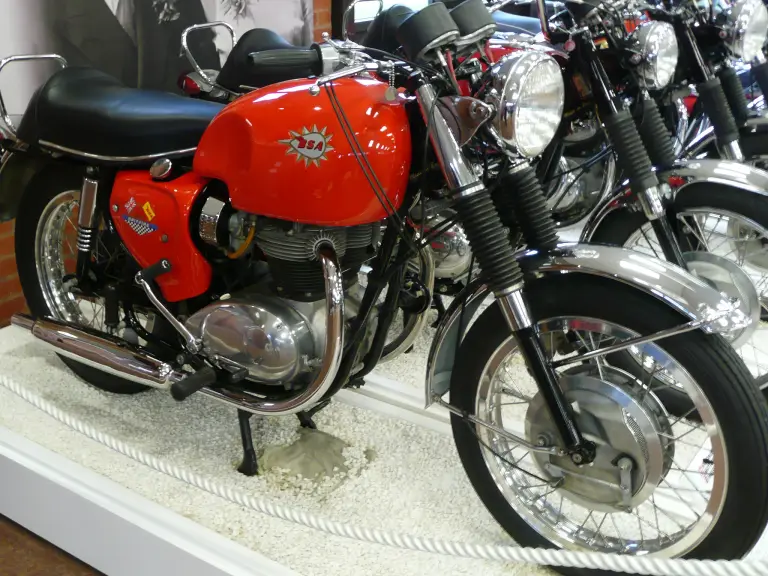
- C15 Starfire roadster (1963–1964): chrome mudguards and tank side panels, with a reshaped seat and tank.
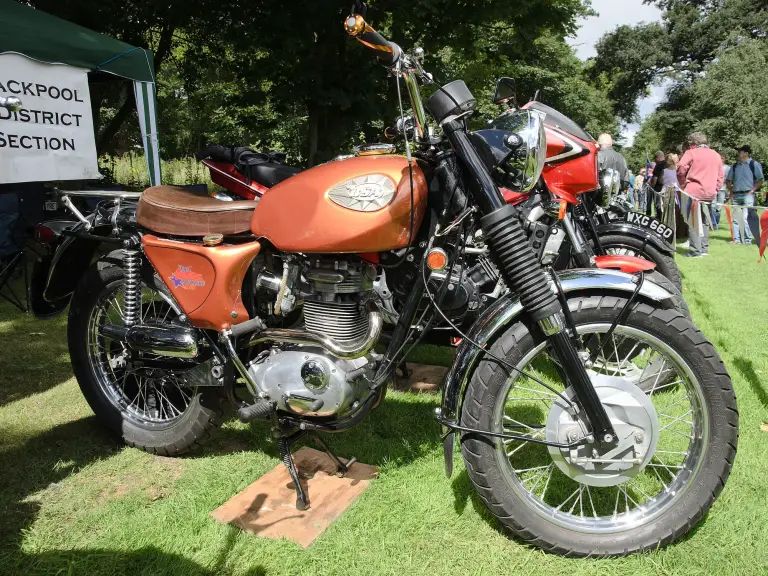
- C15T trials and C15S scrambler: off-road versions, the scrambler with a larger exhaust valve and higher compression.
- C15G (1966–1967): the final and strongest version of the engine.
- C15P: a police model.
The C15 replaced the pre-unit C11 and was replaced by the B25; its engine grew into the 350 cc B40 and the 441 cc B44. More models are in the BSA collection.
Video: BSA C15 SPORT STAR PULLING AWAY
Video by 925si on YouTube.
Sources
- BSA C15, English Wikipedia: development, engineering, models