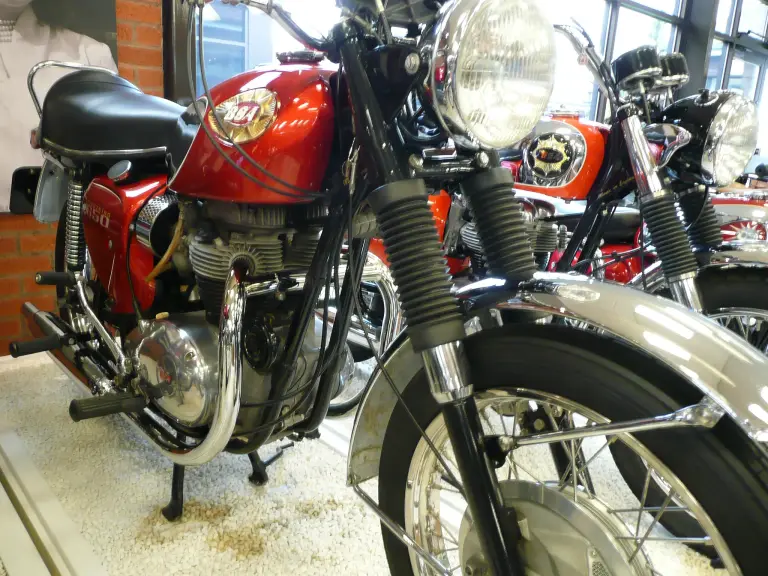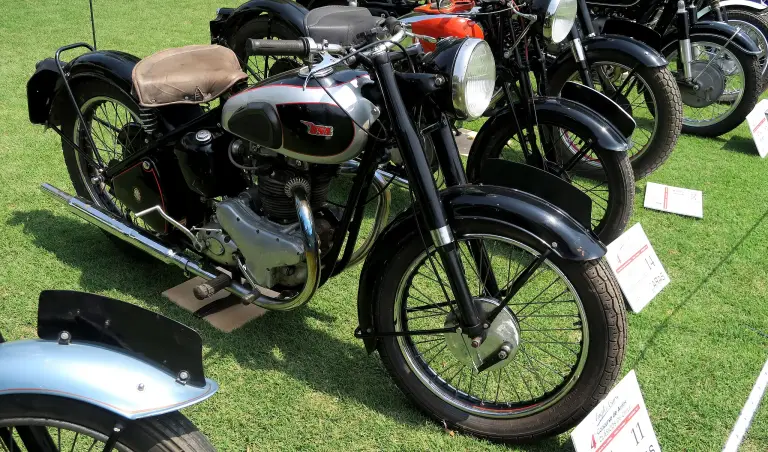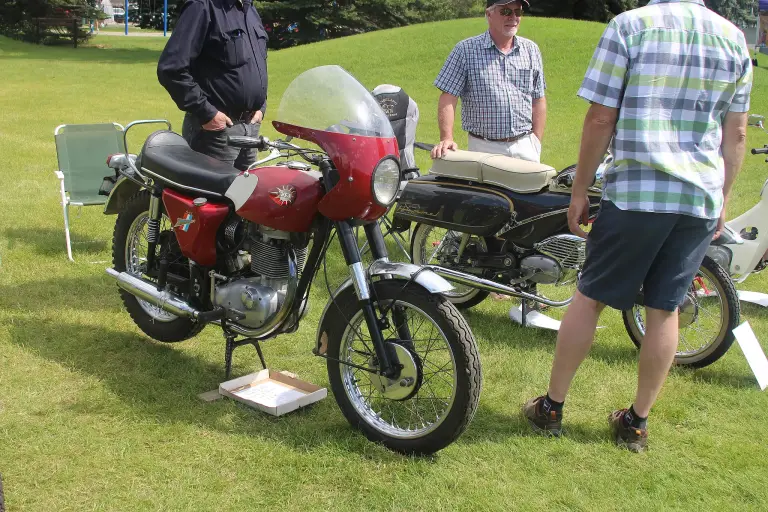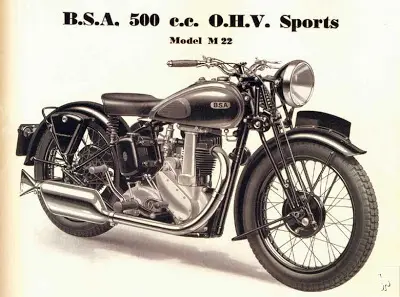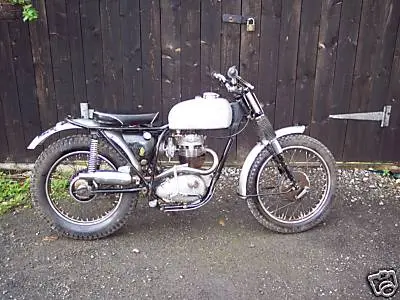
The BSA B40 was a series of 350 cc unit-construction single-cylinder OHV four-stroke motorcycles made by Birmingham Small Arms. Developed from the BSA C15, the machines were produced between 1961 and 1967 for civilian use, and military versions were manufactured from 1967 to 1970. Around 14,000 machines were built in total.
BSA B40 at a glance
| Maker | Birmingham Small Arms Company |
|---|---|
| Civilian production | 1961–1967 |
| Military production | 1967–1970 |
| Total built | around 14,000 |
| Engine | 343 cc unit-construction single, OHV four-stroke |
| Bore | 79 mm, up from the C15’s 67 mm |
| Compression | 7:1 |
| Power | 21 bhp at 7000 rpm |
| Wheels | 18 inch |
| Variants | Star, Sports Star SS90, Enduro Star, Police, WD |
Based on one source, the English Wikipedia article on the B40. No free photographs of the B40 were found, so the page runs without pictures.
History of the BSA B40
The B40 was BSA’s answer to the high-tech, high-performance Honda lightweights that were beginning to appear — Mike Hailwood had won the 1961 Lightweight TT on a twin-cylinder, 125 cc machine with double overhead camshafts. BSA took its lightweight C15 and bored it out: the 67 mm bore went to 79 mm, giving 343 cc. The bottom end was strengthened but kept its plain big end, and worries about reliability led to the compression ratio being reduced to 7:1. A new cast-iron barrel was produced with the pushrod tunnel built in, and the engine gave 21 bhp at 7,000 rpm. Cycle parts came from the C15 apart from heavier-duty front forks, a 7-inch front brake and 18-inch wheels.
The first model was the B40 Star of 1961, with 21 bhp, a cruising speed of 50 to 55 mph and a top speed of 75 mph. It had deeply valanced painted mudguards, metal fork shrouds and the headlamp in a nacelle, finished in red with a black frame and forks or all black; American versions had chrome-sided tanks. In 1962 the big end changed from plain to roller bearings, and in 1965 the points moved from the distributor-type device behind the cylinder to the timing case and the clutch mechanism was redesigned. Very few were made in its final year of 1967, and those carried a roller bearing timing-side main bearing in engines prefixed BD40G, generally acknowledged as the most robust bottom end of the series. The model was called the Star Sportsman in the United States at first, then the Star from 1962 and the Super Star from 1964.
The B40 Sports Star SS90 arrived in June 1962 with tuning like the C15 SS80: compression raised to 8.75:1, larger valves and a bigger carburettor for 24 bhp at 7,000 rpm, plus a roller bearing big end and a close-ratio gearbox. British SS90s were marked out by chrome-sided tanks. The US model of 1963, sold as the BSA SS90, was blue with chrome mudguards and rubber gaiters instead of metal shrouds; in 1964 the US machine became the Sportsman and the British one got chrome mudguards, and in 1965 both had a separate headlight and the US version was called the Super Sports.
The B40 Enduro Star appeared in limited numbers in 1963 for the United States and went into full production in 1964. Built around a trials frame with a 19-inch front wheel for ground clearance, it had an alloy tank, a single seat, a high-level exhaust, a half-width 7-inch front brake, the low-compression engine and a wide-ratio gearbox; it was street legal with lights but no battery. It won competitions in America, including the 1963 500-mile Jack Pine Lightweight and the 1964 National Championship Endurance Run, and was dropped after 1965. A special B40 Police version was produced in 1964 and 1965.
The military B40 WD came about because the newly formed Royal Corps of Transport needed a motorcycle to replace an ageing fleet of mainly BSA M20 and Matchless G3/L machines. BSA submitted four machines to army specification for evaluation at the Fighting Vehicles Research and Development Establishment near Chertsey, Surrey, against four 500 cc Triumphs; both types had major defects and modified versions were tested again. After a 10,000-mile reliability test an order was placed for 2,000 B40s, 880 of them for the BAOR, delivered from 1967 and supplied until 1970.
The army wanted a butterfly carburettor, fearing a slide throttle might stick open, so production machines used an Amal 398 butterfly carburettor, usually found on stationary engines, which restricted performance. Air and oil filtration were upgraded, with a large paper air filter behind the left side panel that pushed the battery to a carrier between oil tank and engine under a fibreglass cover, and an external Vokes oil filter above the primary chaincase. The machine used an all-welded frame derived from the C15 competition bikes, heavy-duty forks, quickly detachable wheels with 7-inch brakes front and rear, frames on both sides of the rear wheel for panniers, a fully enclosed rear chain, a 3.5-gallon tank, dull-chromed parts to cut reflections and deep bronze green paint. Around 3,000 machines went to the British military, including 141 to the RAF and 34 to the Royal Navy, and the Royal Danish Army ordered an initial batch of 400.
Design and features
- C15 bored to 343 cc: a 79 mm bore on the proven lightweight bottom end, detuned to 7:1 for reliability.
- Roller big end from 1962: the biggest weakness of the early plain-bearing engine was fixed a year after launch.
- Four civilian moods: roadster Star, sports SS90, off-road Enduro Star and a police version.
- Military specification: butterfly carburettor, upgraded filtration, enclosed chain and pannier frames for the B40 WD.
BSA B40 versions
- B40 Star (1961–1967): the standard roadster, called Star Sportsman, Star and Super Star in the United States.
- B40 Sports Star SS90 (1962): 24 bhp, close-ratio gearbox and a roller big end.
- B40 Enduro Star (1963–1965): US-market off-road machine on a trials frame with a 19-inch front wheel.
- B40 Police (1964–1965): a special police version.
- B40 WD (1967–1970): the army machine, about 3,000 supplied to the British military.
The B40 was developed from the BSA C15 and shared its engine family with the 250 cc B25 and the 441 cc B44; the side-valve M20 was the machine it replaced in army service. More models are in the BSA collection.
Sources
- BSA B40, English Wikipedia: engine, models, military versions