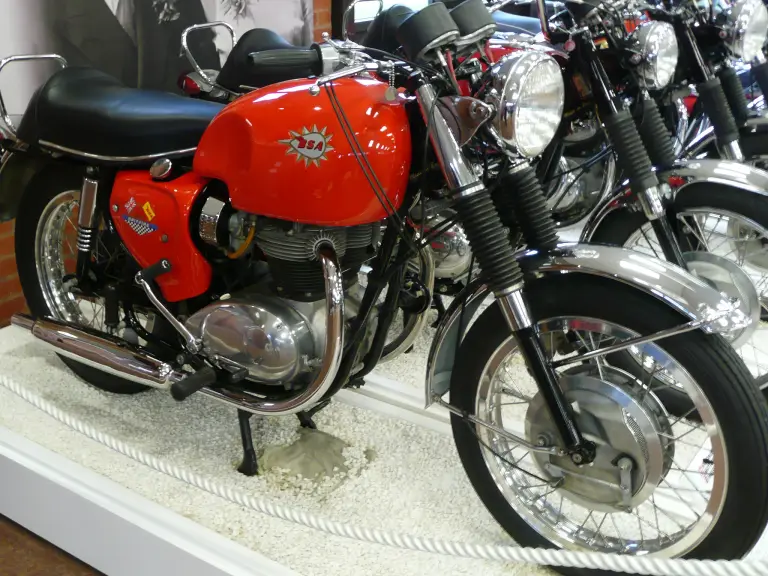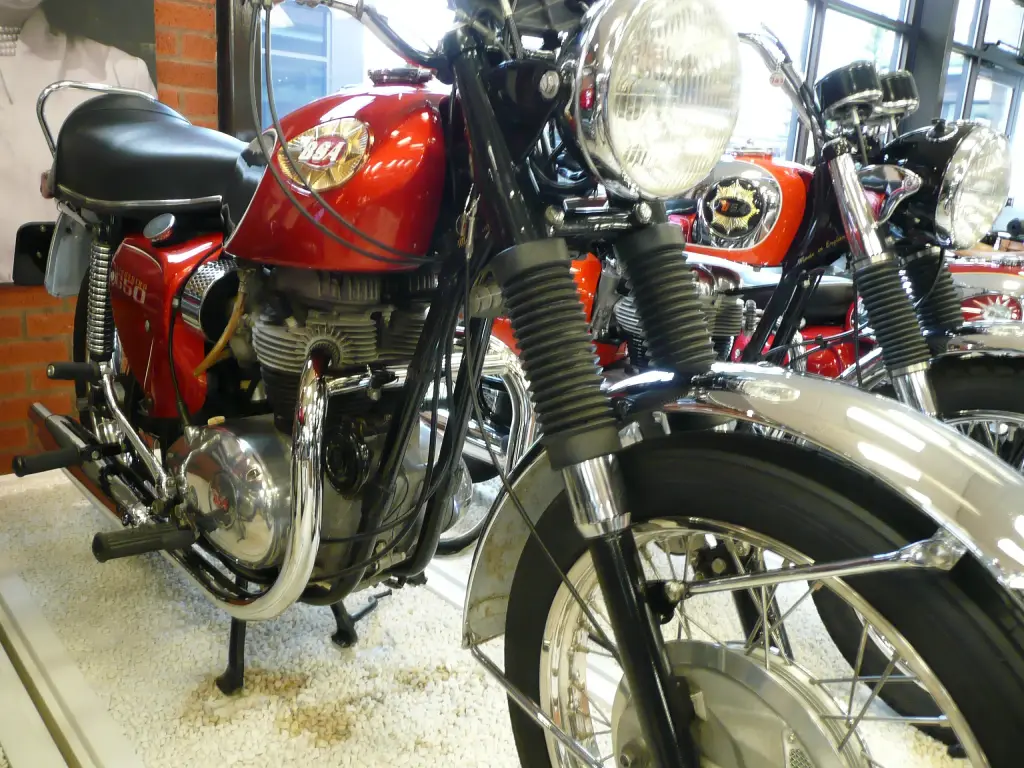
The BSA Lightning is a British 650 cc-class motorcycle made in Birmingham between 1965 and 1972. It was designed as the all-round sports machine of the 1960s, planned largely for export to the United States to complement the touring Thunderbolt and the later, more sporting Spitfire.
BSA Lightning at a glance
| Maker | Birmingham Small Arms Company, Birmingham |
|---|---|
| Production | 1965–1972 |
| Designation | A65L |
| Engine | 650 cc twin with two carburettors |
| Top speed | 108 mph |
| Camshaft | Spitfire grind high-lift from 1965 |
| 1969 update | balanced exhaust pipes, new silencer internals, twin leading shoe front brake |
| 750 cc version | A70L, 201 built in 1971 |
| Film appearance | James Bond, Thunderball, 1965 |
Based on one source, the English Wikipedia article on the Lightning.
History of the BSA Lightning
Development of the Lightning engine aimed at making it more reliable, quieter and less prone to oil leaks, with top speed sacrificed to improve mid-range and rideability. Even so, with twin carburettors the A65L could reach 108 mph. Improvements included an oil pressure warning light, though it had a tendency to malfunction and riders learned to ignore it. In 1964 the Rocket, the A65R, came standard with the Spitfire camshaft, and for 1965 every 650 had the Spitfire grind high-lift camshaft, which gave lively acceleration and performance at higher revs than the earlier A65. Some models came with a close-ratio gearbox, though bottom gear was a little high, so riders had to learn to slip the clutch up to 10 mph. Above 5,000 rpm customers complained of excessive vibration, with a tendency to weave above 90 mph.
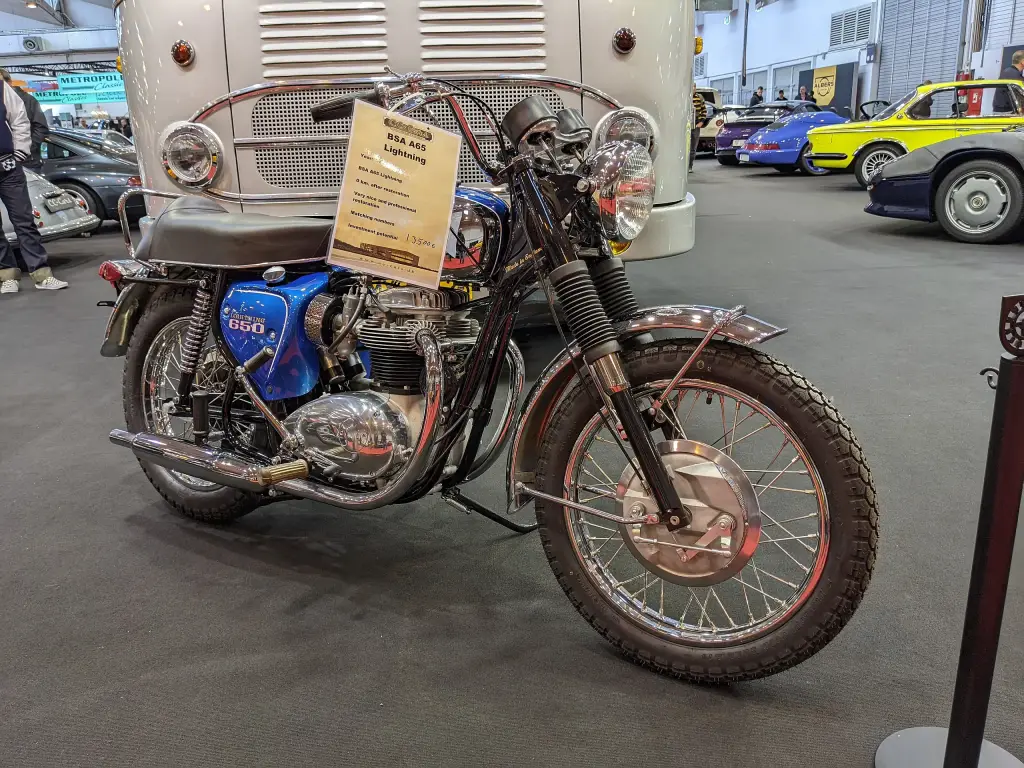
A useful detail was the emergency starting key position, which connected the alternator current straight to the ignition coils when the battery was flat.
From 1969 the Lightning changed to balanced exhaust pipes, redesigned silencer internals, widened crankcase-half mating faces and a twin leading shoe front brake. Testing it, Motorcycle Sport found the natural cruising speed to be 70 mph, but the machine was impossible to ride comfortably above 5,500 rpm in the higher gears because of severe vibration, with 6,200 revs repeatedly breaking the headlamp bulb filament, so no top-speed runs were attempted.
In 1971 BSA produced 201 750 cc versions, designated A70L, for American racing homologation. To make the 750 for AMA Class C racing, BSA lengthened the Lightning crankshaft stroke by 11 mm for 751 cc, and 202 A70 Lightnings were built to meet the minimum production requirement; all were exported to the United States, most to the East Coast distributor in Baltimore. That same year the BSA Group was in financial difficulty and, in a last attempt to extend the brand’s life, a new frame was developed for the A65L. It raised the seat height to an impractical 33 inches and broke during testing at the Motor Industry Research Association track, marking the end of one of the most successful ranges of British twin-cylinder motorcycles.
The Lightning also had a film career. A fully faired, gold-painted BSA Lightning fitted with missiles appeared in the 1965 James Bond film Thunderball, ridden by former road-race champion Bill Ivy as a stunt double, wearing a blonde wig to make him look like Bond girl Fiona Volpe, played by Luciana Paluzzi. Volpe used the machine to fire two rockets and destroy Count Lippe’s car as it chased Bond. A working missile launching system was fitted to the motorcycle, but the explosion was detonated remotely by stunt coordinator Bob Simmons, and the filming was recorded in a Ford Motor Company film, A Child’s Guide to Blowing Up a Motor Car, included on the Ultimate DVD edition of Thunderball. In September 1965 the actual bike was exhibited at a Brighton motorcycle show at the Metropole Hotel.
Design and features
- Twin-carburettor 650: the sporting all-rounder of the range, capable of 108 mph.
- Spitfire camshaft: standard across the 650s from 1965, giving strong performance at higher revs.
- Emergency start position: a key setting that fed the coils directly from the alternator when the battery was flat.
- 1969 update: balanced pipes, revised silencers, stronger crankcases and a twin leading shoe front brake.
BSA Lightning versions
- A65L Lightning (1965–1972): the standard 650 cc sports twin.
- A70L Lightning (1971): the 751 cc homologation special, 201 built for the United States.
- Close-ratio gearbox option: offered on some models, with a notably high bottom gear.
- 1971 frame prototype: a new frame that failed MIRA testing and ended the model.
The Lightning was one of the A65 family, alongside the Spitfire and the touring A50 Royal Star. More models are in the BSA collection.
Sources
- BSA Lightning, English Wikipedia: development, updates, A70, film