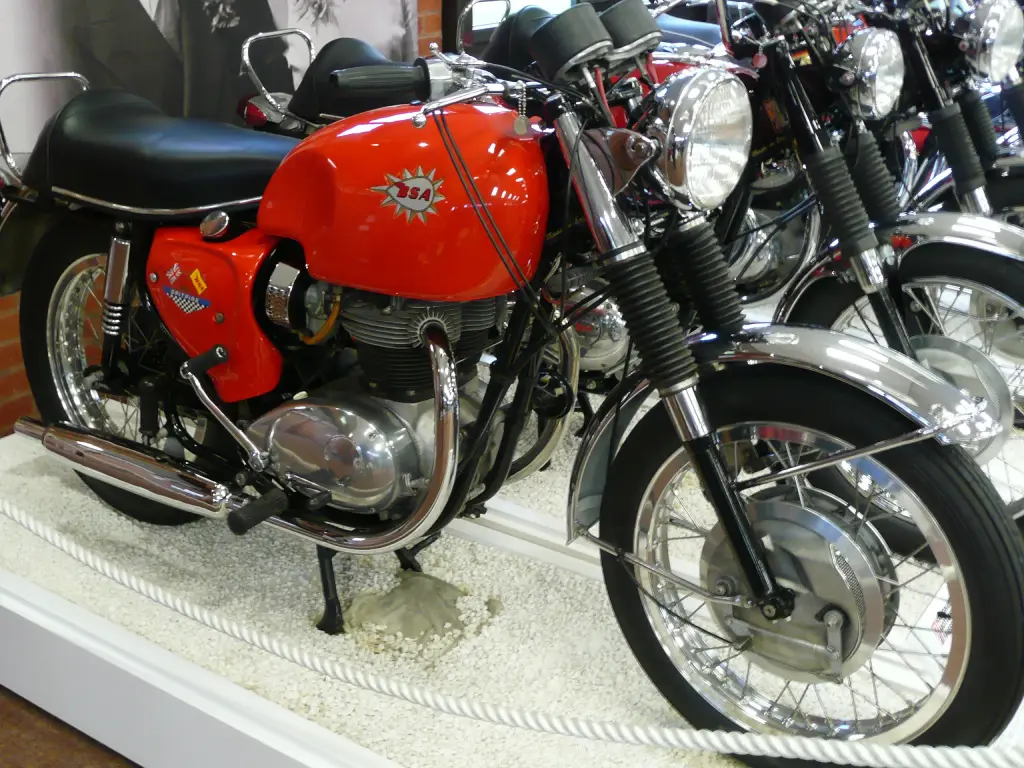
The BSA Spitfire is a high-performance BSA motorcycle made from 1966 to 1968 in MkII, MkIII and MkIV form. Announced at the Brighton show in September 1965, it was based on the earlier BSA Lightning, with power raised by 10.5:1 compression pistons and two large-bore Amal GP carburettors with velocity stacks, and it was one of the first BSAs with 12-volt electrics.
BSA Spitfire at a glance
| Maker | Birmingham Small Arms Company |
|---|---|
| Production | 1966–1968 |
| Models | MkII, MkIII, MkIV |
| Based on | BSA Lightning (A65) |
| Compression | 10.5:1 |
| Carburettors | two large-bore Amal GP with velocity stacks, then Amal Concentric |
| Top speed | 123 mph best run, 119.2 mph average (Motor Cycle) |
| Front brake | 190 mm drum |
| Weight | 174 kg |
| 1968 output | 53 bhp |
Based on one source, the English Wikipedia article on the Spitfire.
History of the BSA Spitfire
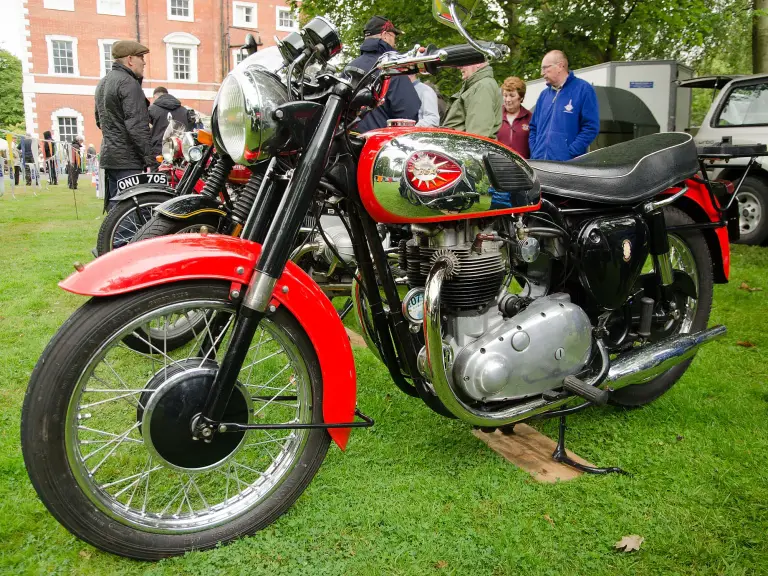
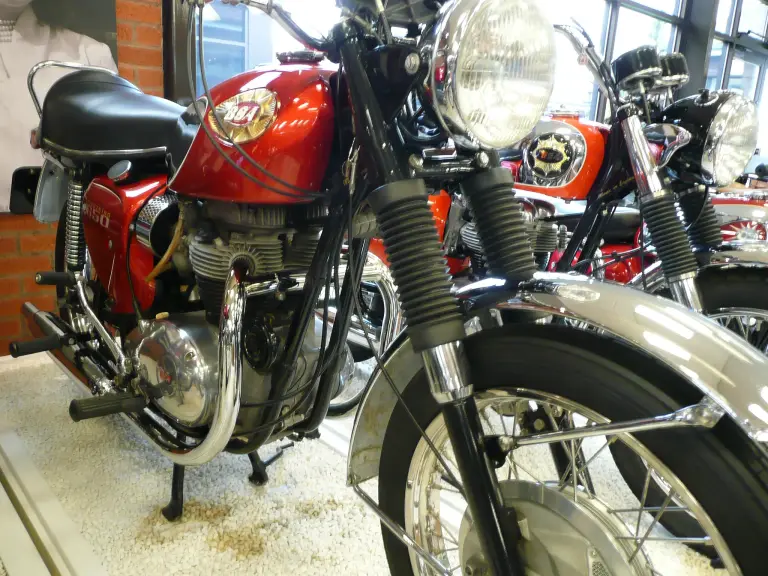
The first A65S Spitfire of 1966 was designated Mark II, the MKI Spitfires having been off-road machines of 1957 based on the A10 platform. It brought two-way damped front forks, Girling shock absorbers and a brace between the downswept exhaust pipes. A 190 mm front drum brake improved braking and lightweight alloy rims brought the weight down to 174 kg. It was supplied as a sports-tourer with a raised handlebar, forward-mounted rider footrests, a large dual seat with a race-styled hump and glass-fibre fuel tank and side panels in Peony Red covering the oil tank and tool compartment and the battery. The British Spitfire had a conventional four-gallon tank, with a five-gallon option from 1967.
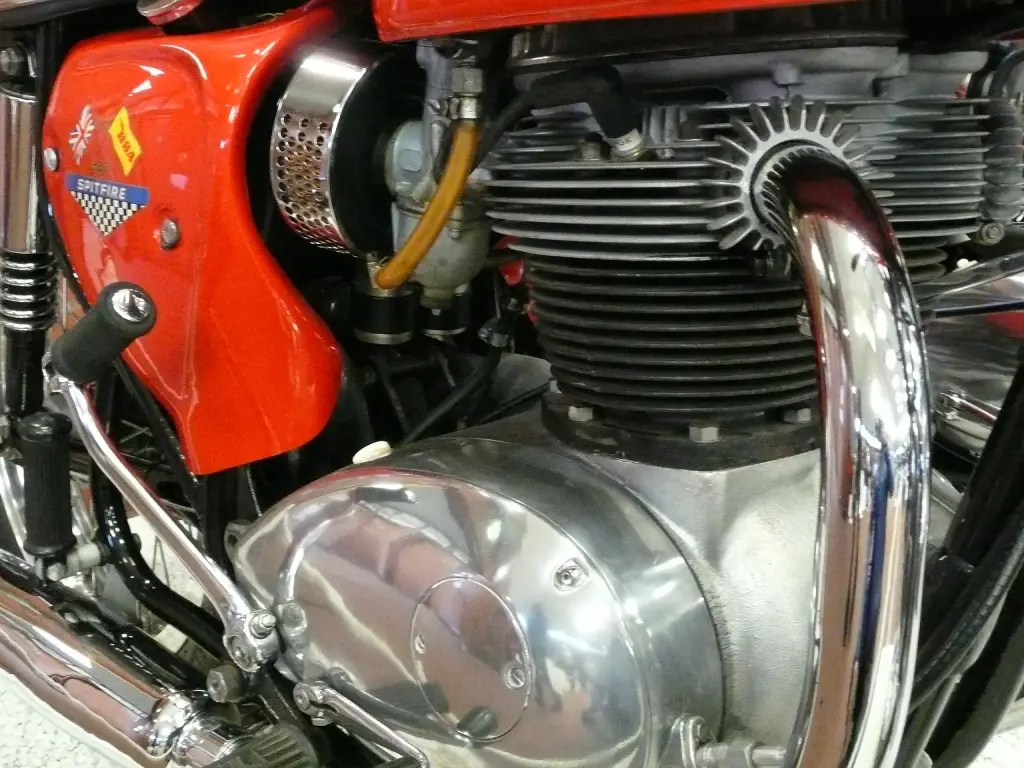
A selection of factory extras let the model go production racing, including a fairing and a single racing seat. The two large-bore Amal GP carburettors with velocity stacks improved acceleration but made the Spitfire hard to kick start when hot, so owners replaced them with Amal Concentrics and conventional round air filters, which became the factory specification in 1967. Keen to boost American sales, BSA also built a Spitfire with a two-gallon tank, following the trend set by the Harley-Davidson Sportster.
For the 1967 model year the Spitfire became the Mark III. The racing Amal GP carburettors with open bellmouths gave way to Amal Concentrics with individual chrome filters for better low-range response, and the fuel tank grew to five imperial gallons, which hampered access to the spark plugs and carburettors. British MkII and MkIII models carried the traditional BSA flash side-panel badges inset in the side cover gelcoat, while the export MkIII, the majority of Spitfires, had a transfer on the side covers similar to other 1967 machines. Other changes were Amal alloy control levers with click-stop cable adjusters, which BSA took over from Amal and sold under its Motoplas accessories brand, and a zener diode voltage regulator in an aluminium heat sink mounted high on the front frame tubes to catch the cooling airstream.
The 1968 Mark IV was the last of the Mark Spitfires, combining Amal Concentric carburettors with twin-leading-shoe front brakes and independently adjustable Lucas ignition points for easier starting and tuning, and engine output rose to 53 bhp. A total of 1,291 true 1968 model year Spitfires were produced, not counting the 478 hybrid 1968 Spitfires that carried 1967-style numbers and were dispatched between March and May 1968 near the end of the model year.
At its introduction in 1966 the Spitfire was the fastest standard BSA ever produced and the fastest standard motorcycle tested by Motor Cycle, with a best run at 123 mph and an average of 119.2 mph. The model was used for travelling marshals’ course duties at the 1967 Isle of Man TT.
Design and features
- High-compression A65: 10.5:1 pistons and two Amal GP carburettors gave the fastest standard BSA of its day.
- 12-volt electrics: one of the first BSAs to move up from six volts, with the zener diode regulator cooled in the airstream.
- Light and strong: alloy rims and a 190 mm front drum brake kept the weight at 174 kg.
- Race-ready extras: a fairing and single racing seat were available from the factory for production racing.
BSA Spitfire versions
- Spitfire Mark II (1966): the first A65S, with Amal GP carburettors, Peony Red glass-fibre bodywork and a four-gallon tank.
- US two-gallon Spitfire: a small-tank version aimed at Sportster buyers.
- Spitfire Mark III (1967): Amal Concentrics with chrome filters, a five-gallon tank and a heat-sinked zener diode.
- Spitfire Mark IV (1968): twin-leading-shoe front brake, adjustable ignition points and 53 bhp, in 1,291 true examples plus 478 hybrids.
The Spitfire was the fastest of the A65 family, developed from the Lightning. More models are in the BSA collection.
Video: 1966 BSA A65 Mk2 CLUBMAN SPITFIRE SPECIAL カフェレーサー BSA
Video by YouTube on YouTube.
Sources
- BSA Spitfire, English Wikipedia: MkII, MkIII and MkIV development, performance