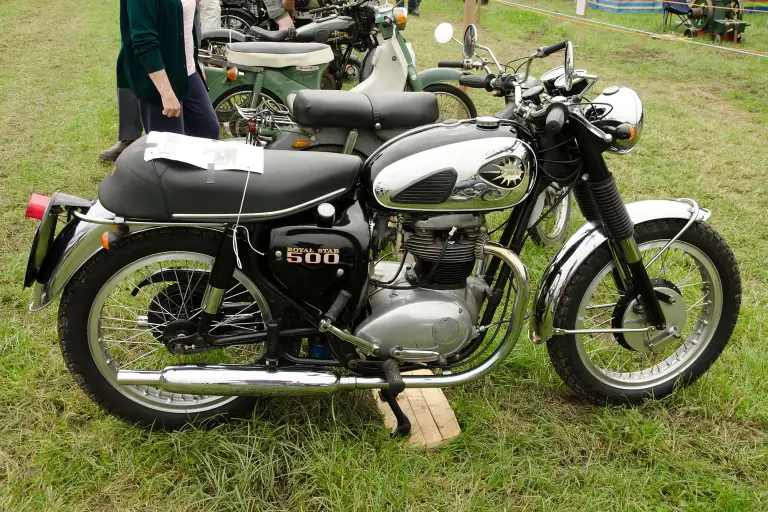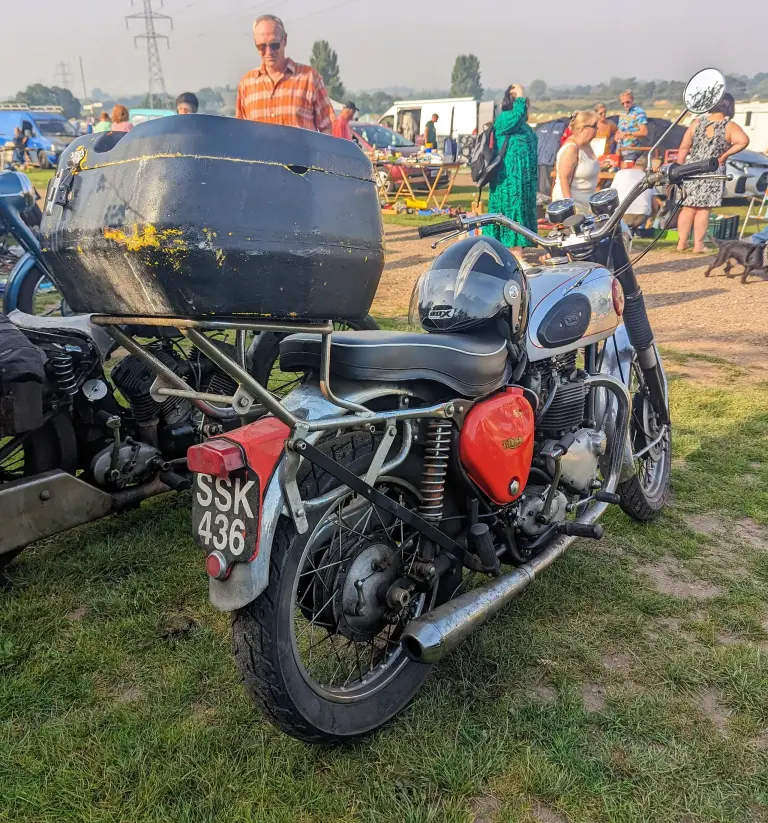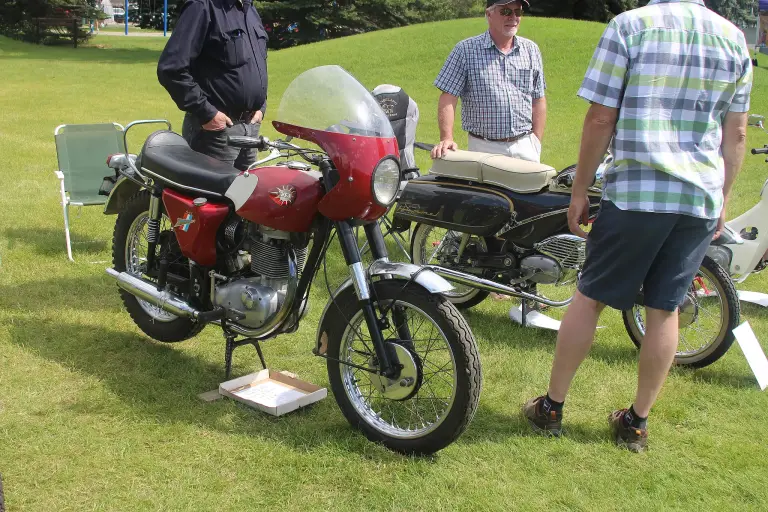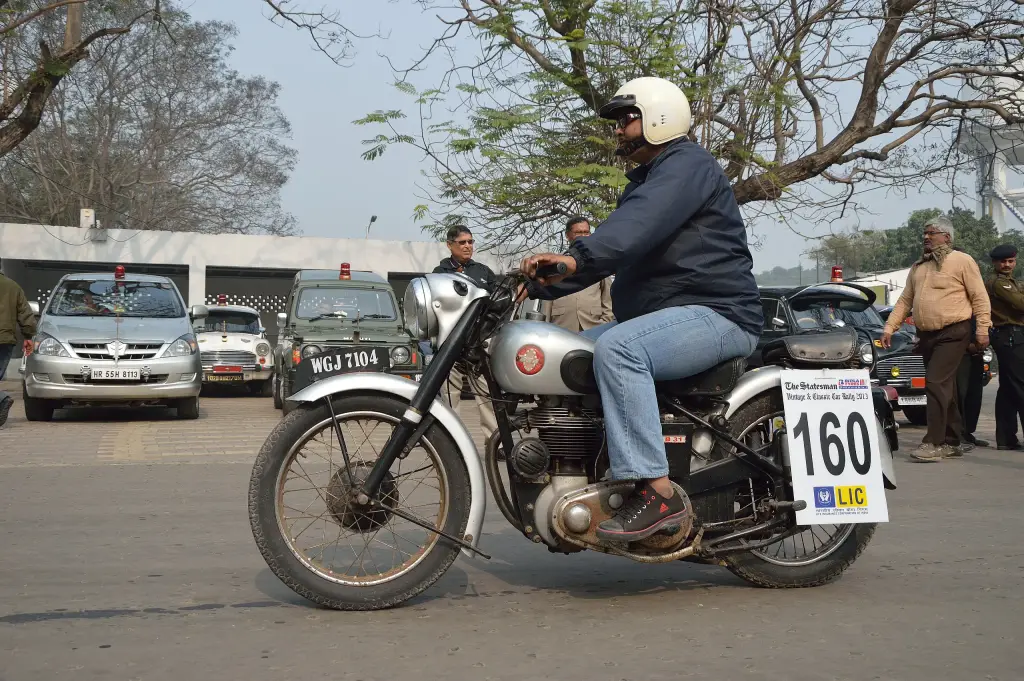
The BSA B31 is a 350 cc pre-unit single-cylinder OHV four-stroke motorcycle made by Birmingham Small Arms at its factory in Armoury Road, Small Heath, Birmingham. It was the first new motorcycle introduced by BSA after the Second World War and was produced from 1945 to 1959.
BSA B31 at a glance
| Maker | Birmingham Small Arms Company, Armoury Road, Small Heath |
|---|---|
| Production | August 1945 – September 1959 |
| Engine | 348 cc pre-unit single-cylinder OHV four-stroke |
| Frame at launch | single downtube rigid |
| Forks | telescopic, new for BSA |
| Plunger frame | optional from 1949, dropped at the end of 1955 |
| Swinging arm | offered from 1954 for £12, standard from 1955 |
| Electrics | Lucas magdyno until 1958, then alternator and coil ignition |
| Related models | B32 competition version, B33 500 cc |
Based on one source, the English Wikipedia article on the B31.
History of the BSA B31
The B31 has its origins in the 1937 Silver Star, designed by Val Page. A revised version, the B29, which used an M-series bottom end with a cast-iron OHV top end, went into production in late 1939, but few were made before civilian motorcycle production stopped and military machines took over. A version of the B29 was offered to the army as the B30; although the army ordered the B30, the order was later changed to the side-valve M20. Development of the B30 went on through the war years with Joe Craig and Edward Turner, the latter redesigning the cylinder head to use conventional coil valve springs instead of the original hairpin springs.
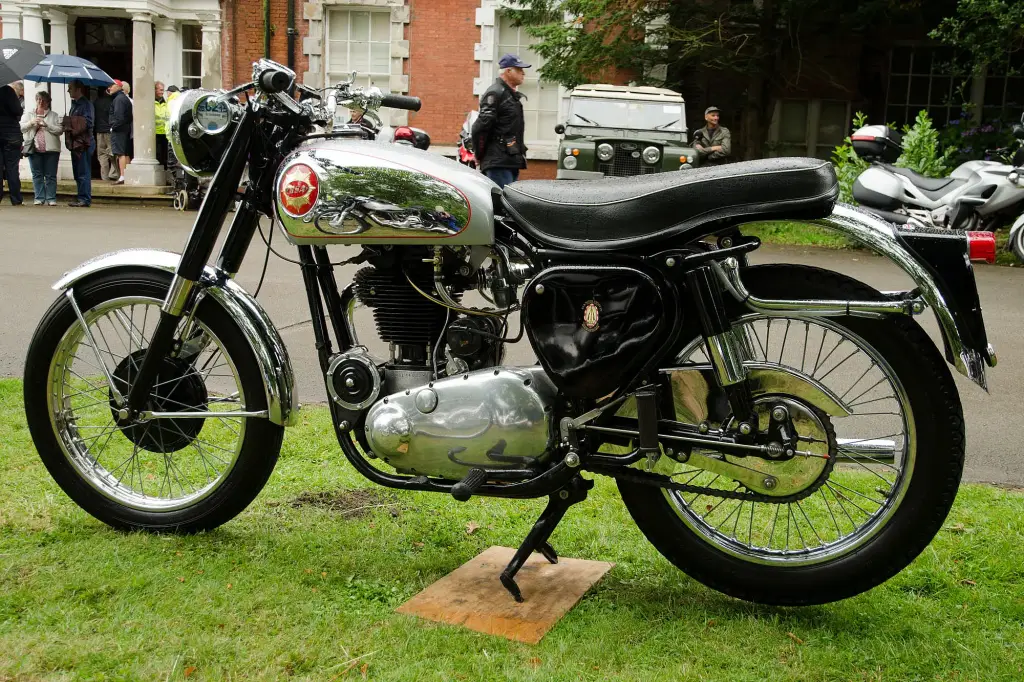
When hostilities ended and civilian production resumed, the 350 single appeared in August 1945 as the B31. The machines had a single downtube rigid frame and, new for BSA, telescopic forks. The speedometer was mounted in the petrol tank, and it moved to the top of the forks in 1948.
Early in 1946 a competition version, the B32, was announced, with lighter chrome mudguards, a high-level exhaust and lower gearing. The following year a 500 cc version, the B33, arrived with the bore increased from 71 mm to 85 mm.
A more substantial frame was introduced in 1949, with a plunger frame offered as an option, and in 1951 a dualseat became standard. In 1954 a swinging-arm frame was offered for an extra £12; the all-welded frame was of the same type used on the Gold Star and the A-series twins, and the gearbox from the A-series twin was fitted too. The rigid frame was discontinued in 1954, and the following year the swinging arm became standard along with a dualseat. The plunger frame was dropped at the end of 1955.
Full-width Ariel hubs arrived in 1956 together with a quickly detachable rear wheel, and Triumph brakes were fitted in 1958. The electrics changed in 1958, with an alternator and coil ignition replacing the Lucas magdyno, which meant moving the transmission shock absorber from the end of the crankshaft to the centre of the clutch. Production of the B31 ended in September 1959.
Design and features
- First post-war BSA: the 350 single that reopened civilian production in August 1945.
- Telescopic forks: a first for BSA, matched to the traditional single downtube rigid frame.
- Steady modernisation: plunger and swinging-arm suspension, full-width hubs and a quickly detachable rear wheel arrived through the 1950s.
- Alternator electrics: the 1958 switch from magdyno to alternator and coil ignition was the last big change before the end.
BSA B31 versions
- B31 (1945–1959): the standard 350 single, rigid, plunger or swinging arm.
- B32 (1946): competition version with chrome mudguards, high-level exhaust and lower gearing.
- B33 (1947): the 500 cc derivative with the bore taken out to 85 mm.
The B31 was the 350 cc stablemate of the M20 that the army chose instead of the B30, and it shared its frame type with the Gold Star and the A10 twins. More models are in the BSA collection.
Video: BSA B31 (1951)
Video by Phinkin Furmiself on YouTube.
Sources
- BSA B31, English Wikipedia: origins, models, development