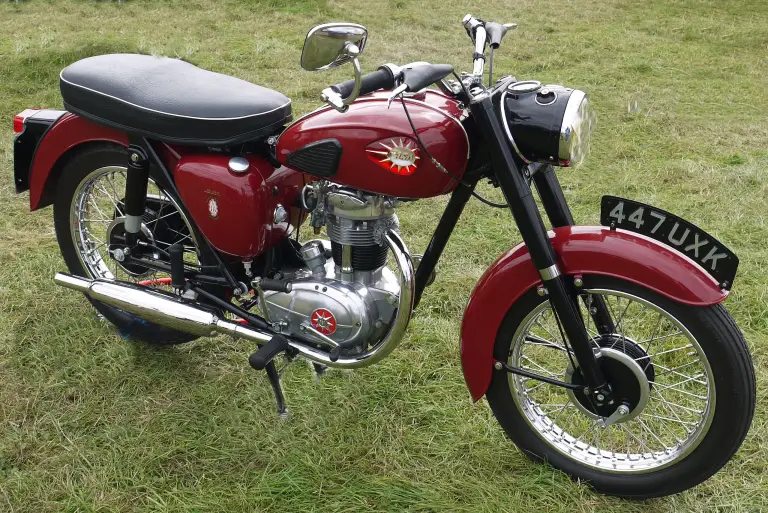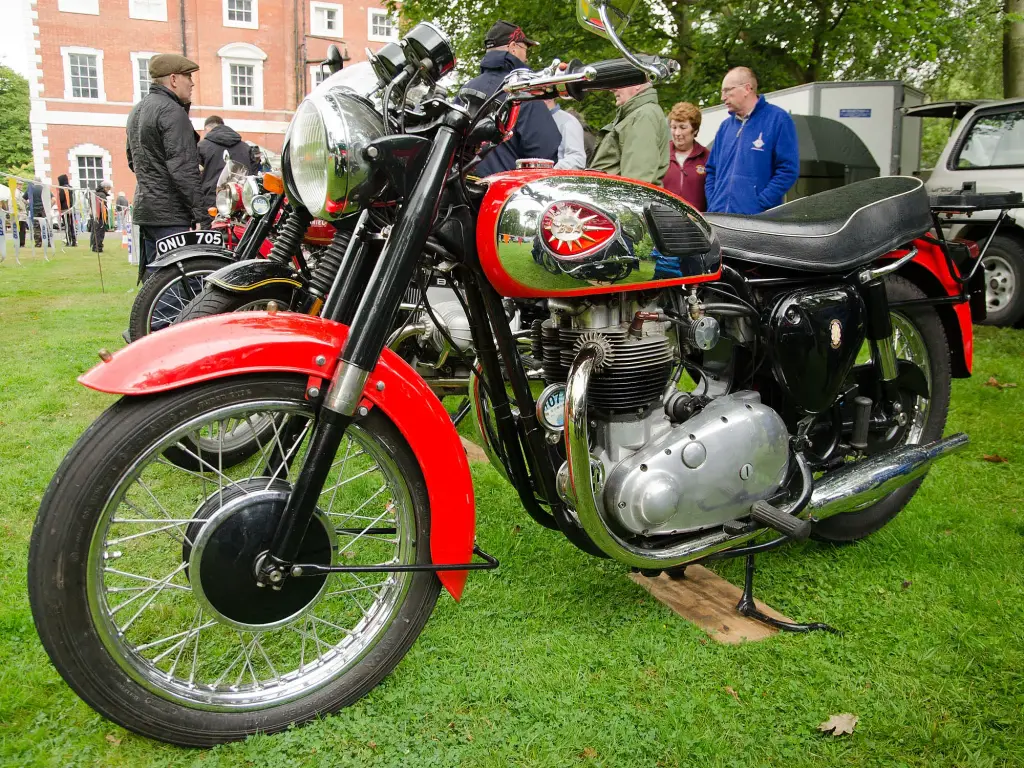
The BSA Golden Flash, commonly misnamed the Gold Flash, was a 646 cc air-cooled parallel twin designed by Bert Hopwood and produced by Birmingham Small Arms at Small Heath, Birmingham. It was the first model in the BSA A10 series, available in black and chrome but named for the distinctive golden paint scheme.
BSA Golden Flash at a glance
| Maker | Birmingham Small Arms Company, Small Heath |
|---|---|
| Launched | October 1949, for the 1950 season |
| Production until | 1963 |
| Designer | Bert Hopwood |
| Engine | 646 cc air-cooled parallel twin |
| Carburettor | single Amal; 389 Monobloc of 1 1/8 inch from 1960 |
| Frame | rigid or plunger at first, swinging arm from 1954 |
| Performance | over 100 mph; standing quarter mile under 16 seconds in 1950 |
| Export share | 80 per cent of production to the United States |
| Successor | BSA A65 Star |
Based on one source, the English Wikipedia article on the Golden Flash. The A10 series article covers the same model and is used only for cross-checking.
History of the BSA Golden Flash
Bert Hopwood served his apprenticeship under Val Page at Ariel and moved to Triumph in 1936, where he worked under Edward Turner on the 1937 Speed Twin, the machine that became the model for the parallel twin in British motorcycling. In April 1947 he joined Norton to design the Dominator engine, and in May 1948 BSA lured him away after only a year at Norton and commissioned a competitive parallel twin. BSA was then the largest British motorcycle maker but was falling behind in the twin race; it had the A7, and it needed to develop it to stay competitive.
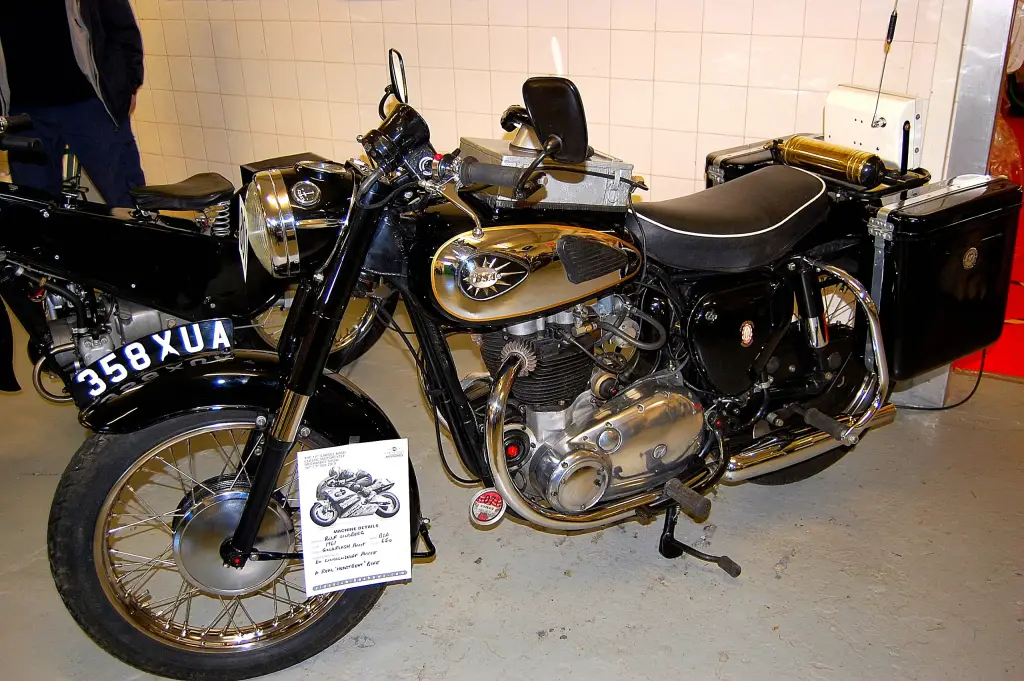
Hopwood’s A10 Golden Flash was launched in October 1949 and drew heavily on Val Page’s and Bert Perkins’ A7 design. Capacity went up to 646 cc with a revised alloy rocker box and a cast-iron cylinder head, plus an integral manifold for the single Amal carburettor. A semi-unit gearbox let the primary chain be adjusted by a slipper tensioner inside the primary chain case. The frame could be had rigid at the rear, but the more common choice was plunger suspension, adopted for the export market, and the A10 had a hinged rear mudguard to make wheel removal easier. Because the A10 was so closely based on the A7, using many of its well-proven components, the carry-over promised greater reliability with little risk of new technical trouble.
The Golden Flash was launched in a new gold colour, and 80 per cent of production went to the United States, which left British customers waiting and able to buy the model only in black. Although it was never designed as a sports machine, it was fast for its time and competitive with the Triumph Tiger 100, reaching over 100 mph in tests in 1950 and covering the standing quarter mile in under 16 seconds. The gold paint proved a marketing success and the model outsold Triumph’s Speed Twin and 6T Thunderbird.
BSA was worried that wear in the plunger suspension led to uncertain handling, so in 1954 the factory adopted a swinging arm and deleted the hinged mudguard. In what looks like a backward step, the semi-unit gearbox was dropped for a separate pre-unit item with a different primary chain adjustment, a modified clutch and new gearbox internals. A tuned Super Flash was sold in the United States in 1963 and 1964, built to American requests for more power with competition department parts while the sports Road Rocket was being developed. An improved four-spring clutch with better friction material replaced the six-spring item in 1957.
For reliability the Golden Flash was upgraded in 1958 to the thick-flange cylinders, with the base flange increased from 3/8 to 1/2 inch, and the larger big ends first used on the Road Rocket. For 1960 it received the 356 sports camshaft and a larger 389 Monobloc carburettor of 1 1/8 inch bore, and in the United States it was renamed the Royal Tourist. An alternator was offered as an alternative to the dynamo from 1961 to 1963, the last three years of production. When Lucas switched from magneto and dynamo systems to alternators and coils in the late 1950s, British makers had to redesign their engines, and with the arrival of the unit-construction A50 and A65 the A7 and A10 were discontinued in 1963. In the British television series Heartbeat a BSA Golden Flash appears as the police motorcycle, having replaced a Francis Barnett Falcon F150.
Design and features
- Gold paint: the colour that gave the model its name and helped it outsell the Triumph Speed Twin and Thunderbird.
- Hopwood’s 650 twin: a 646 cc engine built on A7 foundations, good for over 100 mph in 1950.
- American favourite: four fifths of production crossed the Atlantic, leaving British buyers with black machines and long waits.
- Steady updates: thick-flange cylinders in 1958, a sports cam and bigger carburettor in 1960, an alternator option from 1961.
BSA Golden Flash versions
- Golden Flash (1950–1963): the standard model, rigid or plunger at first and swinging arm from 1954.
- Super Flash (1963–1964): a tuned US-market version built with competition department parts.
- Royal Tourist (1960): the name the 1960 model took in the United States.
- Late models (1961–1963): with an alternator offered as an alternative to the dynamo.
The Golden Flash was the first of the A10 series and grew out of the A7; it was replaced by the unit-construction A65. More models are in the BSA collection.
Video: BSA ‘Golden Flash’ 1956 Twin 650cc
Video by hoxtonmoto on YouTube.
Sources
- BSA Golden Flash, English Wikipedia: development, production, updates