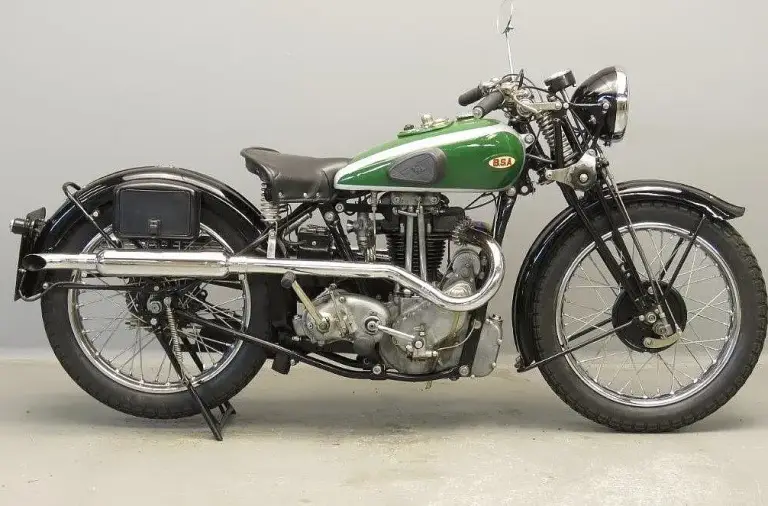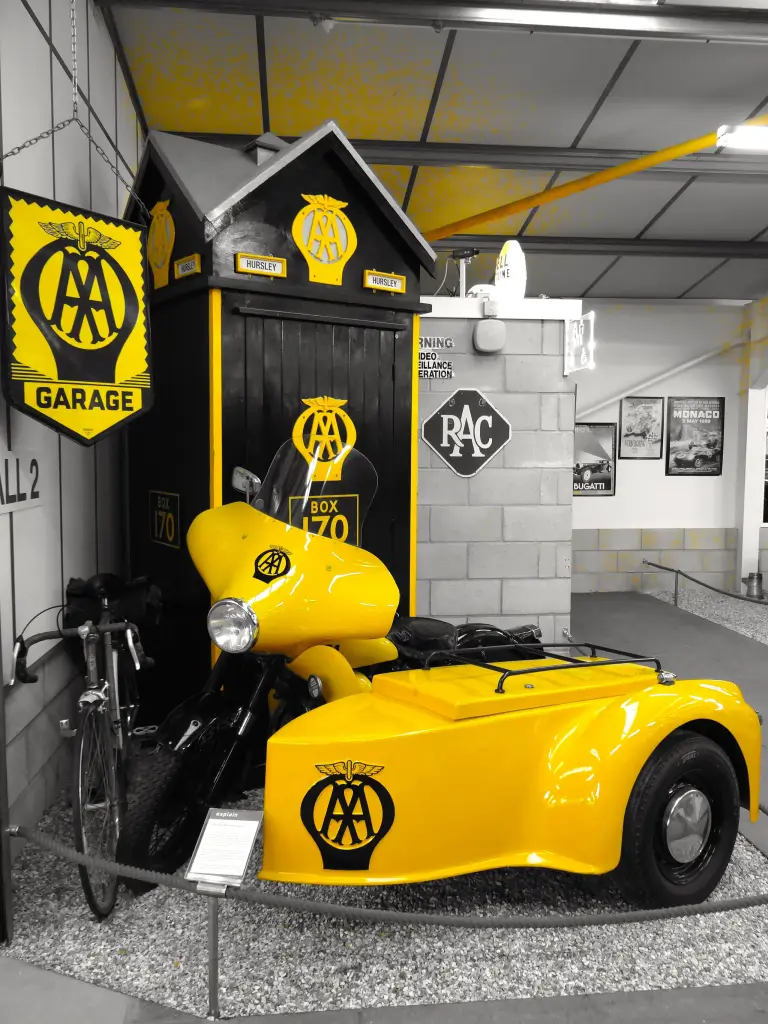
The BSA M21 is a 600 cc single-cylinder side-valve motorcycle manufactured by BSA at Small Heath, Birmingham. It was frequently fitted with a sidecar, and the Royal Dutch Touring Club and the British AA used it for roadside assistance.
BSA M21 at a glance
| Maker | Birmingham Small Arms Company, Small Heath |
|---|---|
| Introduced | 1937 |
| Engine | 600 cc side-valve single |
| Bore × stroke | 85 mm × 105 mm, then 82 mm × 112 mm from 1938 |
| Gearbox | hand change at first, foot change from 1939 |
| Telescopic forks | from 1948 |
| Alloy head | from 1951 |
| Carburettor | Amal Monobloc from 1955 |
| Front brake | 8 inch from 1956 |
| Catalogue life | dropped in 1958, available to special order until 1963 |
Based on one source, the English Wikipedia article on the M21.
History of the BSA M21
In 1936 BSA decided its range needed a revamp to make the most of the improving world economy, and hired Val Page to update it. Page scrapped everything except the V-twins and designed a completely new range of singles, with dry-sump engines, the magdyno behind the cylinder and frames made entirely of tubes instead of the cast backbone used before. Lightweights took a B prefix, heavyweights an M.
The M21 arrived in 1937 as a 600 cc side-valve tourer with an 85 mm by 105 mm bore and stroke. In 1938 the bore came down to 82 mm, the same as the M20, and the stroke went up to 112 mm. It began with a hand gear change, which became a foot change in 1939.
After the outbreak of the Second World War the War Department took every machine BSA could produce, the M21 included. In 1940 BSA concentrated on the M20 for military use and suspended the other models. M21 production resumed in 1946, telescopic forks arrived in 1948 with longer travel that required modifying the frame down tube so the mudguard would not hit the frame, and a revised gearbox followed in 1949.
Side-valve engines tend to run hot, so in 1951 an alloy head was fitted to keep temperatures down, and a frame with plunger rear suspension became an option in the same year. An Amal Monobloc carburettor came in 1955 and a larger 8-inch front brake the following year. The model was dropped from the BSA catalogue in 1958 but remained available to special order until 1963.
Many M21s worked with sidecars. The Royal Dutch Touring Club, the ANWB, ran a fleet with sidecars carrying spares and tools for roadside assistance and breakdowns, and the British AA used a fleet of M21 combinations in the 1950s and 1960s. From 1961 the AA machines had a crankshaft-driven alternator in addition to the dynamo, and the AA combinations were replaced by vans in 1968.
Design and features
- Sidecar engine: 600 cc of side-valve torque, well suited to hauling a chair.
- Val Page’s 1937 range: dry-sump lubrication, magdyno behind the cylinder and an all-tube frame.
- Long development: foot change, telescopic forks, an alloy head and better brakes arrived through the 1940s and 1950s.
- Roadside assistance fleets: sidecar outfits full of spares served AA members and Dutch motorists.
BSA M21 versions
- M21 (1937): 600 cc side-valve tourer with 85 mm by 105 mm bore and stroke and hand gear change.
- M21 (1938–1939): 82 mm by 112 mm engine and a foot gear change.
- Post-war M21 (1946 onwards): telescopic forks from 1948, revised gearbox from 1949, alloy head and plunger option from 1951.
- Late M21 (1955–1963): Monobloc carburettor, 8-inch front brake, special order only after 1958.
- AA combinations: sidecar outfits with spares and tools, with an alternator added from 1961.
The M21 shared its M-series background with the M20 and the M22. More models are in the BSA collection.
Video: bsa m21 1950 very very cold start
Video by YouTube on YouTube.
Sources
- BSA M21, English Wikipedia: history, updates, roadside assistance fleets