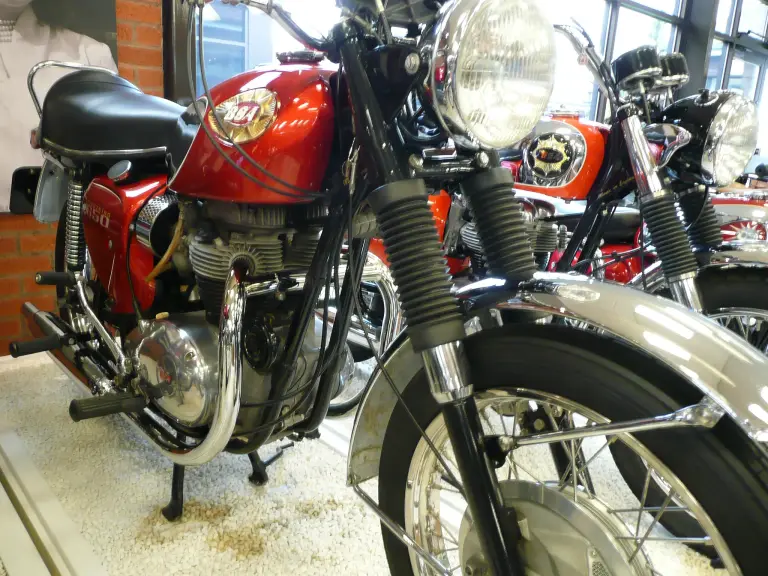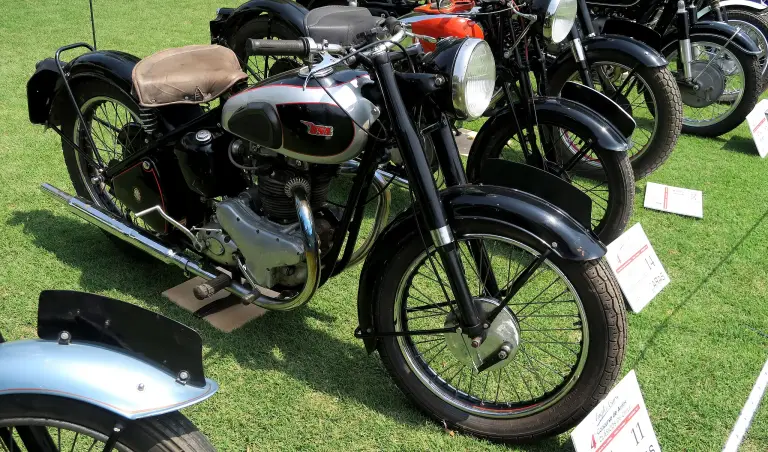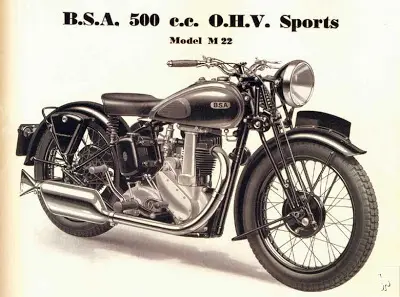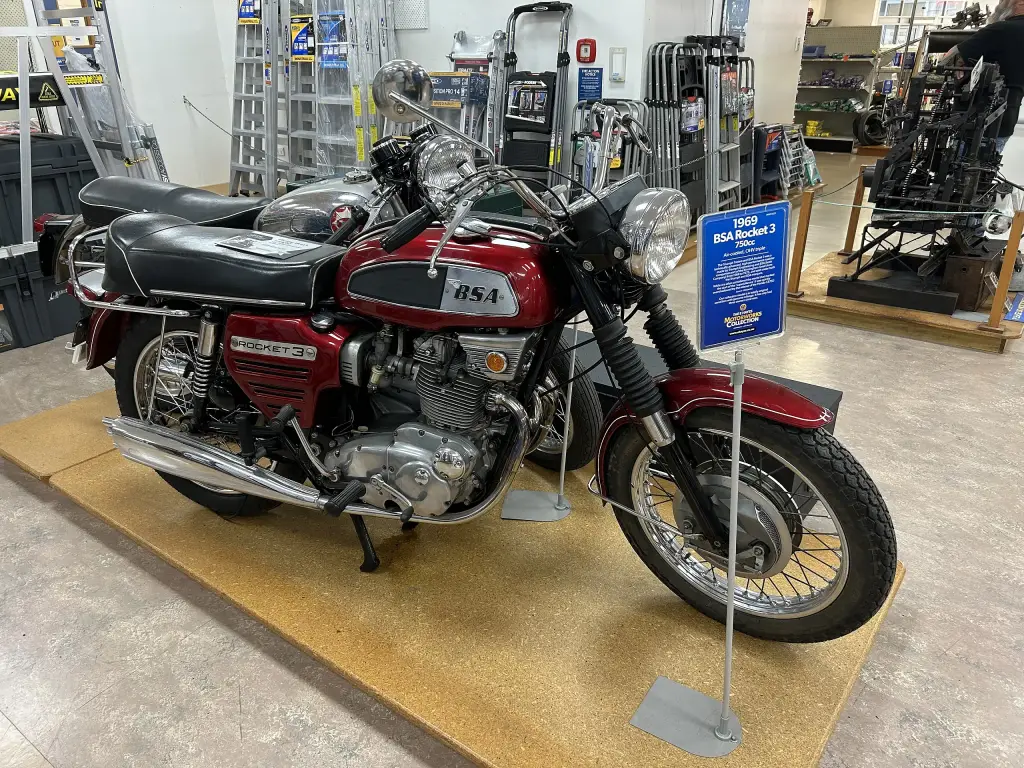
The BSA Rocket 3 and the Triumph Trident were technically advanced, high-performance roadsters made by Triumph Engineering and BSA — both part of the Birmingham Small Arms Company — from 1968 to 1975 and sold under both marques. Alongside the Honda CB750 and later the Kawasaki triples, they brought a new level of sophistication to street motorcycles and marked the beginning of the superbike era.
BSA Rocket 3 at a glance
| Maker | Birmingham Small Arms Company, Small Heath |
|---|---|
| Production | 1968–1975 |
| Engine | 740 cc air-cooled overhead-valve straight three, unit construction |
| Power | 58 bhp |
| Gearbox | four speeds; five from 1971 (A75RV) |
| Clutch | dry single-plate, in the housing between primary chaincase and gearbox |
| Crankshaft | crankpins offset 120 degrees |
| Frame | A65-style double-loop cradle, engine mounted at a slant |
| Combined production | 27,480 Rocket 3s and Tridents |
| Five-speed Rocket 3s | about 205 |
Based on one source, the English Wikipedia article on the Rocket 3 and Trident. The old record’s video is about the Rocket Gold Star, a different model, so no video is embedded.
History of the BSA Rocket 3
The Triumph Trident was designed by Bert Hopwood and Doug Hele, and its three-cylinder design grew out of Triumph’s 1959 5TA unit-construction 500 cc parallel twin, which itself descended from Edward Turner’s 1937 Speed Twin. Following Triumph practice, the pushrod overhead-valve engine had separate camshafts for inlet and exhaust valves. The prototype was ready by 1965, but the factory delayed for years over a cosmetic redesign, so the launch was overshadowed by the visually more modern and technologically superior Honda CB750 of 1969.
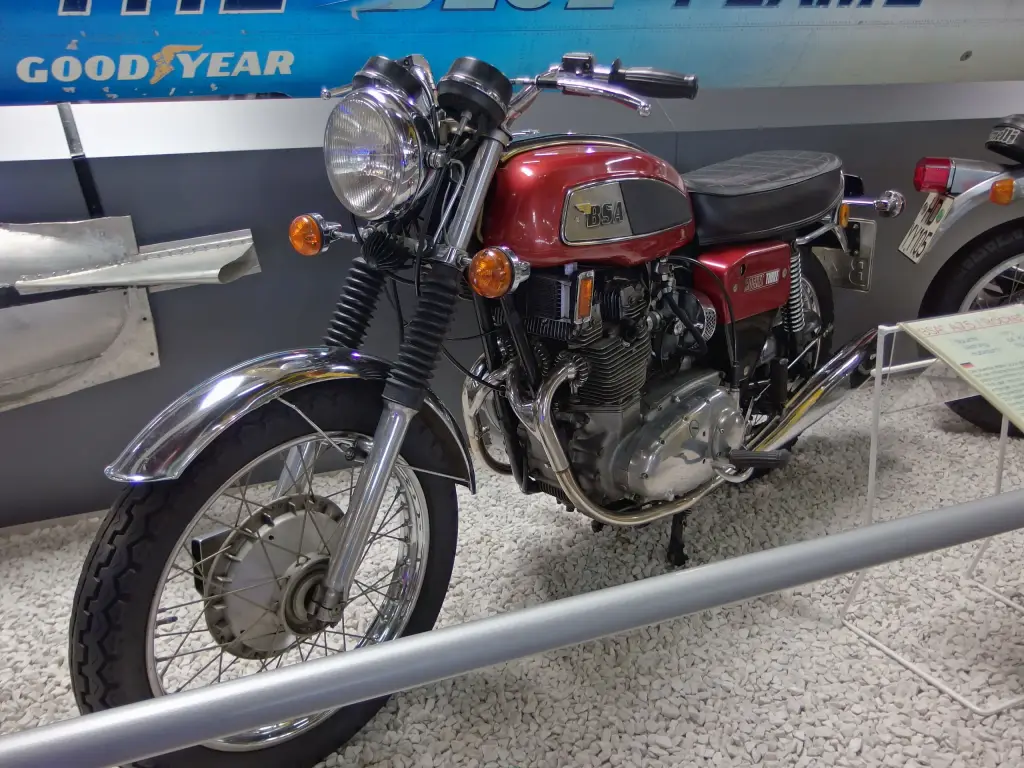
Unlike the CB750 and other Japanese superbikes with horizontally split crankcases, the triple engine was essentially a vertically split parallel twin with a separate central chamber for the third cylinder. Where the Speed Twin was a traditional British twin with a 360-degree crankshaft, the new triple had crankpins offset 120 degrees, giving much smoother primary balance, though with a rocking couple. Most British motorcycles used a wet multiplate clutch, but this triple had a dry single-plate clutch in a housing between the primary chaincase and the gearbox, and a large transmission shock absorber was mounted on the end of the gearbox mainshaft.
Test engineers developed the chassis by fixing lead weights on a standard 650 Bonneville. The first prototype, P1, was running by 1965 and it looked as though Triumph might have a production machine by 1967, but the decision to build a BSA version with sloping cylinders and to employ Ogle Design for the early Tridents and Rocket 3s, with their square tank, added bulk and 40 lb of weight and delayed production by 18 months. A P2 prototype of 1966 had a more production-based Trident engine with different bore and stroke and improved cooling; Hele got 90 bhp from a Trident engine, which led to speculation about a 140 mph British superbike.
All the three-cylinder engines and the Rocket 3 motorcycles were built at BSA’s Small Heath site, while final assembly of the Triumph Trident took place at Meriden in Coventry. The main differences were the engine and frame: the BSA had an A65-style double-loop cradle frame with the engine mounted at a slant, the Triumph a Bonneville-style single downtube frame with vertical cylinders, and the rest was cosmetic. Although the badges read Rocket 3, BSA styled the name as Rocket III in its own advertising. Triumphs sold better in the United States despite BSA’s Daytona racing successes in the early 1970s.
Sales did not meet expectations. For 1971 a fifth gear was added, creating the BSA A75RV and Triumph T150V, but BSA was in financial difficulty and only about 205 five-speed Rocket 3s were built before the BSA variant ended; the five-speed Triumph T150V, with a front disc brake instead of the drum, continued to 1974. For 1975 the Trident became the T160, with electric starting, disc brakes front and rear, a left-foot gear change and a forward-slanted cylinder block for better weight distribution and more room for ancillaries behind the engine.
The Rocket 3 and Trident were introduced in the summer of 1968 to critical acclaim but were eclipsed four weeks later by the Honda CB750, which offered a five-speed gearbox, overhead camshaft, oil-tight engine, electric start and a disc brake. Honda outsold the Triumph in America, and in 1970 Triumph restyled export versions with a classic look to revive sales. American BSA-Triumph management thought the $1,800 price too high and the vertically split crankcases and pushrod valve train too conventional, though they accepted that the bike was fast: the US sales team launched it by setting speed records at Daytona, which stood until the Kawasaki Z1 broke them in 1971. Cycle World recorded a top speed of 117.03 mph.
Design and features
- 120-degree triple: far smoother primary balance than the 360-degree twins the Rocket 3 replaced.
- Dry single-plate clutch: an unusual layout for a British motorcycle, with the clutch between primary chaincase and gearbox.
- Slanted engine: the BSA version sat its cylinders at a slant in an A65-style double-loop cradle frame.
- Record-setting debut: launched in the United States with speed records at Daytona, which lasted until 1971.
BSA Rocket 3 versions
- BSA Rocket 3 (1968–1975): the four-speed Small Heath-built triple with slanted cylinders.
- Rocket III: BSA’s own printed styling of the name.
- A75RV (1971): the five-speed Rocket 3, of which about 205 were built.
- Triumph Trident and T150V: the Meriden-assembled sister models, the T150V with a five-speed gearbox and front disc brake.
- Triumph T160 (1975): electric start, disc brakes front and rear and a left-foot gear change.
The Rocket 3 was the triple that sat above the A65 twins, sharing its frame style with them, and it was developed alongside the Lightning and Spitfire. More models are in the BSA collection.
Sources
- BSA Rocket 3/Triumph Trident, English Wikipedia: development, engine, models, reception