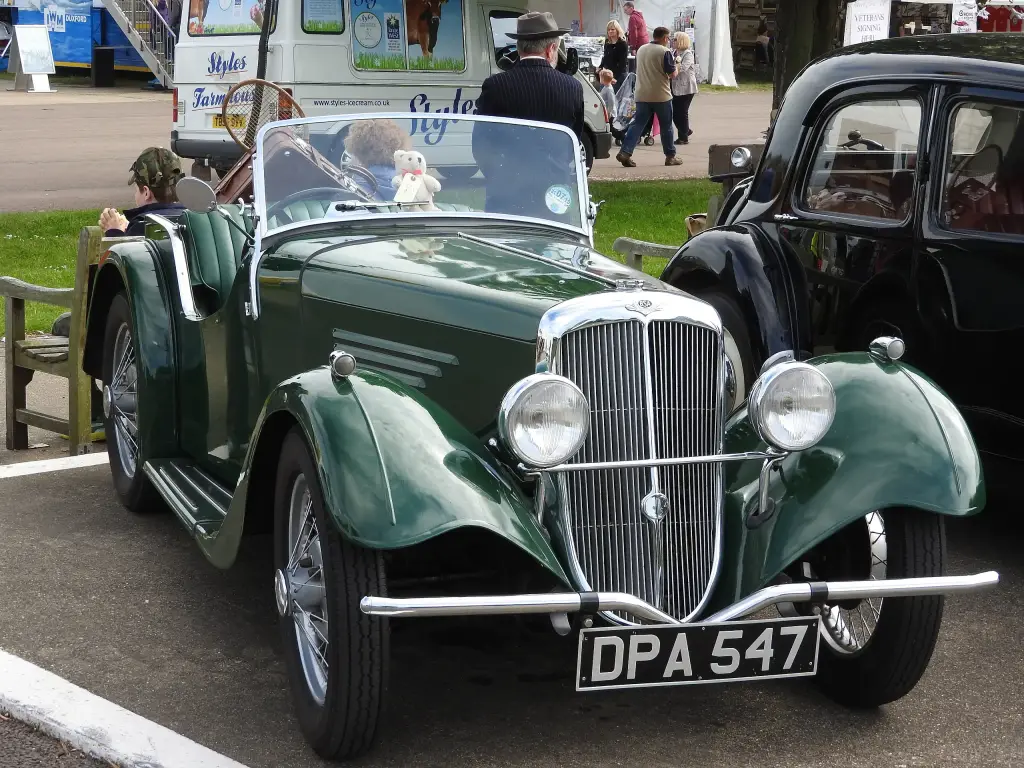
The BSA Scout is a small open two-seater front-wheel-drive car, manufactured and sold by subsidiaries of The Birmingham Small Arms Company and launched at the beginning of April 1935. Because of its front-wheel drive and low centre of gravity it was said to be remarkably stable, taking corners in safety that would be impossible with a normal design.
BSA Scout at a glance
| Maker | The Birmingham Small Arms Company, through its subsidiaries |
|---|---|
| Launched | April 1935 |
| Layout | front-wheel drive, front-mounted engine and gearbox |
| Engine | four-cylinder, 1,075 cc, 9 RAC horsepower |
| Gearbox | three forward speeds and reverse, centrally controlled |
| Clutch | multi-plate, two light alloy discs with cork inserts, running in oil |
| Front suspension | eight quarter-elliptic springs, four to each wheel |
| Rear suspension | half-elliptical springs to a beam axle |
| Body | ash frame panelled in aluminium, leather upholstery |
| Price at launch | £149 10s for the open two-seater |
Based on one source, the English Wikipedia article on the Scout.
History of the BSA Scout
The Scout was built to extend BSA’s reputation for sound design, robust construction and complete reliability into the small open car market for young motorists. At the front of the car sat the engine, clutch, gearbox and a short stiff propeller shaft to the worm-and-spur driven differential and front wheel brake, all flexibly mounted as one unit but in reverse of the usual order, with the differential at the very front. The four-cylinder 1,075 cc engine and transmission had powered thousands of BSA three-wheelers over the previous five years.
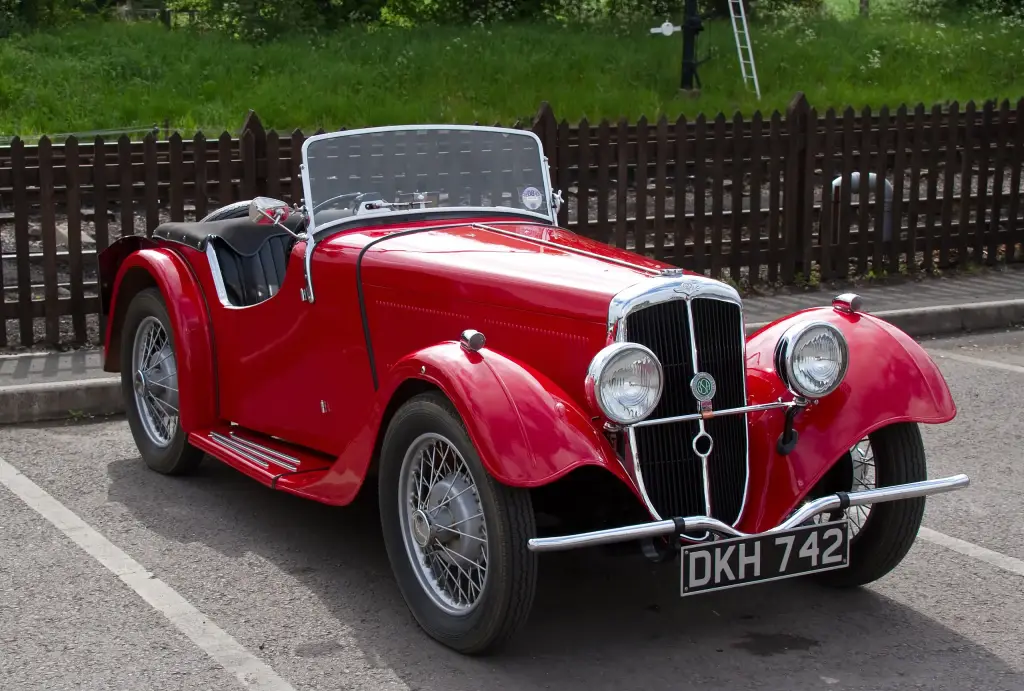
The gearbox was controlled centrally by a lever in the facia, with three forward speeds and reverse, and the propeller shafts from the differential to each wheel had flexible fabric joints and enclosed universal joints. The multi-plate clutch had two light alloy discs with cork inserts and ran in oil. The chassis was of conventional channel-section side members braced by cross members. Suspension used eight quarter-elliptic springs at the front, four to each wheel, giving independent front springing, and ordinary half-elliptical springs to a beam axle at the rear. The single brake for the front wheels was part of the differential unit, with the rear brakes on each wheel. Electrical equipment was six-volt with a five-lamp set including dipped headlights and switch control, and the tyres were 4.5 by 18 inches.
The body was of ash framed and panelled in aluminium, with pneumatically cushioned leather upholstery. The open two-seater had sporting lines with enough leg and elbow room, and during 1936 an open four-seater sports tourer became available at £169 10s and a two-seater coupé with recessed traffic indicators, sunshine roof and other closed-car fittings at £185; these bodies became known as Series 3. A new two-seater drophead coupé, similar to the car that won the coachwork award in the Welsh Rally, was announced in August 1939 at £195.
The Scout was built for speeds approaching 70 mph, and petrol consumption was expected to average 35 to 40 miles per imperial gallon. For the October 1936 Earls Court show the engine grew to 1,203 cc in Series 2 form. Series 4 arrived in August 1937 with shock absorbers all round and braking on the front wheels, and prices fell to £149 10s for the two-seater and £156 10s for the two-seater de luxe, with the four-seater at £159 10s, the four-seater de luxe at £166 10s and the coupé de luxe at £179, that body now offered only with de luxe equipment.
The motoring correspondent of The Times described the two-seater as a rakish-looking body with two wide cut-away doors with cord-operated locks and pockets, a flat unobstructed floor, luggage space in the tonneau behind the squab with a cover, and a hood that folded down completely out of sight, along with a single-panel safety glass folding screen with a curved top line and detachable side screens stored behind the squab. The coupé was of airline type, with a bench seat adjustable at the back, good luggage space behind, a sliding roof, safety glass windows, a windscreen that wound out, a rear blind, scuttle ventilators, large headlamps with stone guards, a spare wheel, door locks, a sports spring steering wheel, flush-fitting traffic indicators, a roof light and an inside reflecting mirror.
Series 5 brought a more powerful 12-volt electrical system and Bendix cable brakes, and Series 6 of October 1938 moved to easy-clean pressed steel wheels instead of wire, made the coupé a four-seater and redesigned the 9.8 engine with more water jacketing, a three-bearing crankshaft with improved lubrication, larger valves and a downdraught carburettor; front and rear tracks became the same at 4 ft 0 in and all cars shared a wheelbase of 7 ft 11 1/4 in. A new drophead coupé two-seater was announced on 1 August 1939, but war broke out on 3 September and very few were made.
Design and features
- Front-wheel drive: engine, clutch, gearbox and differential in one unit at the front, giving a low centre of gravity and unusual stability.
- Independent front springing: eight quarter-elliptic springs, four to each front wheel.
- Light body: an ash frame panelled in aluminium, with leather upholstery.
- Brisk and economical: close to 70 mph and 35 to 40 miles per gallon.
BSA Scout versions
- Series 1 (1935): the original 1,075 cc open two-seater at £149 10s.
- Series 2 (October 1936): engine enlarged to 1,203 cc.
- Series 3 (1936): four-seater sports tourer and two-seater coupé bodies.
- Series 4 (August 1937): shock absorbers all round and front-wheel brakes.
- Series 5: 12-volt electrics and Bendix cable brakes.
- Series 6 (October 1938): pressed steel wheels, four-seater coupé, redesigned 9.8 engine and equal tracks.
The Scout was BSA’s small car of the 1930s, built by the company best known for the Bantam and the M20 motorcycles. More models are in the BSA collection.
Video: BSA SCOUT BROOKLANDS
Video by YouTube on YouTube.
Sources
- BSA Scout, English Wikipedia: launch, mechanicals, bodies, series changes