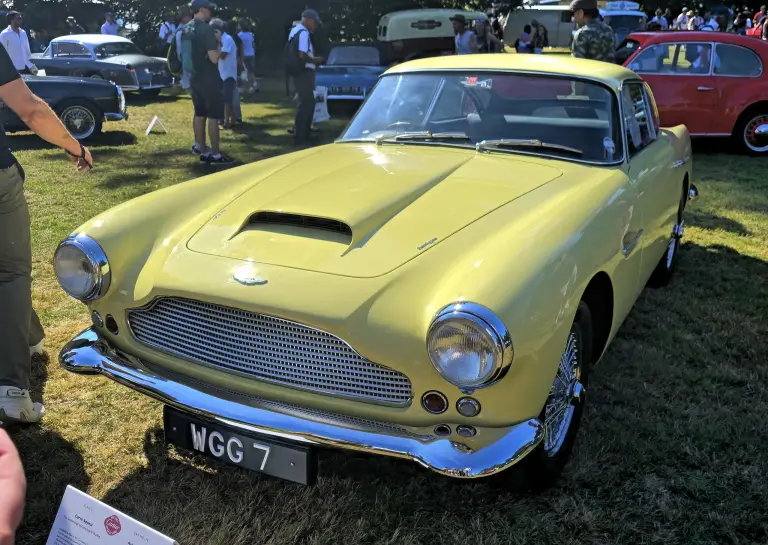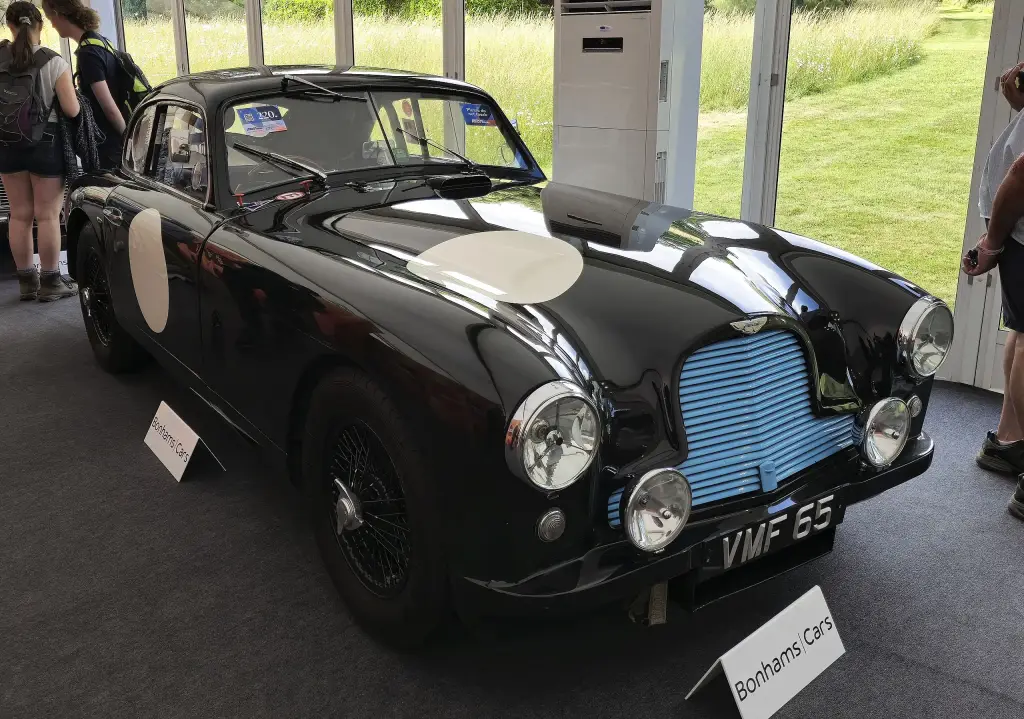
The Aston Martin DB2 is a grand tourer sold by Aston Martin from May 1950 until April 1953. The successor to the 2-Litre Sports (the DB1), it had a comparatively advanced dual overhead cam 2.6 L Lagonda straight-six in place of the previous pushrod four-cylinder.
Aston Martin DB2 at a glance
| Sold | May 1950 to April 1953 |
|---|---|
| Debut | New York Auto Show, April 1950 |
| Built | 411 cars |
| Engine | 2.6 L (2,580 cc) Lagonda dual overhead cam straight-six; original form about 105 hp with dual SU carburettors, bore 78 mm, stroke 90 mm |
| Chassis | a shortened version of Claude Hill’s tube frame for the 2-Litre Sports |
| Body | fastback coupé by Frank Feeley; later also a drophead coupé, a quarter of sales |
| Racing | 5th and 6th at Le Mans 1950, 3rd at Le Mans 1951 |
This page is based on English Wikipedia only (a trusted source), so the facts were not cross-checked against a second source.
History of the Aston Martin DB2
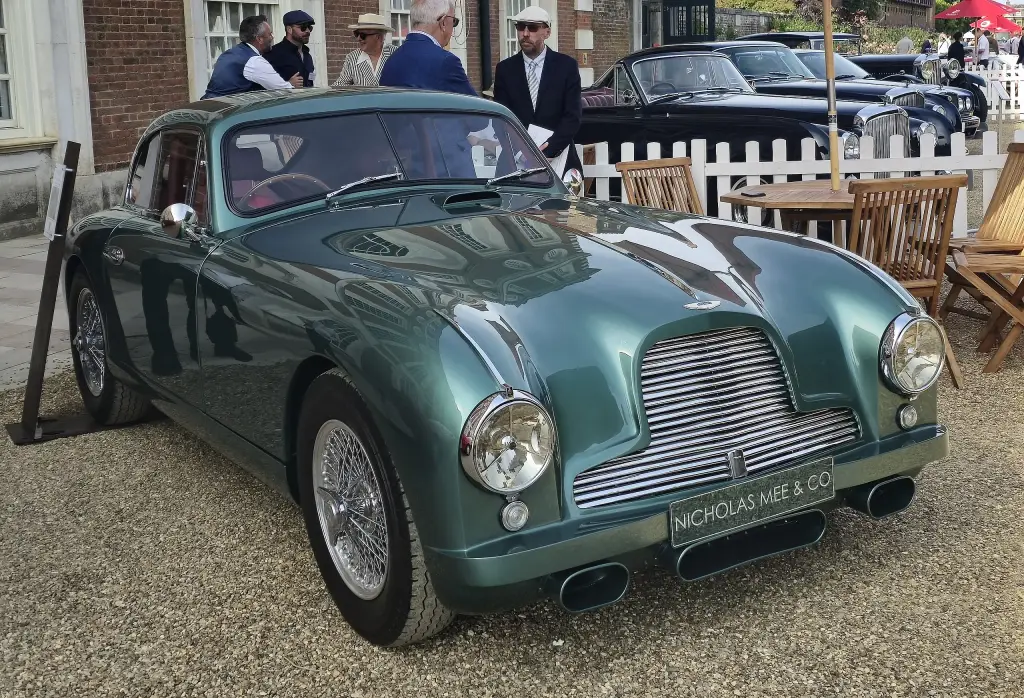
In 1947 David Brown bought Aston Martin and Lagonda. Lagonda’s 2.6 L dual overhead cam straight-six, designed under the supervision of W. O. Bentley and largely by William (Willie) Watson, was the main objective of Brown’s acquisition. The DB2 used it in a shortened version of the tube-frame chassis designed by Claude Hill, with a fastback coupé body designed by Frank Feeley. It was available as a closed two-seater that Aston Martin called a sports saloon, and later as a drophead coupé.
Racing
Three pre-production cars entered the 1949 24 Hours of Le Mans, one with the Lagonda straight-six that became the development car for the DB2 and two with the 2-litre four. The Lagonda car, driven by Leslie Johnson, retired with overheating after six laps; one of the 2-litre cars crashed two hours from the finish, fatally injuring Pierre Maréchal, and the other finished 7th. A month later the larger-engined car finished 3rd at Spa.
For 1950 all three factory team cars had the Lagonda engine; at Le Mans, Abecassis and Macklin finished 5th and Brackenbury and Parnell 6th, giving Aston Martin 1st and 2nd in the 3-litre class. In December 1950 Briggs Cunningham drove his DB2 to 2nd in class at the first Sebring race meeting. In 1951 Macklin and Thompson took 3rd overall at Le Mans, with Abecassis and Shawe-Taylor 5th. David Brown soon began a series of Astons designed specially for competition, starting with the DB3.
Production
The DB2 debuted at the New York Auto Show in April 1950 and stayed in production until April 1953, when 411 had been made.
Design and features
- Engine: the Lagonda straight-six, W. O. Bentley’s design.
- Chassis: a tube frame by Claude Hill, shortened from the 2-Litre Sports.
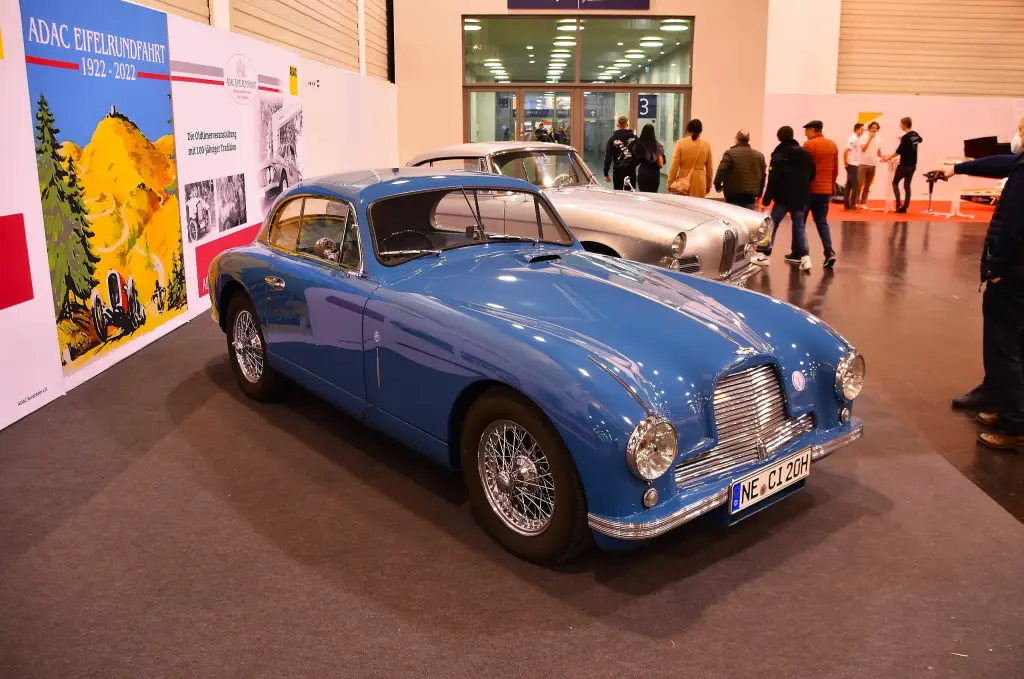
- Body: a fastback coupé by Frank Feeley; the first 49 cars had a chrome-framed three-part grille.
Aston Martin DB2 versions
- DB2 sports saloon (1950–1953): the closed coupé.
- DB2 drophead coupé: a quarter of the total sales.
- Works team cars (1949–1951): Le Mans cars with Lagonda engines.
More Aston Martin cars are in our Aston Martin collection, for example the DB1 it replaced, the DB2/4 and the DB3 racer.
Aston Martin DB2 questions and answers
When was the Aston Martin DB2 built?
From May 1950 to April 1953.
How many were made?
411.
What engine did it have?
The 2.6 L Lagonda dual overhead cam straight-six designed under W. O. Bentley.
Who designed the body?
Frank Feeley.
Did it race at Le Mans?
Yes: 5th and 6th in 1950 and 3rd overall in 1951.
Video: 1952 Aston Martin DB2 Vantage
Video by ClassicarGarage on YouTube.
Sources
- Aston Martin DB2, English Wikipedia: development, racing, production