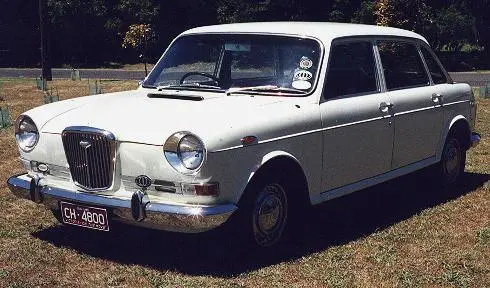
The Wolseley Six was the Wolseley version of BMC’s ADO17 range, the large front-wheel-drive family car nicknamed the Landcrab. The range began with the Austin 1800 of 1964, gained a Wolseley variant as the 18/85 in 1967, and later offered a 2.2-litre engine in cars badged Austin 2200, Morris 2200 and Wolseley Six.
Wolseley Six at a glance
| Maker | British Motor Corporation, later British Leyland |
|---|---|
| Range | ADO17, 1964–1975 |
| Wolseley 18/85 | from 1967 |
| Wolseley Six | 2.2-litre version of the range |
| Layout | front-wheel drive, transverse engine |
| Bodies | four-door saloon |
| Suspension | Hydrolastic interconnected fluid suspension |
| Body stiffness | 18,032 Nm per degree |
| Design | Alec Issigonis and Pininfarina |
| Nickname | Landcrab |
| Award | Austin 1800, European Car of the Year 1965 |
The English Wikipedia article covers the whole ADO17 range; the Wolseley Six is named as the 2.2-litre Wolseley version, so most facts here describe the range as a whole. No free photograph of the Wolseley version was available, so the old record cover is kept. Based on one source.
History of the Wolseley Six
A larger follow-up to the Mini
The ADO17 was developed at BMC as a larger follow-up to the Mini and the Austin 1100, and it was launched in September 1964 as the Austin 1800. Additional badge-engineered Morris 1800 and Wolseley 18/85 variants were launched in 1966 and 1967 respectively to cater for the BMC dealerships selling those marques; the 18/85 name had been used before, on the Wolseley 18/85 of 1938 to 1948. The car was unconventional in appearance, with a large glasshouse and a spacious, minimalist interior using leather, wood and chrome, an unusual instrument display with a ribbon speedometer and a green indicator light on the end of the indicator stalk, and a chrome “umbrella handle” handbrake under the dashboard parcel shelf. The two front seats met in the middle and could be used as a bench seat. Alec Issigonis and Pininfarina both worked on the exterior.
Engineering
The technical layout was unconventional and ahead of its time. The engine was mounted transversely and drove the front wheels, and the car used Hydrolastic suspension together with inertia-controlled brake-force distribution, a valve that transferred braking force between the front and rear axles according to sensed deceleration rather than fluid pressure. There was also a night-dipping system for the tail, brake and indicator lights, which dimmed them when the sidelights were on so as not to dazzle following drivers. The unitary bodyshell was exceptionally stiff, with torsional rigidity of 18,032 Nm per degree. The 1800 was voted European Car of the Year for 1965. Because the car was much wider and lower than most rivals it acquired the nickname “Landcrab”, and its strong shell and sophisticated suspension made it effective in endurance rallies, where it could keep up competitive average speeds on poor roads.
Running changes and the six-cylinder cars
The early cars were revised repeatedly in the months after launch: reclining front seats and an optional rear armrest arrived in December 1964, the final-drive ratio was changed in January 1965 along with higher gearing and reduced valve clearances, the handbrake was repositioned in October 1965, and the rear anti-roll bar was removed at the end of that year. In June 1967 a modified version arrived with repositioned heater controls, a strip of walnut veneer on the fascia and separate bucket seats in place of the split bench. Later the range was marketed with a 2.2-litre engine as the Austin 2200, Morris 2200 and Wolseley Six, and the ADO17 remained in production until 1975.
Design and features
- Front-wheel drive: a transverse engine and front drive gave cabin space that rivalled larger cars.
- Hydrolastic suspension: interconnected fluid displacers for ride comfort and body levelling.
- Very stiff body: torsional rigidity of 18,032 Nm per degree helped durability and rally work.
- Unusual interior: ribbon speedometer, umbrella-handle handbrake and seats that met in the middle.
- Six-cylinder option: the 2.2-litre version sold as the Wolseley Six.
Wolseley Six versions
- Austin 1800 (1964): the original version, European Car of the Year for 1965.
- Morris 1800 (1966): the second badge-engineered variant.
- Wolseley 18/85 (1967): the Wolseley version of the 1.8-litre car.
- Wolseley Six: the 2.2-litre six-cylinder model.
- Austin 2200 and Morris 2200: the other 2.2-litre versions.
The Wolseley 2200 was the next six-cylinder Wolseley, and the Wolseley 1100 was the smaller ADO16 range. More cars are in the Wolseley collection.
Video: Wolseley Six Automatic Inside Drive
Video on YouTube.
Sources
- BMC ADO17, English Wikipedia: range history, engineering, Wolseley versions, running changes