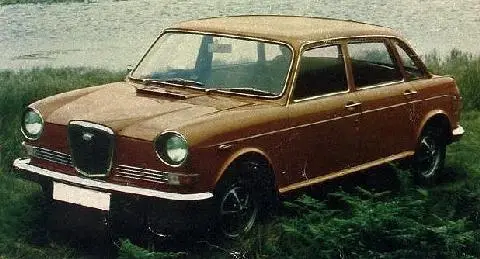
The Wolseley 2200 was the Wolseley version of British Leyland’s 18–22 series, launched on 26 March 1975. It came only with the 2,227 cc six-cylinder engine and luxury velour trim, and it carried the traditional Wolseley grille and illuminated badge for just a few months before the whole range was renamed Princess.
Wolseley 2200 at a glance
| Maker | British Leyland, Austin-Morris division |
|---|---|
| Launched | 26 March 1975 |
| Range | Austin / Morris / Wolseley 18–22 series |
| Design code | ADO71 |
| Rebranded | Princess, October 1975 |
| Production of the range | 1975–1981 (1982 in New Zealand) |
| Designer | Harris Mann |
| Engine | 2,227 cc E-Series SOHC straight-six |
| Other engines in the range | 1,798 cc B-Series four |
| Layout | front-wheel drive, transverse engine |
| Body | four-door saloon with separate boot |
| Total production | 224,942 |
The English Wikipedia page is about the Princess; the Wolseley 2200 is described there as the first, six-cylinder Wolseley version of the 18–22 series. No free photograph of the Wolseley version was available, so the old record cover is kept. Based on one source.
History of the Wolseley 2200
Launch of the 18–22 series
The car was launched on 26 March 1975 under the slogan “the car that has got it all together”. The 18–22 designation referred to the engine sizes carried over from the BMC ADO17 “Landcrab”: the 1,800 cc B-Series and the 2,200 cc E-Series. For the first six months three badge-engineered versions were built, by Austin, Morris and Wolseley. The Austin had the original design intent, with trapezoidal headlights and a simple horizontally vaned grille. The Morris and Wolseley bonnets had a raised hump to take a larger, styled grille; the Wolseley’s was chrome with the traditional illuminated badge in the middle, narrower vertical bars set back within the surround, and four round headlights. The Wolseley was available only with the six-cylinder engine and luxury velour trim.
Engineering and styling
The Princess inherited its front-wheel-drive, transverse-engine layout from the Austin and Morris 1800 range, still unusual in Europe for cars of this size, which gave it an advantage in cabin space. The base engine was the 1,798 cc B-Series pushrod four, a design dating back to 1947 and rated at 84 bhp; the larger unit was the smooth 2,227 cc E-Series single-overhead-cam six. The styling by Harris Mann was wedge-shaped, all angles and slanting panels, and the car was nicknamed “The Wedge” and, inside British Leyland, “The Anteater”. Mann had intended a five-door hatchback, but management decided the Austin Maxi should be the range’s only hatchback, so the Princess received fixed rear glass and a separate boot. An estate version was proposed but never built.
From Wolseley to Princess
Ahead of the October 1975 London Motor Show the 18–22 range was rebranded “Princess”, effectively a new marque created by British Leyland, so the Wolseley version disappeared after only a few months on sale. The Princess remained in production until 1981, with a small number built in New Zealand until 1982, and total output reached 224,942 cars, most of which had been scrapped by the 1990s. A limousine version was devised in late 1975 and built in small numbers by Woodall Nicholson on the top-of-the-range Princess 2200 HLS, stretched at the B-pillar and sold mainly to borough councils as mayoral cars and to the funeral trade. In 1981 the Princess was revamped as the Austin Ambassador hatchback, built until 1984.
Design and features
- Six-cylinder only: the Wolseley came solely with the 2,227 cc E-Series engine.
- Traditional Wolseley face: chrome grille, illuminated badge and four round headlights on a raised bonnet.
- Luxury velour trim: the most generously equipped version of the 18–22 series.
- Wedge styling: Harris Mann’s angular design, with a separate boot rather than a hatchback.
- Front-wheel drive: transverse engine and front drive gave cabin space comparable with larger rivals.
Wolseley 2200 versions
- Wolseley 2200 (1975): six-cylinder, velour-trimmed version sold for the first months of production.
- Austin and Morris 18–22: four- and six-cylinder versions with their own bonnets and grilles.
- Princess (1975–1981): the same car rebranded, in 1800 and 2200 forms.
- Princess 2200 HLS Limousine (1975–1979): Woodall Nicholson conversion with a stretched rear compartment.
- Austin Ambassador (1981–1984): hatchback revamp of the Princess.
The Wolseley Six was the previous six-cylinder Wolseley on the ADO17 platform, and the Wolseley 15/60 shows the marque’s earlier upmarket saloons. More cars are in the Wolseley collection.
Sources
- Princess (car), English Wikipedia: 18-22 launch, Wolseley version, engineering, production