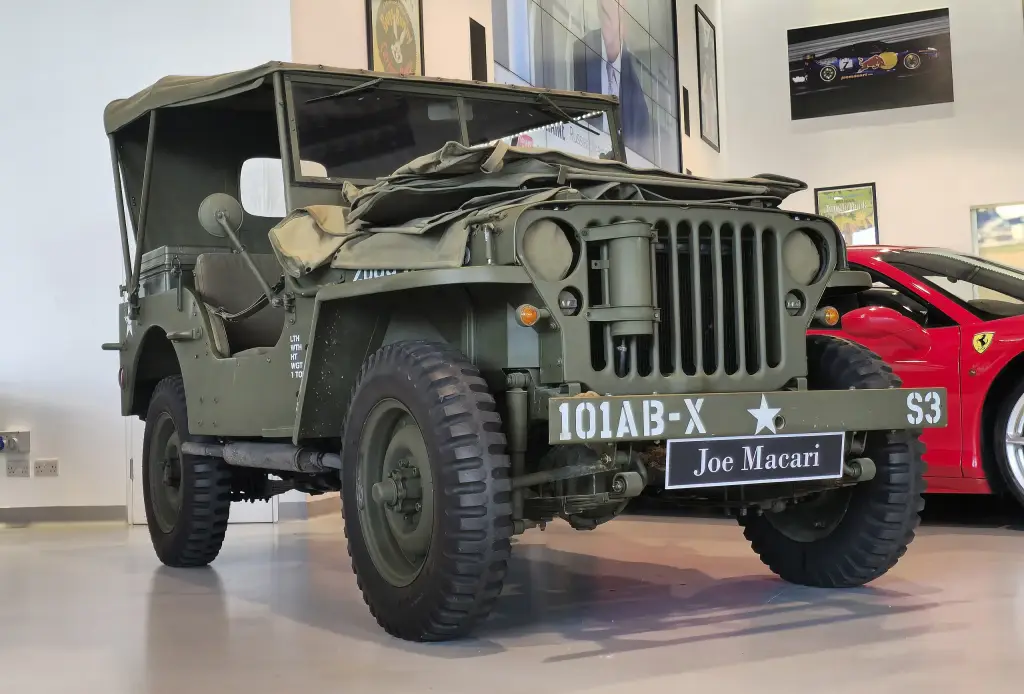
The Willys MB, together with the Ford GPW, was the American quarter-ton four-wheel-drive military utility vehicle of the Second World War, commonly known as the Jeep. Almost 640,000 were built to a single standardised design between 1941 and 1945, making it the world’s first mass-produced four-wheel-drive car. Its influence continued in the civilian CJ Jeeps and in the Jeep brand.
Willys MB at a glance
| Makers | Willys-Overland and Ford (as the GPW) |
|---|---|
| Production | 1941–1945 |
| Role | quarter-ton 4×4 command and reconnaissance vehicle |
| Engine | 2.2-litre four-cylinder, 60 hp |
| Gearbox | three-speed manual with a two-speed transfer case |
| Drive | part-time four-wheel drive |
| Wheelbase | 80 in (2,032 mm) |
| Top speed | 60 mph (97 km/h) |
| Army designation | G-503 |
| Built | about 370,000 by Willys and 270,000 by Ford |
| Successors | Willys M38 and M38A1 |
Based on the English and German Wikipedia articles; both give a total of almost 640,000 jeeps.
History of the Willys MB
In June 1940 the U.S. Army began a race to produce a light, four-wheel-drive cross-country vehicle. The first prototype, the Bantam BRC, was delivered in September 1940, and the Army ordered 1,500 test vehicles each from Bantam, Willys and Ford. The Willys MA won thanks to its stronger engine, and large-scale production was taken up by Willys-Overland and, a little later, by Ford under licence. Willys revised the MA to Army requirements, using the Ford GP as a guide, and the result was the MB. About 370,000 MBs were built by Willys and about 270,000 GPWs by Ford, which differed only in small details; at peak production a jeep was finished every two minutes.
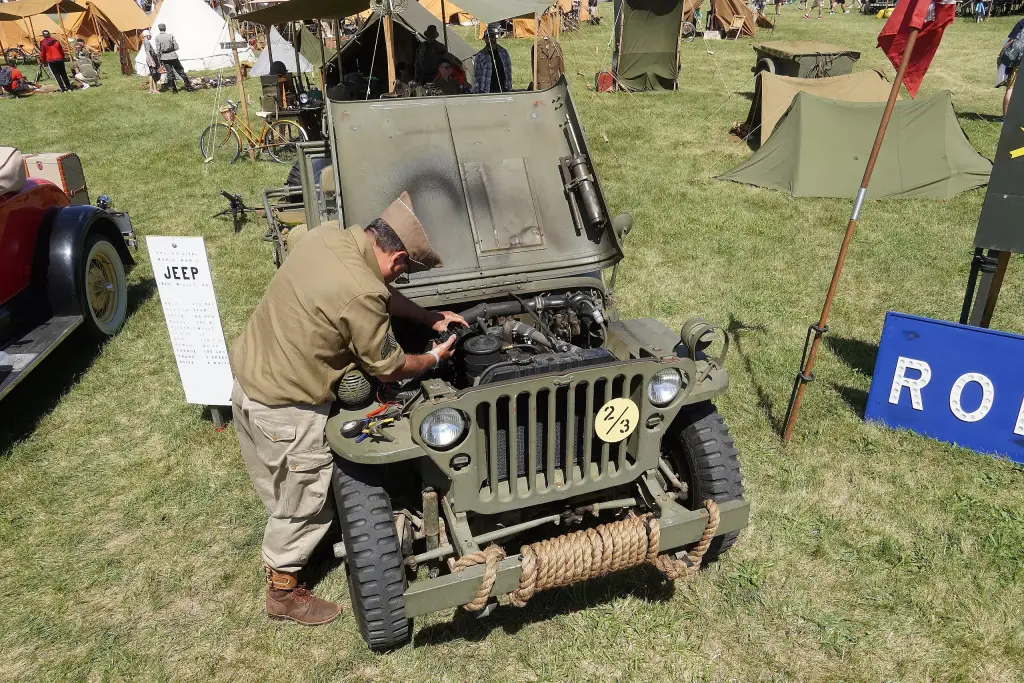
Soldiers called the vehicle the Jeep. One explanation derives the word from the initials GP, an army manual abbreviation sometimes read as General Purpose, although Ford also used GP as an internal code. Another traces it to Eugene the Jeep, a character in the Popeye comic strip. The name was made public by Willys chief test driver Irving “Red” Hausmann, who in February 1941 drove a jeep up the steps of the Capitol in Washington with the journalist Katherine Hillyer beside him; her article in the Washington Daily News of 20 February 1941 established the name, which the military then accepted. Willys registered Jeep as a trademark only in 1950.
The jeep became the workhorse of the American military, replacing horses, draft animals and motorcycles in every role from messaging and cavalry units to supply trains. Some 50,000 quarter-ton jeeps were shipped to the Soviet Union, and the type made up about a quarter of the military support motor vehicles the United States produced in the war. In service it was modified with extra water tanks for the desert and with a kit that let it wade through waist-high water, while Ford built the amphibious GPA. Dwight Eisenhower wrote that most senior officers regarded it as one of the five pieces of equipment most vital to success in Africa and Europe, and George Marshall called it “America’s greatest contribution to modern warfare”. In 1991 the MB was designated an International Historic Mechanical Engineering Landmark. After the war it served in Korea and was developed into the M38 and M38A1, while Willys turned it into the civilian CJ-2A in 1945.
Design and features
- Go Devil engine: a 2.2-litre four of 60 hp, simple and easy to repair.
- Part-time four-wheel drive: a three-speed gearbox and a two-speed transfer case with low range.
- Rugged simplicity: a separate frame, leaf springs and a body that could be fixed in the field.
- Adaptability: desert water tanks, a deep-water fording kit and weapons mounts.
- Amphibious derivative: the Ford GPA, a swimming jeep with a boat-shaped hull.
Willys MB versions
- Willys MA (1940): the 1,500 pre-production test cars.
- Willys MB (1941–1945): the standard production jeep.
- Ford GPW (1941–1945): licence-built version, about 270,000 made.
- Ford GPA: an amphibious jeep with a boat hull and propeller.
- M38 and M38A1: post-war military developments of the MB.
The MB’s military successor was the Willys M38, and its civilian descendant the Jeep CJ. Willys also used the four-wheel-drive platform for the station wagon. More cars are in the Willys collection.
Sources
- Willys MB, English Wikipedia: development, production, role in the war
- Willys MB, German Wikipedia: name, prototypes, technical description