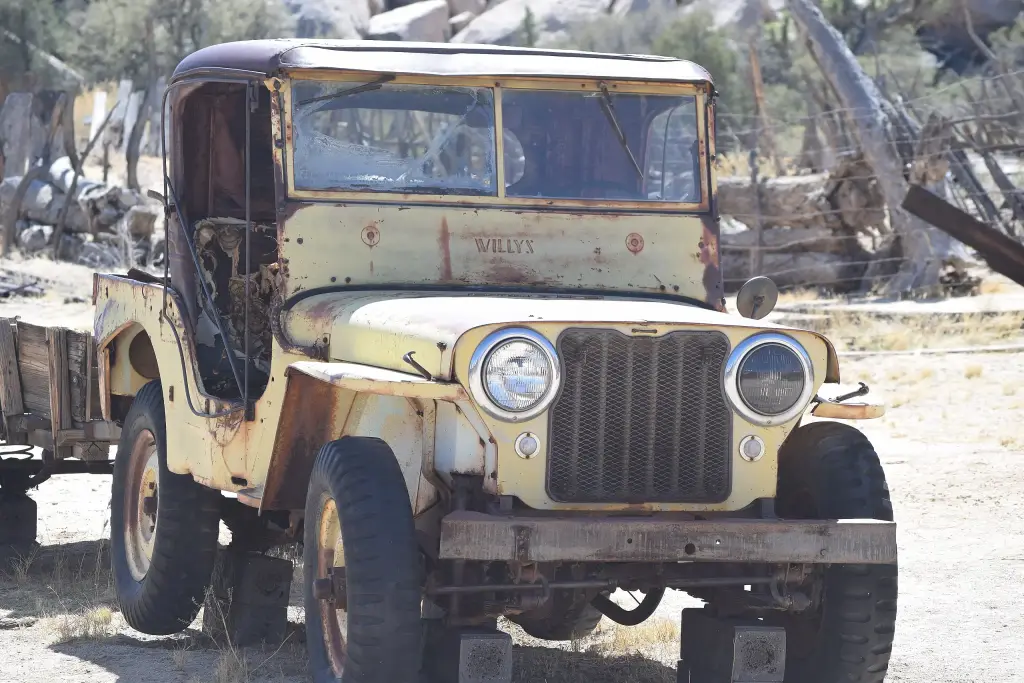
The Jeep CJ was a series of small, open-bodied off-road vehicles and compact pickups built by successive owners of the Jeep marque from 1945 to 1986. The 1945 Willys “Universal Jeep” was the world’s first mass-produced civilian four-wheel-drive car. More than 1.5 million CJs were built, and the line was replaced by the Jeep Wrangler in 1987.
Jeep CJ at a glance
| Maker | Willys-Overland, later Kaiser Jeep and AMC |
|---|---|
| Production | 1945–1986 |
| Predecessor | Willys MB military Jeep |
| Body | open body on a separate frame, removable top |
| Suspension | rigid live axles with leaf springs front and rear |
| Drive | part-time four-wheel drive with high and low range |
| Engines | four- and six-cylinder, later V8 |
| Gearboxes | manual; automatic later in the run |
| Wheelbase | 80 in (2,032 mm); CJ-7 10 in (25 cm) longer |
| Built | more than 1.5 million |
| Replaced by | Jeep Wrangler, 1987 |
Based on the English Wikipedia article on the Jeep CJ.
History of the Jeep CJ
In 1944 Willys-Overland, the main manufacturer of the wartime Jeep, built prototypes of a commercial version, the CJ or “civilian Jeep”. The design was a direct evolution of the military Jeep, and the most obvious change was a tailgate, with the spare wheel moved to the side. Beyond civilian amenities, options and legally compliant lighting, the CJ also needed a sturdier drivetrain than the wartime car, because rural buyers expected years of durability rather than the weeks of wartime service.
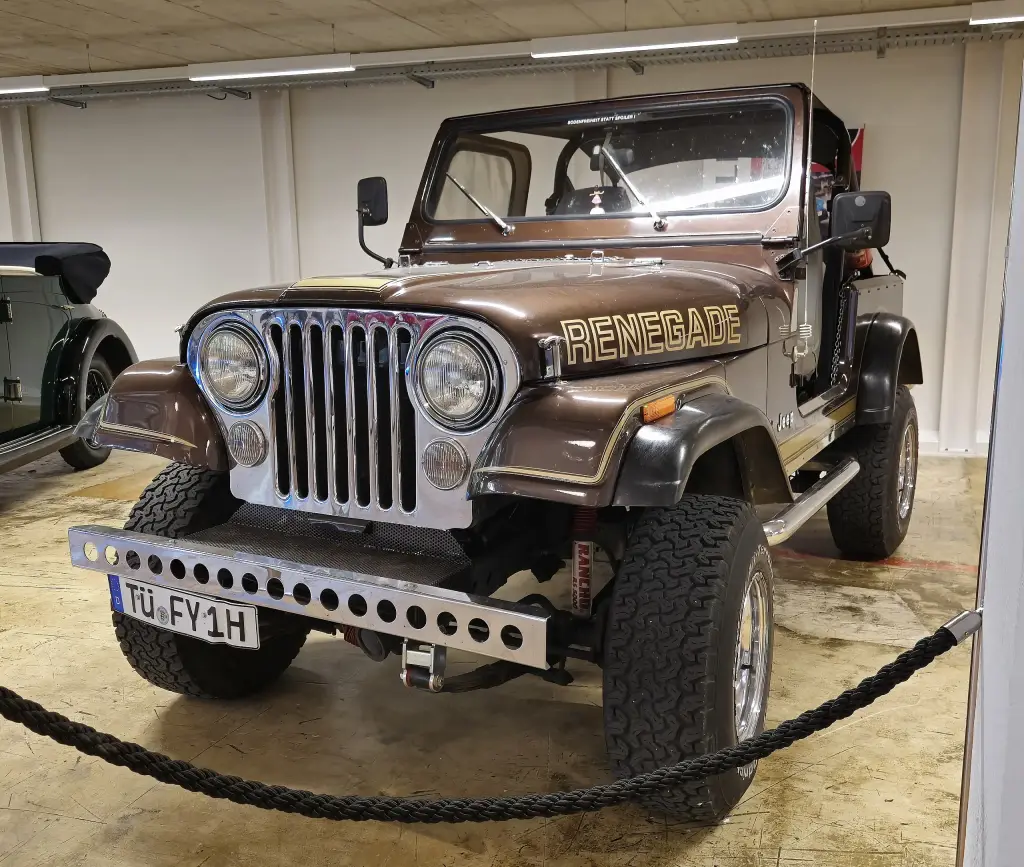
The first CJs, later called CJ-1, were military MBs quickly adapted with a tailgate, lower gearing, a drawbar and a civilian canvas top; none have survived and their number is unknown. At least 40 CJ-2 “AgriJeeps” followed as test vehicles, with tailgates, power take-offs, engine governors, column-shift T90 gearboxes, 5.38 gears and a 2.43:1 low range. They were painted olive drab at first and later in civilian colours, and the lessons learned from them led to the CJ-2A of 1945, the first full-production CJ and the world’s first mass-produced civilian four-wheel-drive car.
From then on every CJ had a separate body and frame, rigid live axles with leaf springs at both ends, a tapering nose with flared fenders, a fold-flat windshield and no fixed doors. Most had part-time four-wheel drive with high and low gearing and open bodies with removable hard or soft tops. The 1955 CJ-5 introduced round rather than flat fenders; straight-six and V8 engines, automatic gearboxes and different four-wheel-drive systems came later, and the 1976 CJ-7 stretched the wheelbase by 10 inches (25 cm) and made doors and a removable hardtop common. Production ended after 1986, with more than 1.5 million built, and the 1987 Wrangler replaced the CJ-7 on the same wheelbase and leaf springs.
Design and features
- Civilian body: a tailgate and a side-mounted spare wheel were the first changes from the military MB.
- Open body: a fold-flat windshield, no fixed doors and a removable hard or soft top.
- Simple chassis: a separate body and frame with leaf-sprung live axles at both ends.
- Part-time four-wheel drive: high and low gearing, with two-wheel drive for the road.
- Long life: the same basic body style served for 45 years, from 1945 to 1986.
Jeep CJ versions
- CJ-1 (1944): one or two prototypes converted from the MB; none survive.
- CJ-2 “AgriJeep” (1944–45): at least 40 test vehicles, never sold to the public.
- CJ-2A (1945–1949): the first full-production CJ, sold as the Universal Jeep.
- CJ-5 (1955): round fenders replaced the flat-fendered body.
- CJ-7 (1976–1986): a wheelbase 10 inches (25 cm) longer, with doors and a removable hardtop as common items.
- DJ Dispatcher (1956): a two-wheel-drive version with open, fabric or steel body for hotels, resorts, police and the US Postal Service.
The CJ grew out of the Willys MB, and its military successor was the M38. Willys also built the Jeepster and the station wagon. More cars are in the Willys collection.
Sources
- Jeep CJ, English Wikipedia: history, CJ-1 and CJ-2, body details, production total