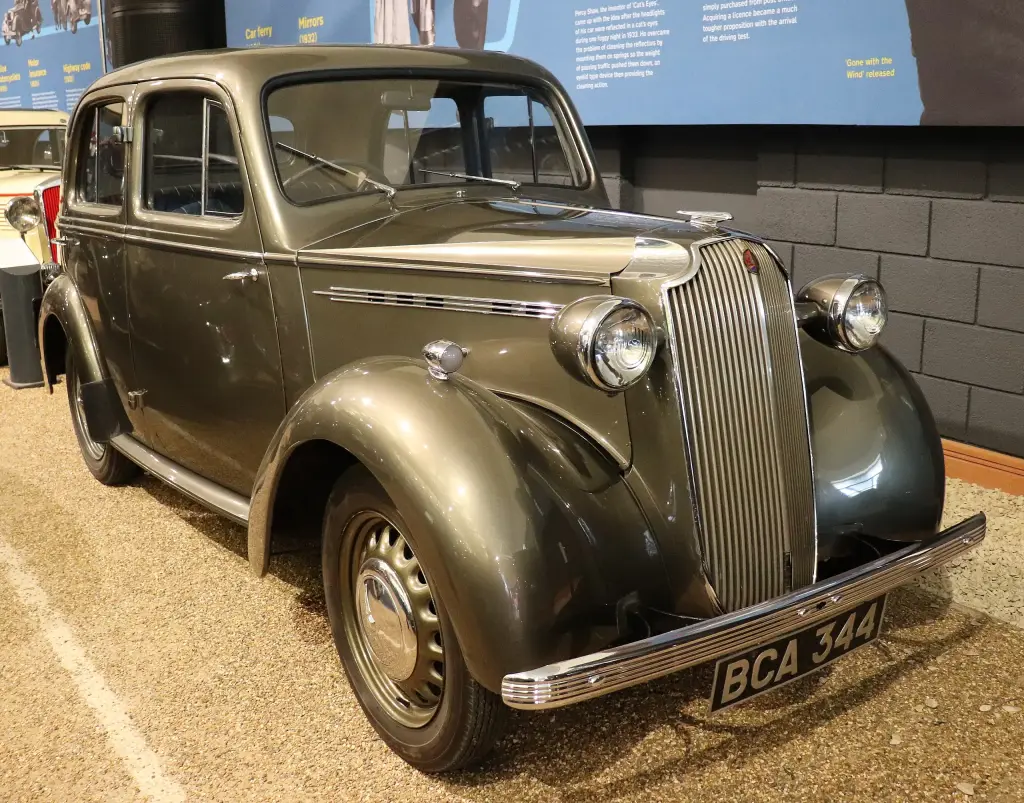
The Vauxhall Ten, also called the 10-4, was launched at the London Motor Show in October 1937 and was the first British car with a unitary construction body. It was built until 1940, came back briefly after the war and was withdrawn in 1947.
Vauxhall Ten at a glance
| Maker | Vauxhall Motors, Luton |
|---|---|
| Production | 1937–1940, then 1946–1947 |
| Model code | H Type; post-war HIY |
| Engine | 1,203 cc overhead-valve four |
| Power | 34 bhp in 1937 |
| Construction | unitary, chassisless body, a British first |
| First delivery | 1 November 1937 |
| Built before 1940 | 55,000 |
| Coupé | 1938–1939, on a separate DX-series chassis |
| Successor | Vauxhall Twelve (1948), then the Viva in 1963 |
Written from the English Wikipedia article on the 10-4, with the German article for background.
History of the Vauxhall Ten
The Ten was launched at the October 1937 London Motor Show, and the first car was delivered to a customer on 1 November 1937. Its structural innovation, following the pattern set in 1935 by General Motors’ German subsidiary, was integral chassisless construction: it was the first British car to have a unitary construction body. According to Maurice Platt, who moved from technical journalism to Vauxhall in 1937 and later became the company’s chief engineer, the Ten became known inside the company as the million-pound car, reflecting the size of the investment in tooling for the new model. The name referred to its fiscal horsepower, the class in which it competed with the Morris Ten, Standard Ten and Ford Model C Ten; advertised output in 1937 was 34 bhp.
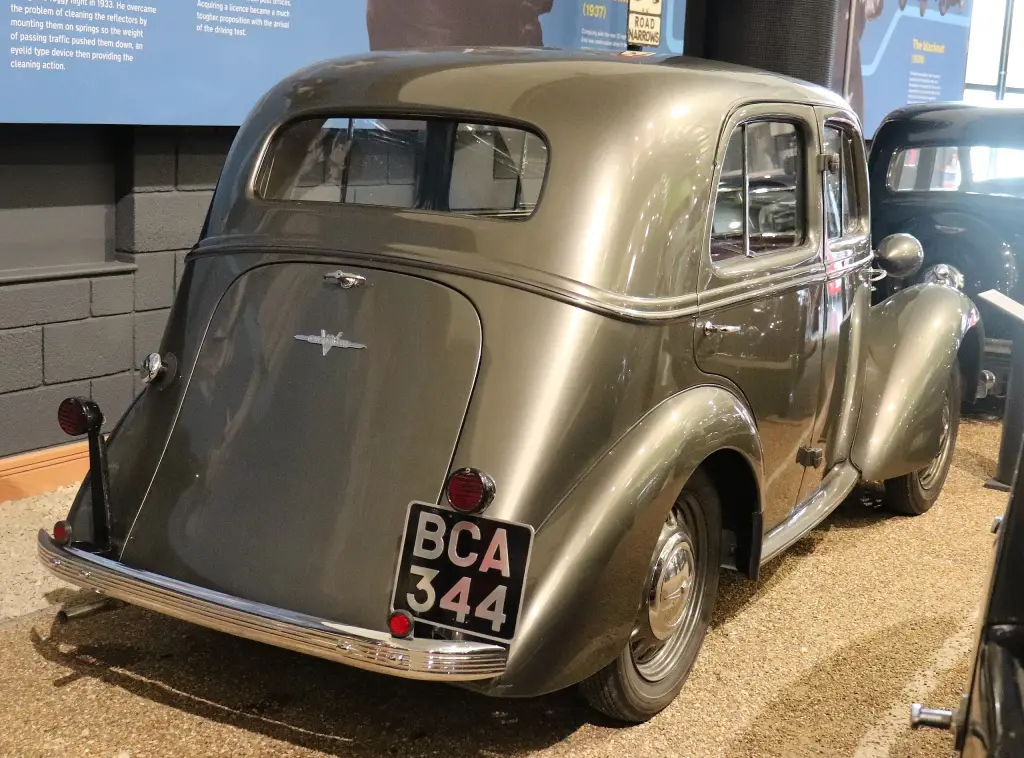
In 1938 and 1939 a two-door coupé version was also offered, built on a separate chassis because the smaller production numbers did not justify the tooling costs of a monocoque version. The coupé sat on a shortened and otherwise modified version of the earlier DX-series chassis, which meant that the more expensive coupé was heavier than the saloon and no faster, limiting its appeal although it did better in some export markets.
The war intervened almost as soon as production had begun: Vauxhall’s Luton plant switched to truck and tank production and the Ten was unavailable after 1940. 55,000 had been built by May 1940, when production stopped. The model was reintroduced in 1946 with the same 1,203 cc overhead-valve engine, though with a reduction in claimed power, and was little changed otherwise. With British buyers short of cash and the small family car market closely contested, Vauxhall withdrew the Ten in 1947 and concentrated on larger models until the Vauxhall Viva arrived in 1963.
Post-war production lasted only two years: in mid-1947 the body and chassis received a larger 1,442 cc engine, which pushed the car into the 12 tax horsepower bracket and turned it into the 1948 Vauxhall Twelve. A light commercial version was sold as the Bedford HC, with the same engine and a 672 lb (305 kg) payload. In Australia, General Motors-Holden’s built a 10-4 look-alike called the Vauxhall Wyvern, fitting the 10-4 front end and mechanicals to its own chassis and body because it lacked the presses for monocoque construction.
Design and features
- Unitary body: the first British car built without a separate chassis.
- The million-pound car: Vauxhall’s nickname for the investment it represented.
- Small and cheap: a 1,203 cc four of 34 bhp aimed at Morris and Ford rivals.
- Bedford HC: the light commercial version with a 305 kg payload.
Vauxhall Ten versions
- Ten saloon (1937–1940): the unitary four-door.
- Ten coupé (1938–1939): a separate-chassis two-door, heavier than the saloon.
- Post-war Ten (1946–1947): the HIY code with reduced claimed power.
- Bedford HC: the van version.
- Vauxhall Twelve (1948): the larger-engined successor.
The Ten was replaced by the Wyvern family and later by the Viva in 1963. More cars are in the Vauxhall collection.
Sources
- Vauxhall 10-4, English Wikipedia: launch, construction, coupé, production, post-war
- Vauxhall 10-4, German Wikipedia: model background