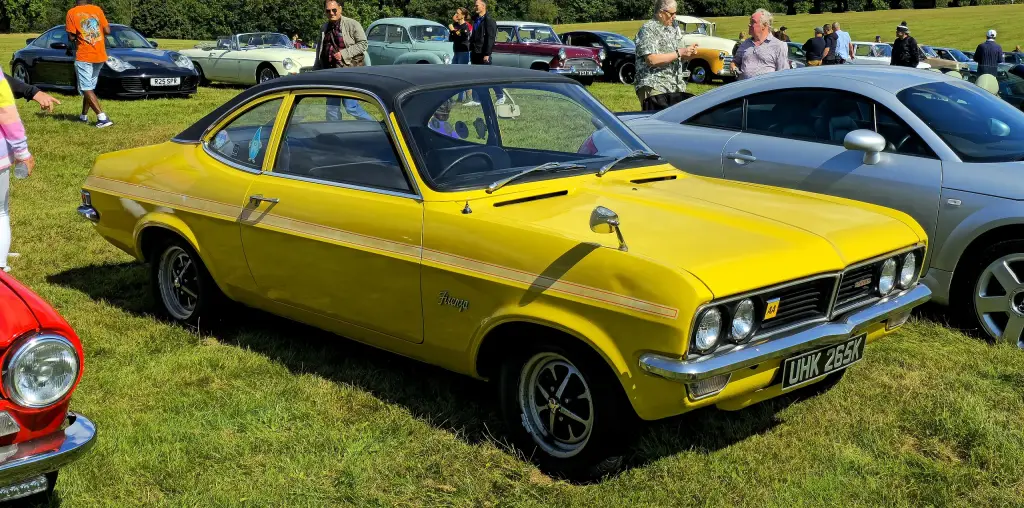
The Vauxhall Firenza was a two-door fastback coupé sold from May 1971 to 1975. It was developed from the Viva, and its most famous version — the High Performance Firenza of 1973 with its aerodynamic “droopsnoot” nose — was built in tiny numbers but shaped Vauxhall design for the rest of the decade.
Vauxhall Firenza at a glance
| Maker | Vauxhall Motors, Luton |
|---|---|
| Production | May 1971 – 1975 |
| Body | two-door fastback coupé |
| Based on | Vauxhall Viva |
| Launch engines | 1,159 cc overhead valve; 1,599 and 1,975 cc Slant-4 |
| From December 1971 | 1,759 and 2,279 cc |
| Top model | 2300 Sport SL, 122 bhp, seven-dial dash |
| HP Firenza | 1973, 131 bhp, GRP droopsnoot nose |
| HP Firenza built | 204, against 30,000 projected |
| Driven wheels | rear |
Written from the English Wikipedia article on the Firenza, with the German article for background.
History of the Vauxhall Firenza
The Firenza was launched in May 1971 as a development of the Viva with a distinctive fastback coupé body and two doors. The first cars used the 1,159 cc overhead-valve engine carried over from the Viva HB, plus two models with the Slant-4 overhead-camshaft engine from the Victor FD in 1,599 and 1,975 cc forms. The entry engine lasted three months before a 1,256 cc unit arrived in August 1971, and the small engine was dropped in July 1972. Six months after launch, in December 1971, the engines grew to 1,759 and 2,279 cc; those cars were built from March 1972 to September 1973. All models had a front-mounted four-cylinder engine driving the rear wheels, and the SL trim was the highest in each engine size.
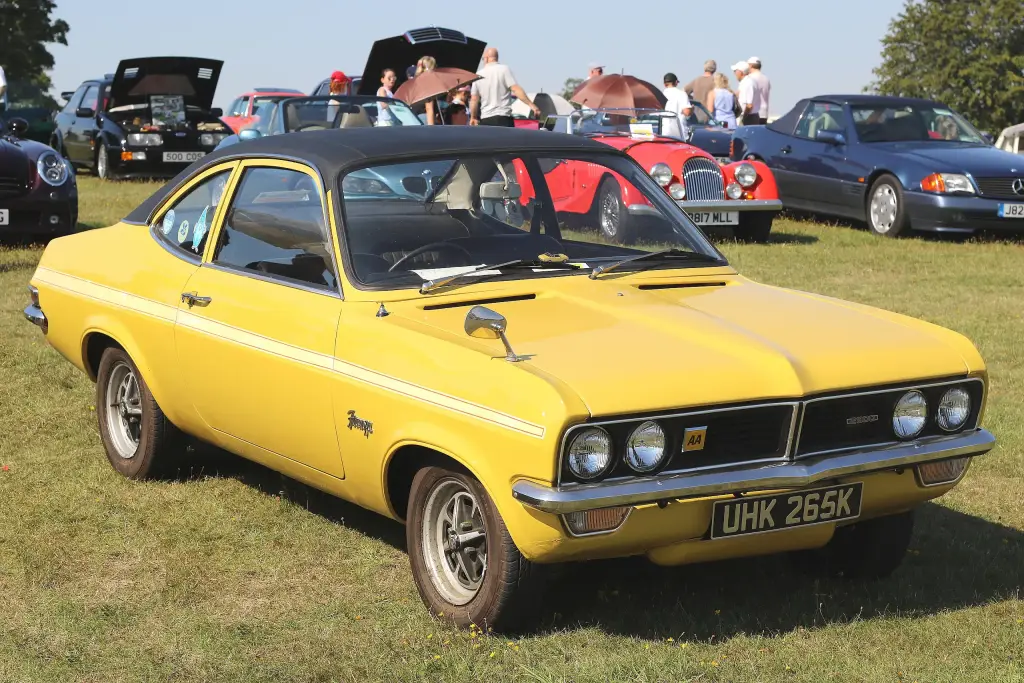
The chassis used double wishbones and coil springs at the front and a live axle with trailing arms and coils at the rear. Its suspension and steering were adapted for the Jensen-Healey sports car. Early in 1972 Vauxhall added the 2300 Sport SL, shown at the Geneva Motor Show, with the 2,279 cc inclined four, single overhead camshaft and twin Stromberg carburettors giving 122 bhp. It was the only version with the seven-dial dashboard — speedometer, clock, rev counter, fuel, oil pressure, water temperature and battery charge — and it had bucket seats front and rear for four people and a distinctive centre console with heater controls. Dealer Team Vauxhall raced the 2300 Sport SL in Castrol colours after its successes with the Viva GT.
In 1973 came the High Performance Firenza, known as the droopsnoot for its aerodynamic GRP nose with two pairs of Cibié headlamps behind toughened glass covers. Wayne Cherry restyled David Jones’s original into an exceptionally low-drag shape, and the 2.3-litre Slant Four was uprated by Blydenstein Racing to 131 bhp with twin 175 Strombergs, a high-lift camshaft and a free-flow tubular manifold. The suspension and brakes were uprated, and a five-speed ZF dog-leg gearbox was fitted. It was the first production car on alloy Avon Safety Wheels, designed to keep the tyre in place after a puncture, and every car was painted Silver Starfire with a black interior and silver-grey cloth seats. The car was launched in a one-off race at Thruxton with Gerry Marshall and Barry Williams among the drivers, but the fuel crisis and production difficulties meant just 204 were built instead of the projected 30,000.
At that point the flat-fronted Firenza was rebadged as the Magnum coupé, and the Firenza name was used only for the HP model. The droopsnoot nose, productionised, went on to appear on the Chevette, Cavalier and Carlton, and the Firenza was also successful in saloon car racing in its Old Nail and Repco-Holden V8 Baby Bertha forms, driven by Gerry Marshall. In South Africa the car was sold as the Chevrolet Firenza until 1975.
Design and features
- Droopsnoot: the GRP nose with four Cibié lamps that changed Vauxhall design.
- Avon Safety Wheels: the first production car to use them.
- 2300 Sport SL: 122 bhp and the seven-dial dashboard.
- Racing pedigree: Old Nail and Baby Bertha in saloon car racing.
- Rarity: just 204 HP Firenzas built.
Vauxhall Firenza versions
- Firenza 1159 and 1256: the early overhead-valve entry models.
- Firenza 1600 and 2000: Slant-4 engined cars from launch.
- Firenza 1759 and 2279 (1972): the enlarged engines.
- 2300 Sport SL: the seven-dial, 122 bhp top model.
- HP Firenza droopsnoot: 131 bhp, 204 built.
The Firenza was developed from the Viva, and its flat-fronted coupé version became the Magnum. More cars are in the Vauxhall collection.
Sources
- Vauxhall Firenza, English Wikipedia: engines, 2300 Sport SL, HP Firenza, racing
- Vauxhall Firenza, German Wikipedia: model history