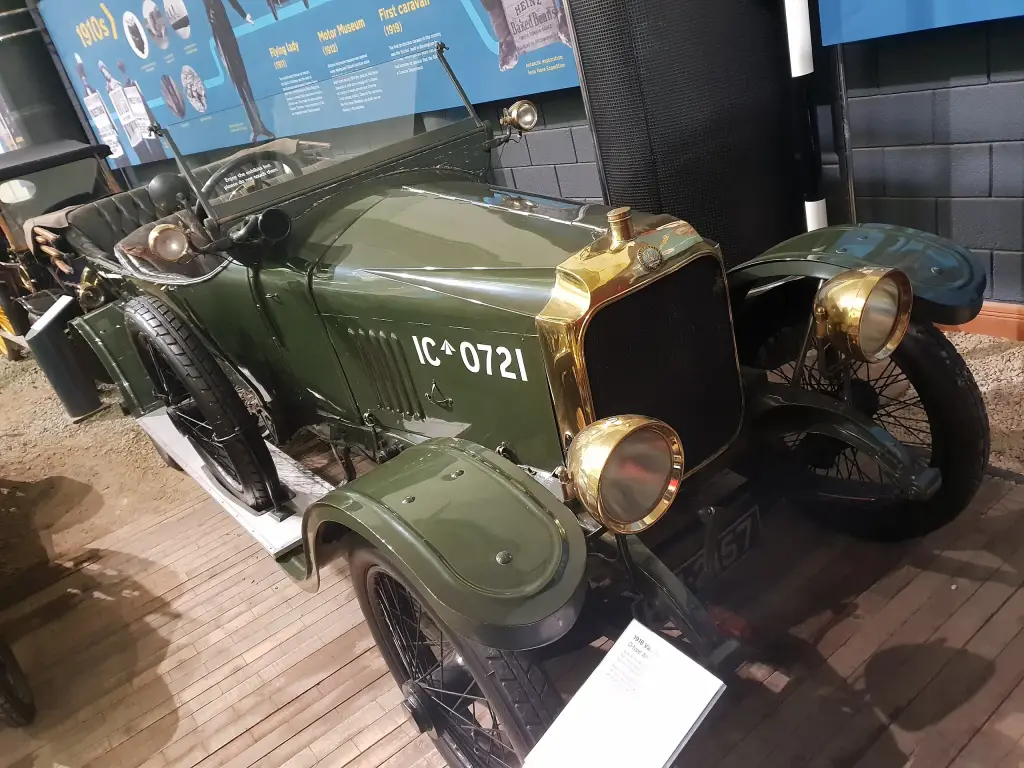
The Vauxhall 25 was the company’s large four-cylinder car of the 1910s and early 1920s; its chassis code, D-Type, is the name most enthusiasts use today. More than 1,500 were bought by the British Army as staff cars during the First World War, and about 4,500 were built before the 23-60 replaced it in July 1922.
Vauxhall 25 at a glance
| Maker | Vauxhall Motors, Luton |
|---|---|
| Production | 1912–1922 |
| Chassis code | D-Type |
| Engine | four-cylinder, 95 × 140 mm, 3,969 cc |
| Power | de-rated from the Prince Henry unit; German Wikipedia gives 50 bhp at 2,000 rpm |
| Top speed | about 60 mph (96 km/h) |
| Transmission | multi-plate clutch, separate four-speed gearbox, rear-wheel drive |
| Brakes | no front brakes; transmission brake by pedal, rear brakes by hand lever |
| Military orders | 1,556 cars for the British armed forces |
| Total built | about 4,500 |
| Replaced by | Vauxhall 23-60, July 1922 |
Written from the English, German and Italian Wikipedia articles on the D-Type.
History of the Vauxhall 25
The 25 hp Vauxhall appeared at the Olympia Motor Show in November 1912 alongside two of its three stablemates, the 5-litre six-cylinder 30 hp car and the lighter 25 hp Prince Henry. All of them wore a new tapered bonnet that ran flush into the body; the smallest Vauxhall, the 16-20, was not shown. The 25 grew out of the Prince Henry: after 1911 many of those sporting cars were given heavy bodies, so Vauxhall re-tuned the engine and de-rated its output, marketing the result as the “weight carrying chassis”. Top speed was around 60 mph.
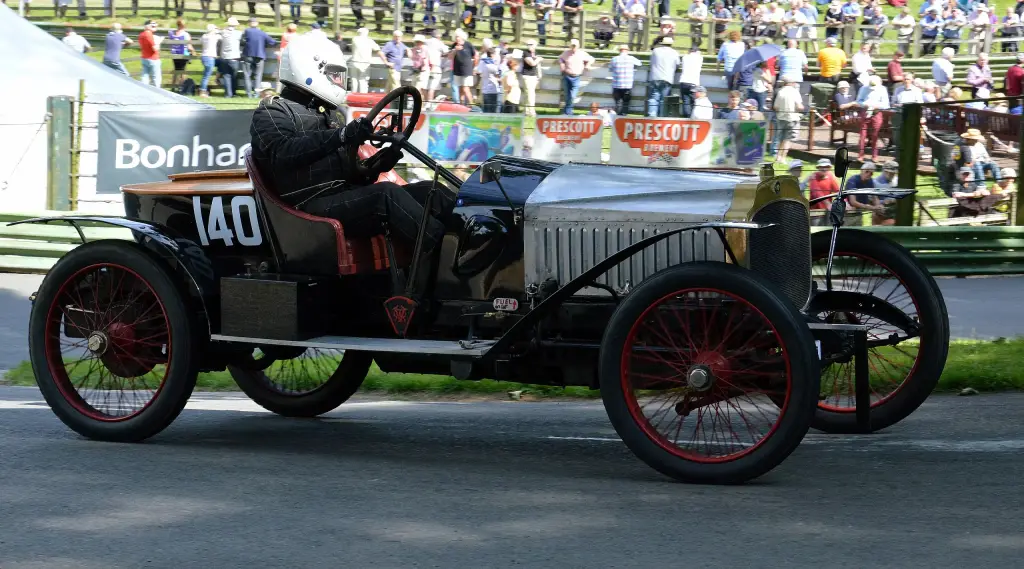
The chassis was substantial, with semi-elliptic leaf springs and rigid axles front and rear. The fixed-head engine of 95 mm bore and 140 mm stroke drove through a multi-plate clutch and a four-speed gearbox separated from the engine; engine, clutch and gearbox sat together on a subframe. Front wheels were unbraked, a transmission brake behind the gearbox was worked by the foot pedal and the rear brakes by a hand lever inside the car. In April 1921 The Times road-tested what it took to be a new model and called it “a thoroughly well-bred machine of the greyhound type”, praising its reserve of power and the ease of its controls, while noting that adjusting the rear brakes needed tools.
The Kington open tourer was the leading line, and the March 1921 catalogue listed works bodies from £1,660 for the Armidale limousine to £1,785 for the Cholmeley cabriolet, with the Warwick landaulette at £1,760. Grosvenor supplied the Denbigh two-seater at £1,528, the Pullman landaulette at £1,979, the Arundel all-weather cabriolet at £1,735 and the Malvern six-seater at £1,550, while Mulliner of Northampton built saloons and limousines from £1,800 to £1,835. Every chassis was sold with a three-year guarantee that included regular inspections.
The war made the model: 1,556 cars went to the armed forces, and British soldiers knew the type on the Western Front. About 4,500 were built in all. The 25 was superseded by the 23-60, which had an overhead-valve engine and later four-wheel brakes.
Design and features
- Army staff car: 1,556 of the 4,500 built were supplied to the British forces in the First World War.
- Subframe powertrain: engine, clutch and gearbox were mounted together on a separate frame.
- Three-year guarantee: every chassis was sold with regular inspections included.
- Catalogue coachwork: works bodies and Grosvenor and Mulliner Northampton designs, priced from £1,528 to £1,979.
Vauxhall 25 versions
- Kington tourer: the factory’s leading open body.
- Works bodies: Cholmeley cabriolet, Armidale limousine and Warwick landaulette.
- Grosvenor bodies: Denbigh, Pullman, Arundel and Malvern.
- Mulliner Northampton: domed-roof and standard saloons and limousines.
- Army staff car: the War Department version used on the Western Front.
The 25 was developed from the sporting Prince Henry, and its place at the top of the range was later taken by the six-cylinder Big Six. More cars are in the Vauxhall collection.
Sources
- Vauxhall D-Type, English Wikipedia: history, engineering, road test, catalogue
- Vauxhall Typ D, German Wikipedia: production years, power, bodies, army order
- Vauxhall D-Type, Italian Wikipedia: engine capacity, production total