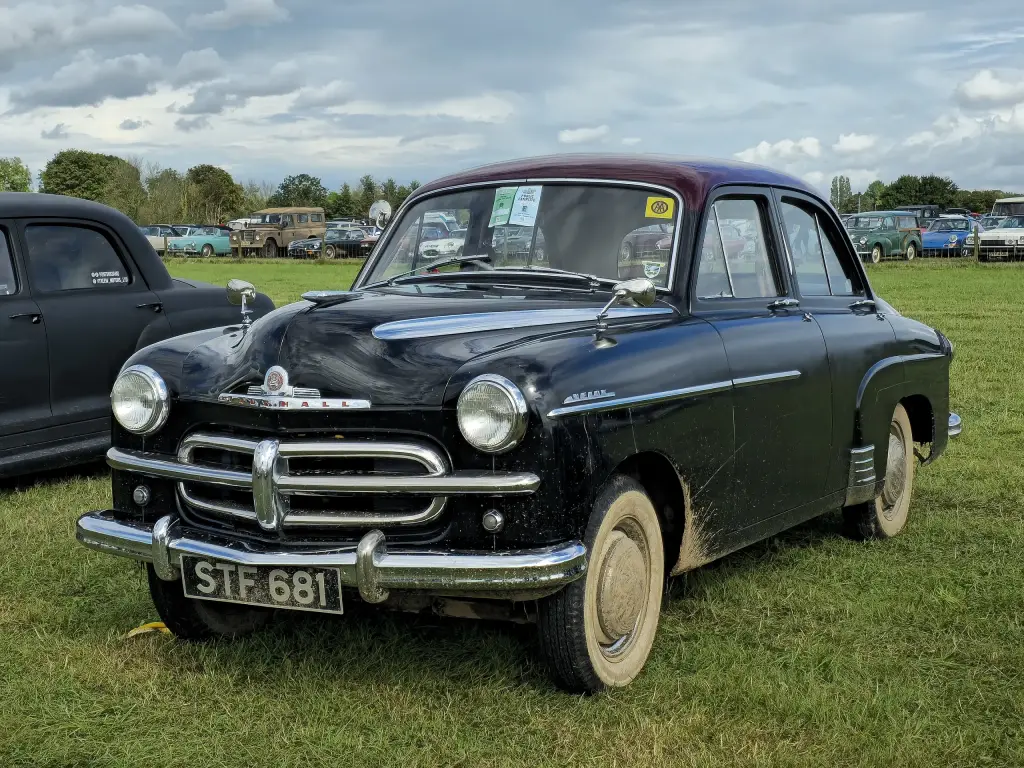
The Vauxhall Velox was a six-cylinder executive car sold from 1948 to 1965. It was introduced shortly before the London Motor Show in October 1948 as a successor to the Vauxhall Fourteen, and it competed in Britain directly with the Ford Zephyr and, to a lesser extent, with the Austin Westminster models.
Vauxhall Velox at a glance
| Maker | Vauxhall Motors, Luton |
|---|---|
| Production | 1948–1965 |
| Series | LIP and LBP (1948–1951), EIP and EBP (1951–1957), PA, PB, PC |
| Engine | 2,275 cc straight six, then 2,262 cc |
| Power | 54 bhp at launch; 58 bhp from 1951; 64–68 bhp from 1952 |
| Top speed | 74 mph at launch; 80.4 mph by 1952 |
| Gearbox | three-speed manual, synchromesh on the top two ratios |
| Shared bodies | Wyvern until 1957, Cresta from 1954 |
| Australian version | Vagabond tourer and coupé utility, from December 1952 |
| Name dropped | 1965, in favour of the Cresta |
Written from the English Wikipedia article on the Velox, with the German article for background. The Viscount is described in the Cresta article.
History of the Vauxhall Velox
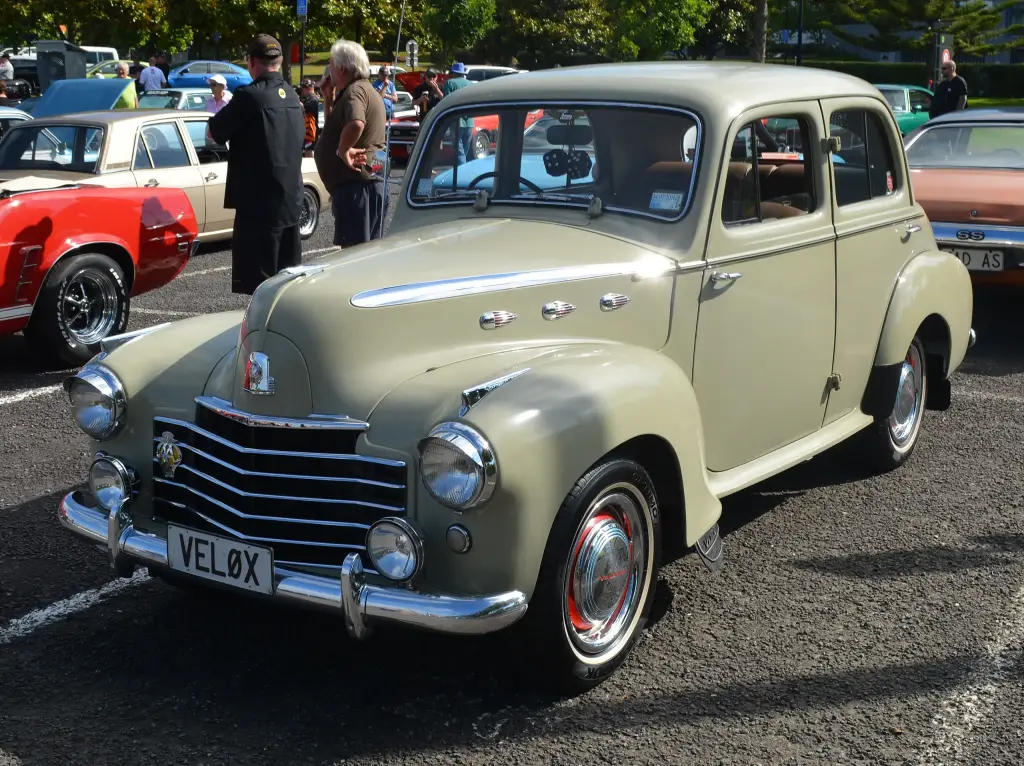
The classic four-door Velox of 1948 had a newly developed straight-six of 2,275 cc with overhead valves, giving 54 bhp and a claimed 74 mph, through a three-speed manual gearbox with synchromesh on the top two ratios. Optional extras included a heater that distributed warm air evenly between the front and rear of the cabin and could be set to de-ice the windscreen in winter or provide cool ventilation in summer, plus an AM radio built into the fascia. Between 1948 and 1957 the Velox shared its body with the less powerful four-cylinder Wyvern.
In August 1951 a longer, wider Velox was launched as the EIP series, with a modern three-box shape and integral construction, again sharing its body with the Wyvern. It used the previous engine with output raised to 58 bhp; The Motor tested it at 77.4 mph and 0–60 mph in 23.7 seconds at 23.5 mpg, for £802 including taxes, against £842 for a similarly equipped Ford Zephyr Six. In April 1952 the car became the EIPV with a new over-square 2,262 cc engine of 64 or, with a higher compression ratio, 68 bhp; a 1952 test recorded 80.4 mph and 21.4 seconds to 60 mph at 23.6 mpg, for £833 including taxes.
In December 1952 General Motors-Holden launched Australian tourer and coupé utility versions of the EIPV Velox, with chassis prefixed EBP and using modified Vauxhall bodies on the Bedford CA chassis. The tourer was originally to be called the Caleche but was renamed the Vagabond at launch; it was a two-door five-seater with a folding top and side curtains, and it did not survive the 1955 facelift.
From August 1954 the Velox shared its body with the more luxurious Cresta, a tradition that lasted until the new PC Vauxhalls of 1965. The Velox and its Opel contemporaries mirrored North American styling trends more closely than most European cars of the time, especially after the 1957 PA version. In 1965 the Velox name was dropped in favour of the more upmarket Cresta, and a new flagship, the Viscount, was launched.
Design and features
- Six-cylinder executive: Vauxhall’s rival to the Ford Zephyr.
- Shared bodies: the Wyvern until 1957, the Cresta from 1954.
- American styling: Ponton shapes and, from 1957, the PA’s fins and wrap-around glass.
- Australian Vagabond: a tourer and utility built on Bedford CA chassis.
Vauxhall Velox versions
- Velox LIP and LBP (1948–1951): the original 2,275 cc car.
- Velox EIP (1951): longer three-box body and 58 bhp.
- Velox EIPV (1952): 2,262 cc engine with 64 or 68 bhp.
- Velox PA, PB and PC: the later generations shared with the Cresta.
- Vagabond: the Australian tourer and coupé utility.
The Velox shared its body with the Wyvern and later the Cresta, and its place at the top of the range was eventually taken by the Viscount. More cars are in the Vauxhall collection.
Sources
- Vauxhall Velox, English Wikipedia: series, engines, prices, road tests, Australian versions
- Vauxhall Velox, German Wikipedia: model history