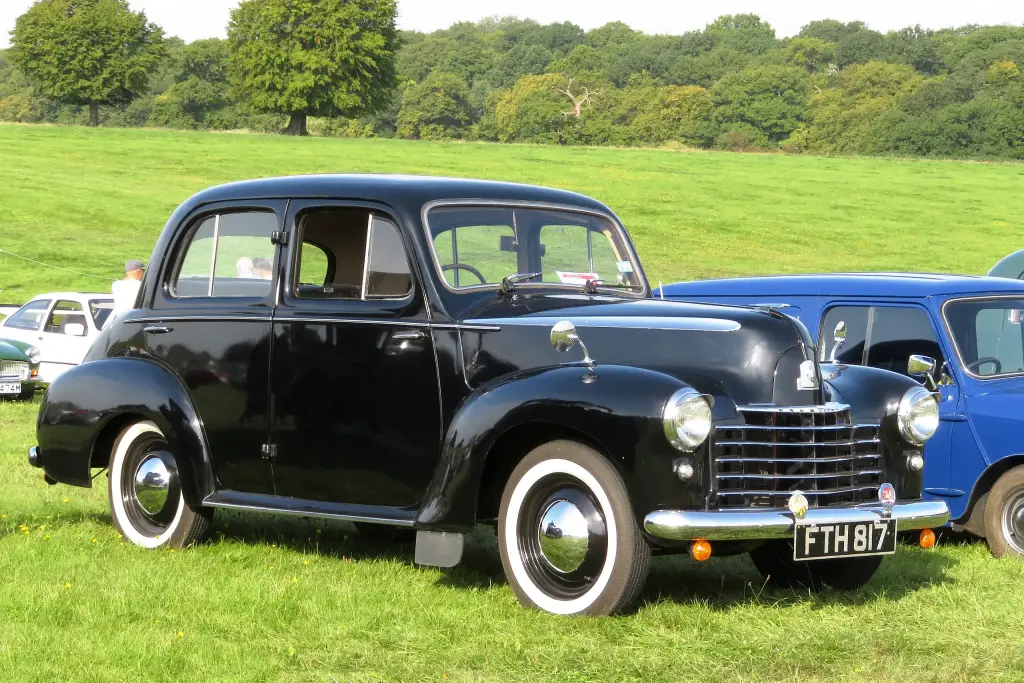
The Vauxhall Wyvern was a medium-sized family car introduced in 1948 as a successor to the Vauxhall Twelve. It was the four-cylinder sister of the six-cylinder Velox, and it stayed in production until 1957, when the smaller but more radically styled Victor replaced it.
Vauxhall Wyvern at a glance
| Maker | Vauxhall Motors, Luton |
|---|---|
| Production | September 1948 – 1957 |
| Series | LIX (1948–1951), EIX and EIXW (1951–1957) |
| LIX engine | 1,442 cc four, 35 bhp |
| LIX top speed | 62 mph |
| EIXW engine | 1,508 cc four, 45 bhp at 4,000 rpm |
| EIXW top speed | 72 mph |
| Sister model | Vauxhall Velox, with six cylinders |
| Built | 5,313 EIX; 105,275 EIXW |
| Replaced by | Vauxhall Victor, 1957 |
Written from the English Wikipedia article on the Wyvern, with the German article for background.
History of the Vauxhall Wyvern
The L-series Wyvern and the Velox were Vauxhall’s first new post-war models. Incorporating American influence, the Wyvern started production in September 1948 and finished in July 1951, and many were exported to help the British economy. The car had a 1,442 cc four-cylinder engine of 35 bhp and a top speed of 62 mph, with a radio, heater and foglight available as options. Because of its American styling, it resembled a miniaturised Chevrolet Fleetline. Australian cars carried the model code LBX.
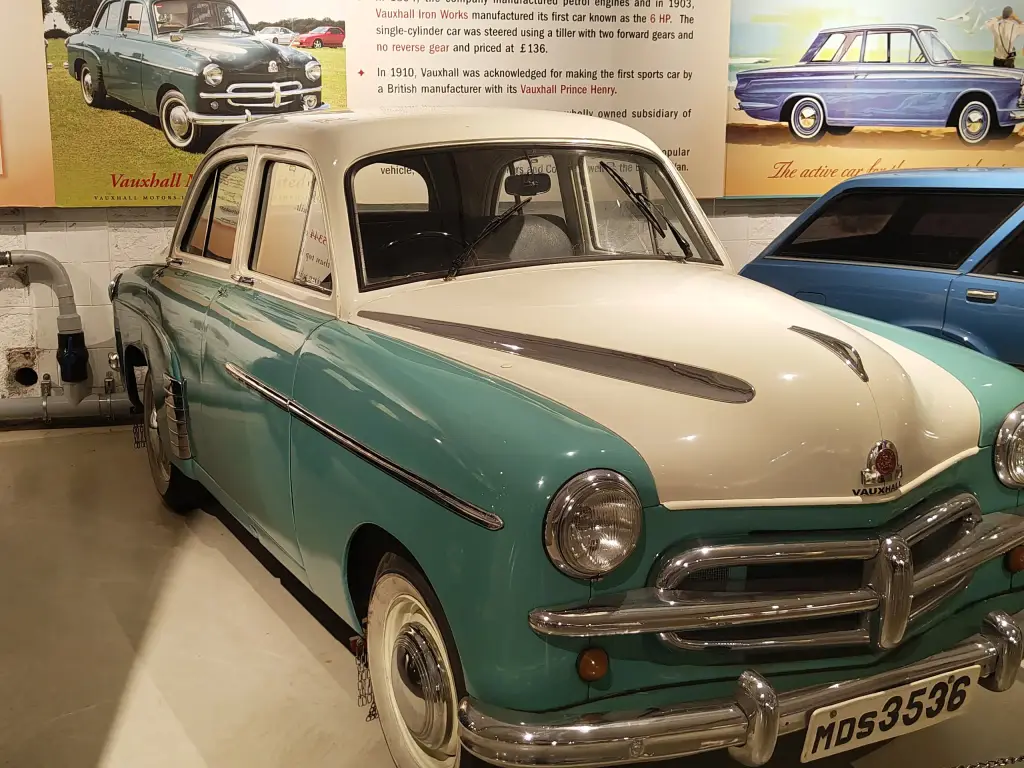
In August 1951 a completely new Wyvern was launched with a modern Ponton three-box shape in a unitary construction body. In spite of the abandonment of the old RAC horsepower tax system that favoured long-stroke engines, the old long-stroke 35 bhp four was retained, allowing a claimed top speed above 62 mph despite the car’s increased size; a more powerful Velox was offered with the same new body. 5,313 of this EIX series were made.
After only six months the Wyvern received, in April 1952, Vauxhall’s new short-stroke 1,508 cc four-cylinder engine. With its six-cylinder Velox sister, the new engine had a bore of 79.3 mm and a stroke of 76.2 mm, identical measurements and therefore capacity to the rival Ford Consul and Zephyr engines introduced two years earlier. With 45 bhp at 4,000 rpm, maximum speed rose to 72 mph. The Motor tested a car with this engine in 1952 at 71.6 mph and 0–60 mph in 37.2 seconds, recording 30.4 mpg; the test car cost £771 including taxes. 105,275 were made.
The EIX series Wyvern received a new bonnet and grille in 1955, a wrap-around rear window in 1956 and another new grille in 1957. It sold well in Britain until Vauxhall abandoned the six-seater four-cylinder market and replaced it with the smaller but more radically styled Victor F-Series in 1957. In Australia, General Motors-Holden built Wyverns from 1938 to 1957; although they looked much like the British cars, some retained a separate chassis, which allowed open tourer and utility bodies, sold as the Caleche and later the Vagabond.
Design and features
- Four-cylinder Velox: the same body as the six-cylinder car.
- American styling: the LIX resembled a smaller Chevrolet Fleetline.
- Short-stroke engine: the 1,508 cc unit of 1952 matched Ford’s dimensions.
- Australian bodies: separate-chassis tourer and utility versions built by GMH.
Vauxhall Wyvern versions
- Wyvern LIX (1948–1951): 1,442 cc and 35 bhp.
- Wyvern EIX (1951–1952): new Ponton body with the old engine.
- Wyvern EIXW (1952–1957): 1,508 cc and 45 bhp.
- Caleche and Vagabond: Australian open and utility versions.
The Wyvern shared its body with the Velox and was replaced by the Victor; its engine was later enlarged into the Vauxhall Twelve. More cars are in the Vauxhall collection.
Sources
- Vauxhall Wyvern, English Wikipedia: series, engines, prices, Australian production
- Vauxhall Wyvern, German Wikipedia: model background