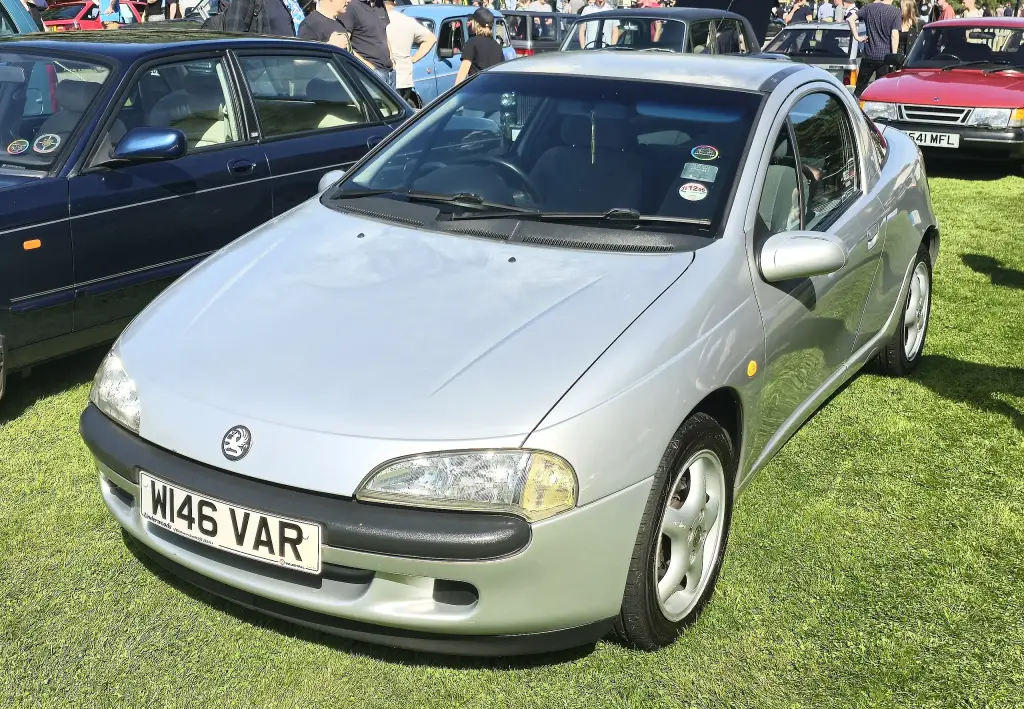
The Vauxhall Tigra was the British name for two Opel cars based on different generations of the Corsa. The first, from 1994 to 2000, was a small 2+2 coupé built in Spain; the second, from 2004 to 2009, was the Tigra TwinTop, a two-seat coupé-cabriolet with a folding hardtop.
Vauxhall Tigra at a glance
| Maker | Vauxhall (Opel Tigra on the continent) |
|---|---|
| Tigra A | 1994–2000, 2+2 coupé based on the Corsa B |
| Tigra A plant | Zaragoza, Spain |
| Tigra A engines | 1.4 90 PS and 1.6 106 PS, both 16-valve |
| Tigra A performance | 0–100 km/h in 10.5 s, 203 km/h |
| Tigra A built | 256,392 worldwide |
| Tigra TwinTop | 2004–2009, based on the Corsa C |
| TwinTop roof | retractable hardtop, built by Heuliez |
| TwinTop engines | 1.4 90 PS, 1.8 125 PS, 1.3 diesel from 2005 |
| TwinTop built | 90,874 |
Written from the English and German Wikipedia articles on the Opel Tigra; the Vauxhall cars are the same models with British badges.
History of the Vauxhall Tigra
The first Tigra was based on the coupé concept car shown at the 1993 Frankfurt Motor Show, alongside an open Tigra Roadster concept and the Scamp off-roader. Its British première came in October 1993 at the London Motorfair. The production car was introduced at the beginning of 1994 and built at Opel’s Zaragoza plant in Spain, with production starting in September 1994.
The Tigra used the platform of the second-generation Corsa but shared no body panels with it, and the interior layout was different although it kept the Corsa dashboard and most major engine parts. It had a 2+2 seating arrangement, with limited rear space because of the coupé styling and compact dimensions. The design carried a lightning theme from the Opel logo, visible where the roof and waistlines meet the reverse rake of the B-pillar. Two 16-valve Ecotec engines were offered: a 1.4 of 90 PS and a 1.6 of 106 PS taken from the Corsa GSi. The 1.4 could be had with a four-speed automatic, and the 1.6 came with front fog lights as standard.
The suspension was essentially unchanged from the Corsa, though tuned by Lotus, and the coupé carried about 150 kg more than the equivalent Corsa. The 1.6 reached 100 km/h in 10.5 seconds, a second slower than the Corsa GSi, but a higher top speed of 203 km/h came from taller gearing, a drag coefficient of 0.31 and standard 15-inch wheels. Television advertisements in Britain used The Pogues’ tune “Fiesta”. GM also sold the car as the Chevrolet Tigra in Brazil and Mexico, and Pontiac considered importing it to the United States before deciding it was too small. Production ended in July 2000 with 256,392 sold worldwide, 59,462 of them in Germany.
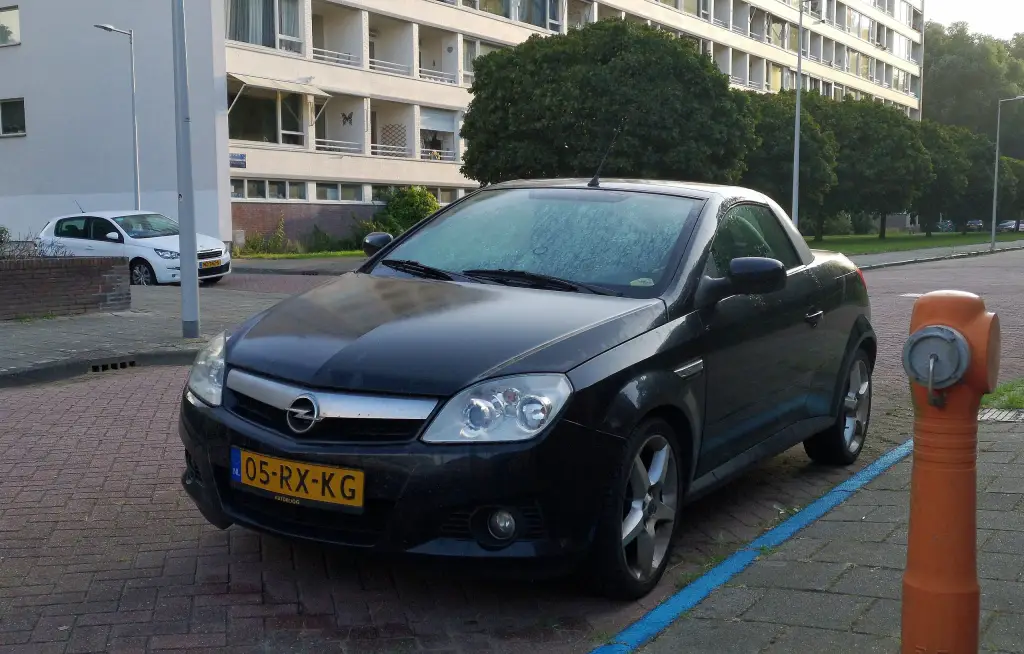
The name returned in June 2004 for the Tigra TwinTop, a two-seater coupé-cabriolet with a retractable hardtop in the fashion of the Peugeot 206 CC, based on the third-generation Corsa. It was launched at the Geneva Motor Show in March 2004 and produced by the French coachbuilder Heuliez, with sales from October 2004. Engines were a 1.4 of 90 PS and a 1.8 of 125 PS, with an economical 1.3-litre Fiat Multijet diesel added in 2005, and the styling featured Vauxhall’s V grille first seen on the 1994 Omega. Production ended in May 2009 after 90,874 cars.
Design and features
- Two cars, one name: a 1990s coupé and a 2000s folding-hardtop roadster.
- Corsa underneath: both generations used Corsa platforms and engines.
- Lotus tuning: the first Tigra’s suspension was set up by Lotus.
- Heuliez roof: the TwinTop’s folding hardtop was built in France.
Vauxhall Tigra versions
- Tigra A 1.4: 90 PS, optional four-speed automatic.
- Tigra A 1.6: 106 PS from the Corsa GSi.
- Chevrolet Tigra: the Brazilian and Mexican version.
- Tigra TwinTop 1.4 and 1.8: the 2004 open cars.
- Tigra TwinTop 1.3 CDTI: the diesel added in 2005.
Both Tigras were based on the Corsa, and the first shared its platform with the Nova’s successor. More cars are in the Vauxhall collection.
Sources
- Opel Tigra, English Wikipedia: both generations, engines, production numbers
- Opel Tigra, German Wikipedia: model background