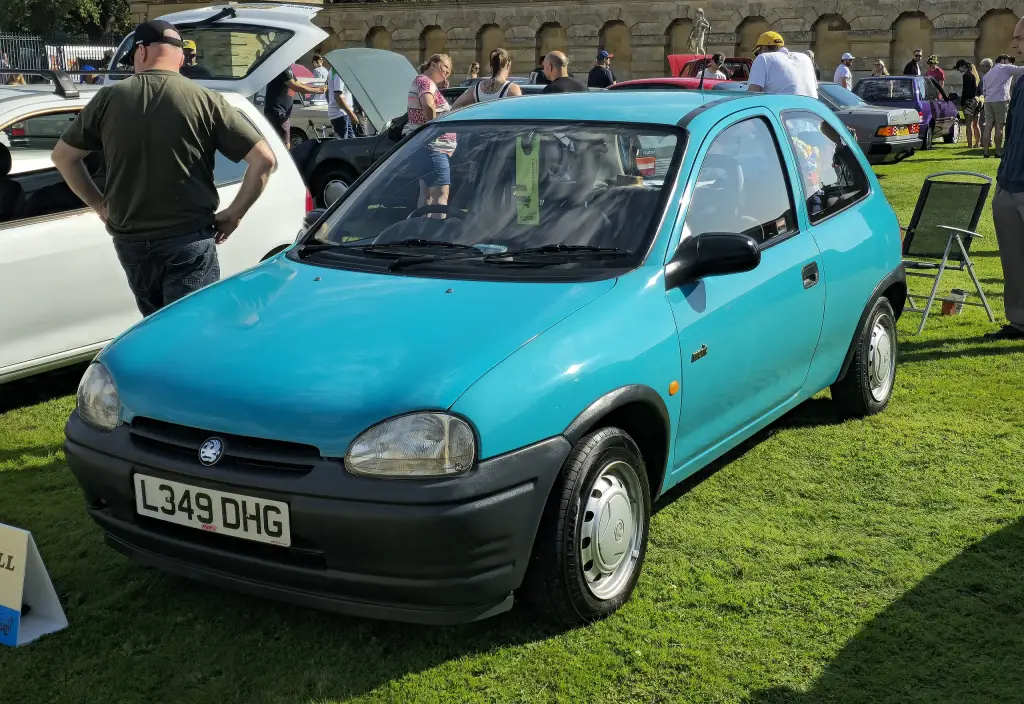
The Vauxhall Corsa is the British name for Opel’s supermini, on sale since 1982 and sold in Britain from April 1983 as the Vauxhall Nova. It became Vauxhall’s best-selling model, and in 1998 the Corsa was the best-selling car in the world with 910,839 sales.
Vauxhall Corsa at a glance
| Maker | Vauxhall (Opel Corsa on the continent) |
|---|---|
| Launched | September 1982 as the Opel Corsa A |
| UK launch | April 1983, as the Vauxhall Nova |
| Built at | Zaragoza, Spain |
| Engine range at launch | 1.0 45 PS, 1.2 55 PS, 1.3 70 PS |
| Hot models | 1.6 GSi from 1987, 101 PS |
| Rally special | Nova Sport of 1985, 500 built, 93 hp |
| Facelift | September 1987 |
| World best-seller | 910,839 Corsas sold in 1998 |
| Corsas built by 2007 | over 18 million |
Written from the English Wikipedia article on the Opel Corsa and the German article on the Corsa A; the Vauxhall Nova and Corsa are the same cars with British badges.
History of the Vauxhall Corsa
The front-wheel-drive Opel Corsa was launched in September 1982, six months after a two-seat roadster concept had been shown at Geneva as a teaser. It went on sale first in France, Italy and Spain, markets where small cars made up 34 to 43 per cent of sales. General Motors’ internal code for the Corsa and Nova was the S-car, a name previously used for an abandoned 1970s supermini proposal that had evolved into the three-door hatchback version of the Kadett C and Chevette. The Corsa was GM Europe’s entry into the supermini class, filling the gap below the Kadett D and Astra, and it followed the template of the Fiat 127, Volkswagen Polo and Ford Fiesta with a transverse engine and front-wheel drive.
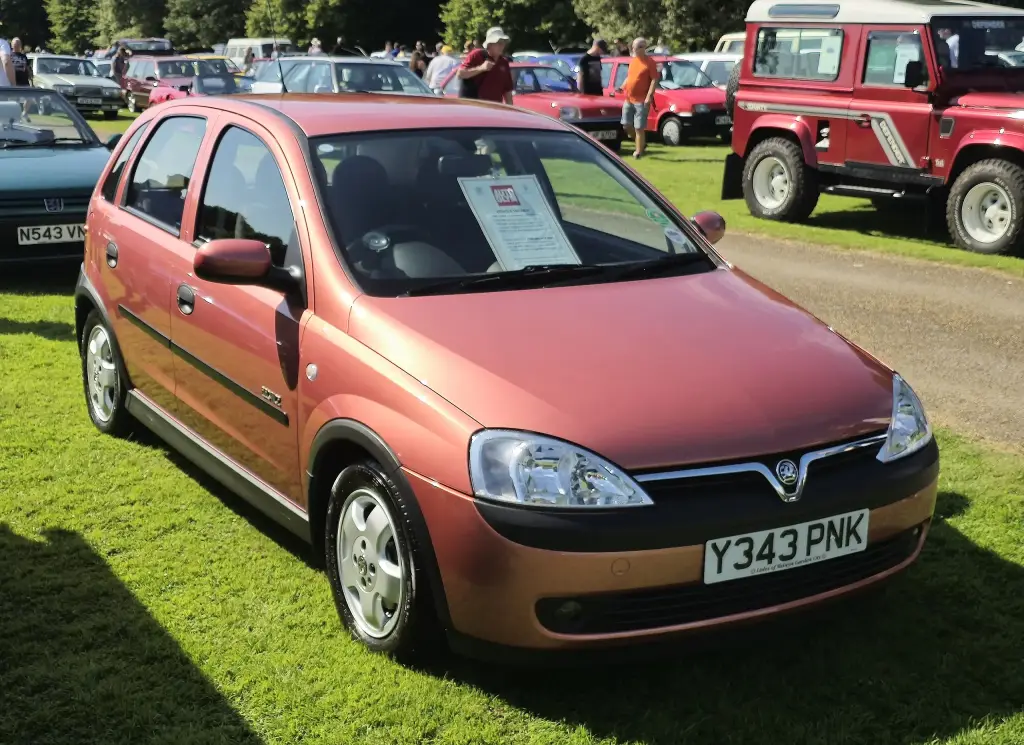
The first Corsas were three-door hatchbacks and two-door saloons, built in Zaragoza, Spain, with four- and five-door versions added in 1984; commercial van models were sold in some markets too. The basic trim was called simply Corsa, followed by Luxus, Berlina and the sporty SR with a spoiler, alloy wheels, checkered seats and a 70 PS engine. In Britain the car was the Vauxhall Nova, a legacy nameplate used elsewhere in the GM empire because Corsa was rejected for sounding too coarse. It launched in April 1983 after a seven-month union dispute over the car being built in Spain rather than Britain, and import tariffs made the trade one-sided: cars from Spain into the European Community paid 4.4 per cent, while cars going the other way paid 36.7 per cent.
Power came from 1.0-litre 45 PS, 1.2-litre 55 PS and 1.3-litre 70 PS petrol engines, all carburetted at first, with fuel injection later but never for the 1.0. The 1.0 and early 1.2 used the older Opel OHV engine, the rest the GM Family I design. At the Frankfurt Motor Show in May 1987 two new engines joined the range: an Isuzu-built 1.5-litre turbo diesel of 67 PS and a 1.6-litre multi-point injection unit of 101 PS in the GSi, with mapping by Irmscher; a 1.4-litre 82 PS SRi followed in Britain. A light facelift in September 1987 brought a new grille shared by hatchbacks and saloons, an updated interior and other small changes, and for 1989 the 1.3 was bored out to 1.4 litres. A rare Sport model of 1985, built to homologate the car for the sub-1,300 cc class of the British Rally Championship, used twin Weber carburettors and gave 93 hp, 112 mph and 0–60 mph in 8.9 seconds; only 500 were made.
The Nova name gave way to Corsa with later generations, and the car’s success grew: in 1998 the Corsa was the best-selling car in the world with 910,839 sales, assembled on four continents and sold under five marques in five body styles, and by 2007 more than 18 million had been sold worldwide. The Corsavan, the car-derived van version, continued the commercial line that had begun with the earliest Corsa vans.
Design and features
- Nova beginnings: the Corsa A was sold in Britain as the Vauxhall Nova from 1983.
- Zaragoza build: the first generation came from Opel’s Spanish plant.
- GSi and SRi: the 1.6-litre 101 PS and 1.4-litre 82 PS sporting models.
- Rally special: 500 Nova Sports built in 1985 for Group A homologation.
- World best-seller: 910,839 Corsas sold in 1998 alone.
Vauxhall Corsa versions
- Corsa A / Nova (1983–1993): hatchback and saloon, later Corsa B by name.
- Nova Sport (1985): 500 cars with twin Weber carburettors.
- Nova GTE and GSi (1987): the 1.6-litre hot models.
- Nova SRi: the 1.4-litre 82 PS version.
- Corsavan: the car-derived van body.
The Corsa replaced the Chevette at the bottom of the range and shares its platform with the Combo van. More cars are in the Vauxhall collection.
Sources
- Opel Corsa, English Wikipedia: Corsa A, Nova, engines, GSi, sales figures
- Opel Corsa A, German Wikipedia: model background