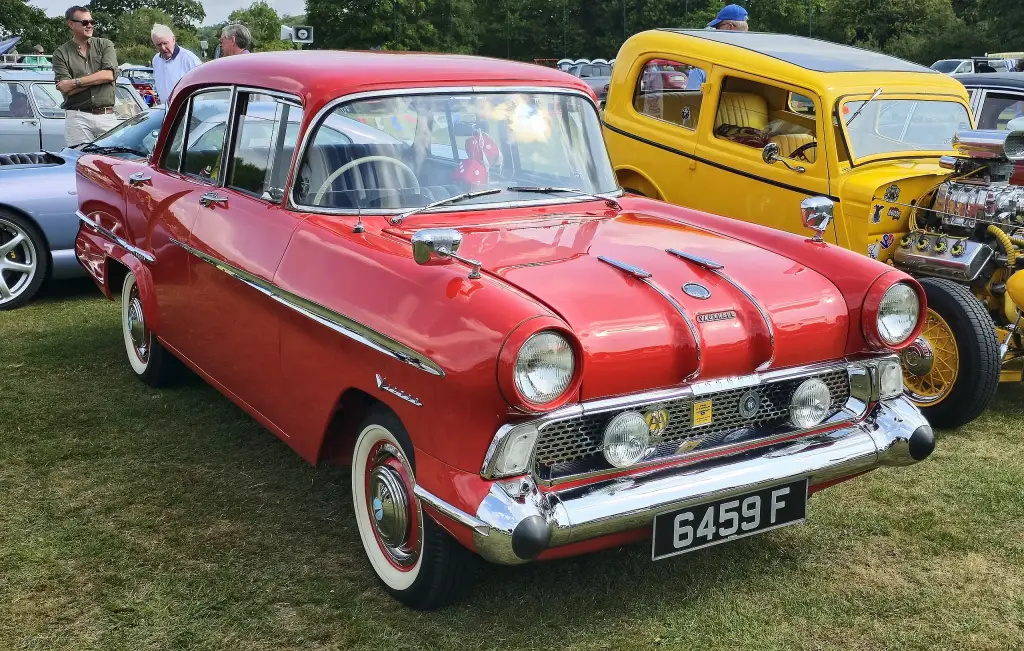
The Vauxhall Victor was a large family car produced from 1957 until 1976, then renamed the Vauxhall VX Series and built until 1978. Over five series it grew from a small 1.5-litre saloon into a large car, and its sporting and luxury derivatives carried the Ventora, VX4/90, VX490 and VX2300 names.
Vauxhall Victor at a glance
| Maker | Vauxhall Motors, Luton |
|---|---|
| Production | 1957–1976 as Victor; 1976–1978 as VX Series |
| Series | F, FB, FC, FD and FE |
| F Series launch | 28 February 1957 |
| F Series engine | 1,508 cc four, 55 bhp |
| F Series bodies | four-door saloon; estate from 1958 |
| FB Series | 1960–1964, with the VX4/90 sports model |
| Sporting models | VX4/90, Ventora, VX490, VX2300 |
| Also built in India | Hindustan Contessa, from the FE |
| Replaced by | Vauxhall Carlton, 1978 |
Written from the English and Italian Wikipedia articles on the Victor; the Ventora, VX4/90, VX490 and VX2300 are covered in the same article.
History of the Vauxhall Victor
The original Victor, launched on 28 February 1957, was coded the F series and ran to more than 390,000 units. It was of unitary construction with a large glass area and heavily curved windscreen and rear window, and its body style was derived directly from the 1955 Chevrolet Bel Air, with forward-sloping A-pillars in the American fashion. Bench seats were fitted front and rear, trimmed in Rayon and Elastofab, with two-colour interior trim as standard; the Super had extra chrome around the windows, remnants of the Vauxhall bonnet flutes along the front flanks and an exhaust pipe exiting through the rear bumper. It was meant to compete with the Ford Consul Mk2, Austin A55 Cambridge and Morris Oxford Series III. An estate variant arrived in 1958, and a Series II was announced in 1959 with simplified styling, losing the 1957 Buick-style bumper pods.
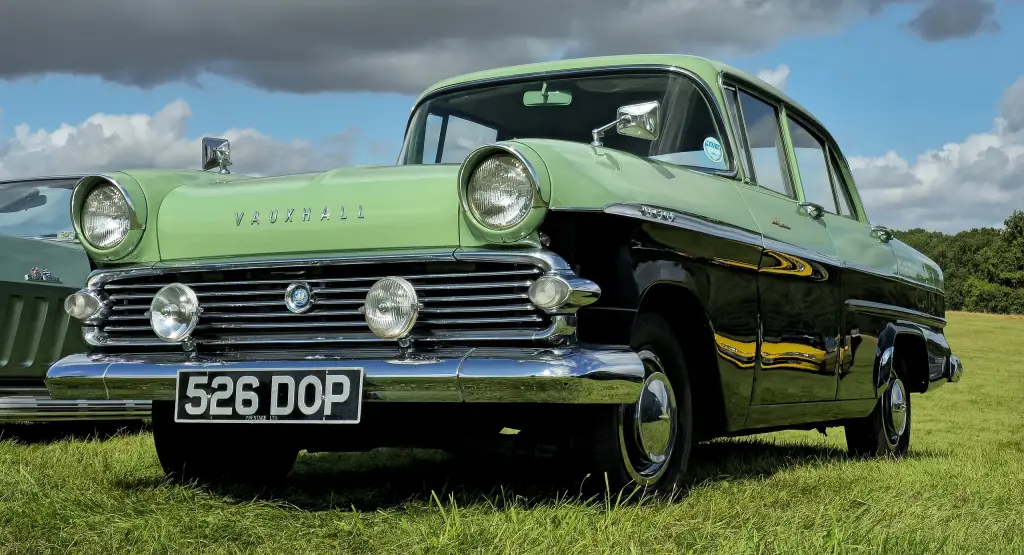
The F Series engine was new in critical respects despite being of similar size to the Wyvern’s, with a single Zenith carburettor and 55 bhp at 4,200 rpm, and it gained a reputation for a long trouble-free life. Synchronised premium petrol allowed the compression ratio to rise from 6.8:1 to 7.8:1. The three-speed gearbox had synchromesh on all forward ratios and a column-mounted lever, and Newtondrive two-pedal control was optional in early 1958. Front suspension was independent by coil springs with an anti-roll bar on a rubber-mounted cross member, the rear used a live axle and semi-elliptic springs, and Lockheed 8-inch drum brakes were fitted. The Motor tested a Super in 1957 at 74.4 mph and 0–60 mph in 28.1 seconds, at 31 mpg, for £758 including taxes; the estate cost £931.
The more cleanly styled FB was announced on 14 September 1960 and ran until 1964 with much better rust protection. It was widely exported, although American sales ended after 1961 when Pontiac, Oldsmobile and Buick launched their own compacts, and it reached 328,000 cars. Mechanically the main change was an optional four-speed all-synchromesh floor-change gearbox alongside the standard three-speed column change, and the engine was revised to 49.5 bhp, then enlarged from 1,508 to 1,594 cc in September 1963. The sporting VX4/90 used a twin-choke carburettor and a higher compression ratio for 71 bhp, plus servo brakes, side stripes, a different grille and larger rear lamps.
The Victor briefly became Britain’s most exported car, sold in the United States through Pontiac dealers, in Canada as both Victor and Envoy, and in Australia, New Zealand, South Africa, Ceylon, India, Pakistan, Malaysia, Thailand and Singapore. The FE of the 1970s was built under licence in India as the Hindustan Contessa with an Isuzu engine into the 1980s and 1990s. In 1976 the Victor was renamed the VX Series, and in 1978 it was replaced by the Carlton, essentially a badge-engineered Opel Rekord E. The Ventora, VX4/90, VX490 and VX2300 were all derivatives of the same line rather than separate models.
Design and features
- American styling: the F Series body came from the 1955 Chevrolet Bel Air.
- Export success: for a time the Victor was Britain’s most exported car.
- VX4/90: the sporting version with 71 bhp, servo brakes and side stripes.
- Long life abroad: built in India as the Hindustan Contessa.
- VX Series: the name used for the last two years, 1976–1978.
Vauxhall Victor versions
- Victor F (1957–1961): 1,508 cc saloon and estate.
- Victor FB and VX4/90 (1960–1964): the cleaner second series and its sporting model.
- Victor FC, FD and FE: the later series of the 1960s and 1970s.
- Ventora: the luxury six-cylinder derivative.
- VX490 and VX2300: the sporting models of the 1970s.
- VX Series (1976–1978): the final name for the range.
The Victor replaced the Wyvern in 1957 and was itself replaced by the Carlton; its sporting versions overlapped with the Magnum. More cars are in the Vauxhall collection.
Sources
- Vauxhall Victor, English Wikipedia: series, engines, prices, exports, VX4/90
- Vauxhall Victor, Italian Wikipedia: F and FB series details, production figures