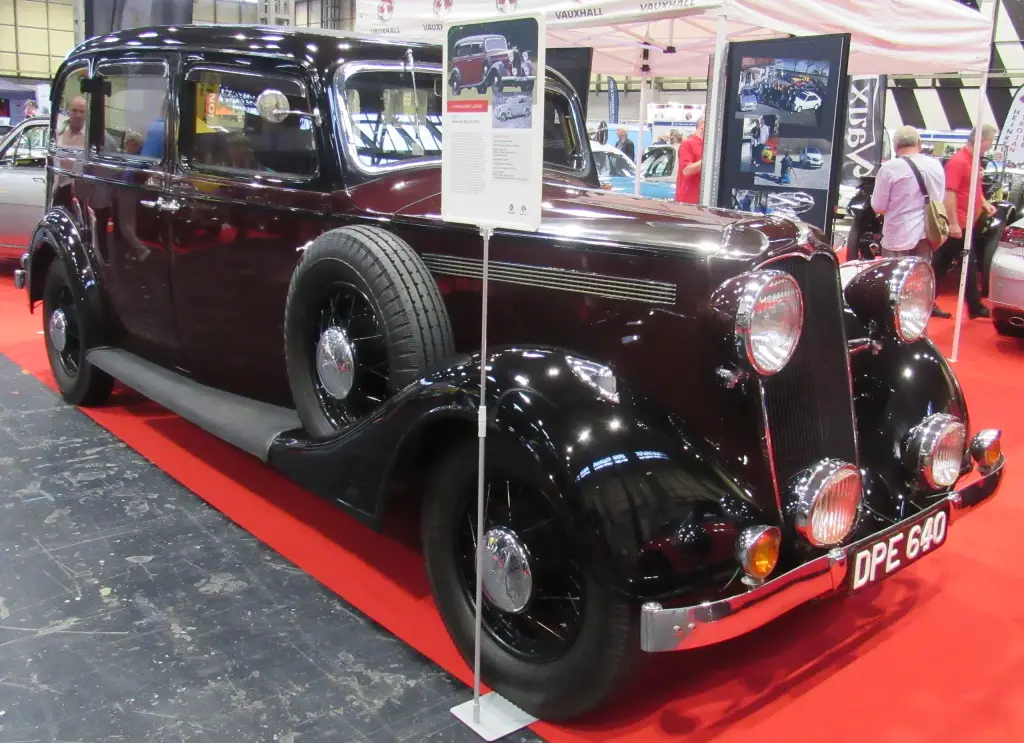
The Vauxhall Big Six was the company’s large six-cylinder car of the 1930s. Introduced in 1934 on a lengthened Cadet chassis, it grew into the 1937 GY/GL — the last chassis Vauxhall designed — and went out of production when the Second World War began.
Vauxhall Big Six at a glance
| Maker | Vauxhall Motors, Luton |
|---|---|
| Production | 1934–1940 |
| Models | BX, BY and BXL (1934–1937); GY and GL (1937–1940) |
| Chassis | lengthened Cadet, 111 in wheelbase; BXL and GL 130 in |
| Engines | 3,180 cc six (27 hp); 2,393 cc six (20 hp, 52 bhp) |
| 1937 engine | 3,215 cc six |
| Gearbox | four-speed, “silent third”, synchromesh on third and fourth |
| Starting | Pedomatic — the accelerator pedal worked the starter |
| Brakes | Lockheed hydraulic, dual circuit, from 1937 |
| Price at launch | £325 for the standard saloon, £550 for the long-wheelbase limousine |
| Built | 3,788 BX/BY, 796 BXL, 6,822 GY/GL |
Written from the English Wikipedia article on the Big Six, with the German article for background.
History of the Vauxhall Big Six
The Big Six was based on a lengthened 111-inch version of the Vauxhall Cadet, with a conventional chassis, semi-elliptical leaf springs all round, Vauxhall-Lovejoy hydraulic dampers and wire-spoked wheels. The engine sat further forward than in the Cadet, and a long-wheelbase BXL model on a 130-inch chassis was offered for buyers who wanted larger coachbuilt bodies. Two six-cylinders were available: a 3,180 cc unit rated at 27 hp and a smaller 2,393 cc, 20 hp engine of 52 bhp at 3,900 rpm. Power went to the rear axle through a single-plate clutch and a four-speed gearbox with a “silent third” and synchromesh on third and fourth; the car had twelve-volt electrics.
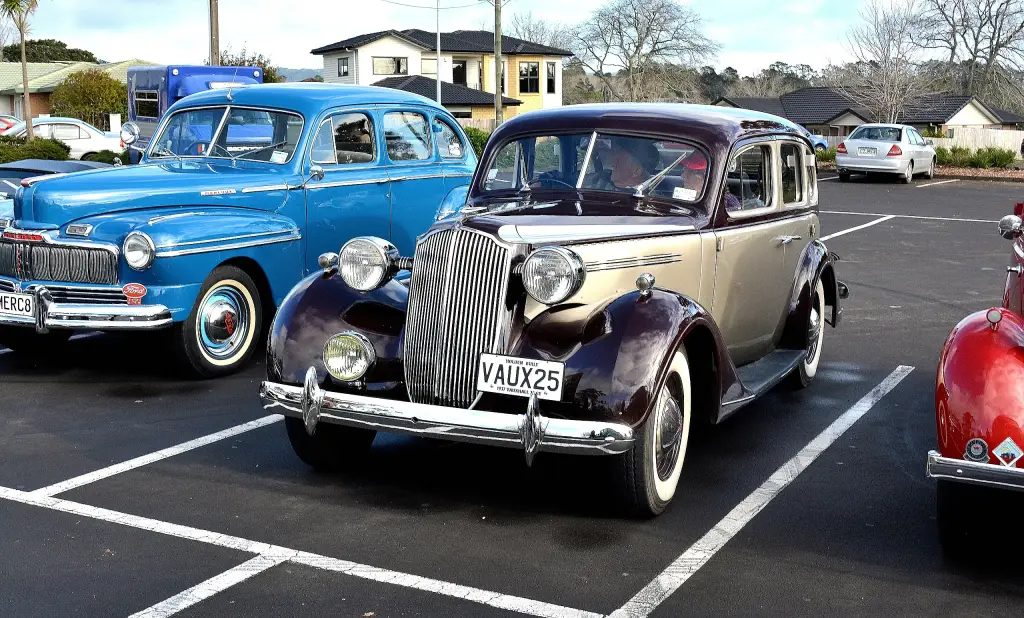
One feature was unique to the Big Six: the Pedomatic starting system. The driver depressed the accelerator pedal, which switched on the starter motor; once the engine caught, the vacuum in the inlet manifold disengaged the starter. The factory saloon was well equipped, with leather upholstery, plenty of wood trim and Triplex toughened glass throughout, and the brochure listed the Hurlingham coupé by Grosvenor, the Rye cabriolet, and Denton and Romney coupés by Martin Walker. A seven-seater Newmarket saloon joined the range in 1934, and 1935 brought a body-coloured radiator grille, a spare-wheel cover and redesigned front seats. The standard saloon cost £325 at launch and the long-wheelbase limousine £550. The Motor tested a 27 hp BY in 1934 at 72 mph and 0–60 mph in 28 seconds; Autocar recorded 36.5 seconds to 60 mph in a 20 hp BX in 1936.
The GY/GL, also called the Twenty Five, replaced the BX/BY in 1937 after being shown at the 1936 London Motor Show. The chassis had the same wheelbase options but was completely new, with cross-braced spacing members for rigidity, and it was the last car chassis Vauxhall designed. Steel wheels replaced wire ones, the front suspension became independent on torsion bars, and Lockheed hydraulic brakes with a dual circuit were fitted. The engine grew to 3,215 cc by lengthening the stroke to 101.6 mm and reducing the bore to 81.9 mm, which moved the car into the lower 25 hp tax class. Synchromesh reached first gear in 1938, when a heater became standard and the Pedomatic system was dropped. Autocar recorded 76 mph and 0–60 mph in 21.9 seconds. Production stopped with the war after 6,822 cars, and the model did not return.
Design and features
- Pedomatic starting: the accelerator pedal operated the starter, disengaged by inlet vacuum.
- Two sixes: a 27 hp 3,180 cc and a 20 hp 2,393 cc engine.
- Coachbuilt choice: Grosvenor, Martin Walker and other bodies alongside the factory saloon.
- 1937 GY/GL: independent torsion-bar front suspension and dual-circuit hydraulic brakes.
- Last Vauxhall chassis: the GY/GL was the final separate chassis the company designed.
Vauxhall Big Six versions
- BX (20 hp): the smaller-engined Big Six.
- BY (27 hp): the larger 3,180 cc model, tested at 72 mph.
- BXL: long-wheelbase chassis for coachbuilt bodies, 796 built.
- GY/GL Twenty Five (1937): new chassis, 3,215 cc and hydraulic brakes.
- Newmarket saloon: seven-seater added in 1934.
The Big Six was built on a lengthened Cadet chassis, and the smaller six-cylinder cars of the same years are covered in the Wyvern article. More cars are in the Vauxhall collection.
Sources
- Vauxhall Big Six, English Wikipedia: models, engines, equipment, prices, production
- Vauxhall Big Six, German Wikipedia: model history