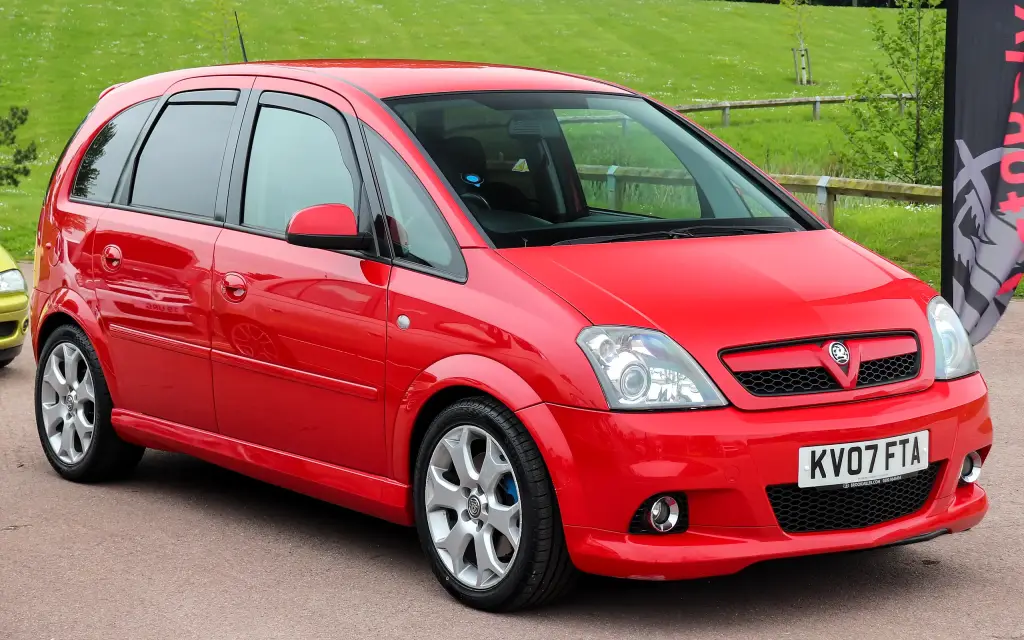
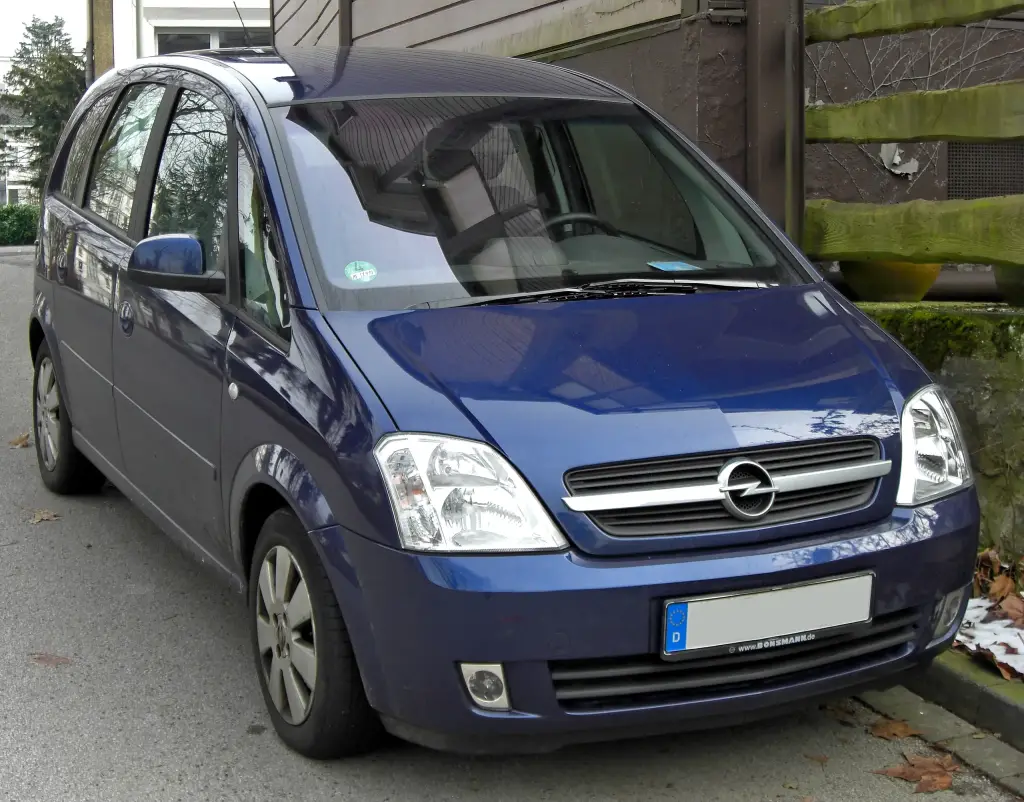
The Vauxhall Meriva was a small people carrier based on the Corsa, sold from May 2003 to June 2017 in two generations. The first was a mini MPV with a flexible rear bench, the second a larger car with rear-hinged doors called FlexDoors.
Vauxhall Meriva at a glance
| Maker | Vauxhall (Opel Meriva on the continent) |
|---|---|
| Production | May 2003 – June 2017 |
| Generations | Meriva A (2003–2010), Meriva B (2010–2017) |
| Based on | Opel Corsa C, then a Zafira Tourer-related floorpan |
| Seats | five, in two rows |
| Meriva A length | 4,052 mm |
| Meriva B length | 4,288 mm |
| Meriva A facelift | February 2006, adding the OPC/VXR |
| Meriva B launch | 12 June 2010, with FlexDoors |
| Replaced by | Crossland X, 2017 |
Written from the English and German Wikipedia articles on the Opel Meriva; the Vauxhall car is the same model with a different badge.
History of the Vauxhall Meriva
The first Meriva went on sale in May 2003, based on the third-generation Opel Corsa. It was described variously as a mini MPV, a supermini-MPV, a small people carrier and an estate car. Like the larger Zafira it had a flexible interior marketed as FlexSpace: although there were only five seats in two rows, the second row could slide forwards or backwards or fold flat into the floor to make a level platform and a bigger boot, and could be ordered to carry two or three passengers. In two-passenger mode the seats were separated from the doors and from each other like the front seats; in three-passenger mode the back seat looked like a normal one-piece bench. The front seat could be pushed fully backwards.
From launch there were three petrol engines and one diesel; in 2005 the 1.6 8v petrol was replaced by a more powerful and efficient 1.4. A 1.6 turbo with a six-speed manual was the quickest standard model, and the 1.6 16v and 1.8 petrols could be had with a five-speed Easytronic gearbox. The Meriva was also built and sold in South America as the Chevrolet Meriva, developed jointly by Opel and General Motors do Brasil at São José dos Campos, until the Chevrolet Spin replaced it in 2012. A facelift in February 2006 revised the front and rear ends, brought new and revised engines and added an OPC/VXR trim level with a 1.6 turbo of 180 PS. Euro NCAP gave the Meriva four stars for adult occupants and one for pedestrians in 2003.
The second generation was a larger car, launched on 12 June 2010 after appearing in November 2009 and at the Geneva Motor Show in March 2010. At 4,288 mm it was some 236 mm longer than the first Meriva, and it used revised suspension with a floorpan related to the seven-seat Zafira Tourer and an interior similar to the 2009–2015 Astra and Insignia. Front seats came from the Insignia and Astra with 240 mm of length adjustment and 65 mm of height. Its signature feature was the rear-hinged rear doors marketed as FlexDoors; a panoramic sunroof was standard on top versions. Euro NCAP gave the Meriva B five stars in 2010.
A facelifted Meriva was shown at the Frankfurt Motor Show in September 2013 and premiered at the Brussels show in January 2014, and in January 2014 Opel added a new 1.6 CDTI diesel in 95, 110 and 136 PS forms. Production ended in June 2017, and the Meriva was replaced by the Crossland X as Opel and Vauxhall moved from MPVs towards SUVs.
Design and features
- FlexSpace: the sliding, folding second row of the first Meriva.
- FlexDoors: rear-hinged rear doors on the second generation.
- OPC/VXR: the 180 PS 1.6 turbo of 2006.
- Five stars: Euro NCAP rating for the Meriva B in 2010.
Vauxhall Meriva versions
- Meriva A (2003–2010): the original Corsa-based mini MPV.
- Meriva OPC/VXR (2006): 1.6 turbo with 180 PS.
- Chevrolet Meriva: the South American version built in Brazil.
- Meriva B (2010–2017): the larger car with FlexDoors.
- 1.6 CDTI (2014): the new diesel in three power outputs.
The Meriva was based on the Corsa and sat below the larger Zafira in the range. More cars are in the Vauxhall collection.
Sources
- Opel Meriva, English Wikipedia: both generations, engines, safety, end of production
- Opel Meriva, German Wikipedia: model background