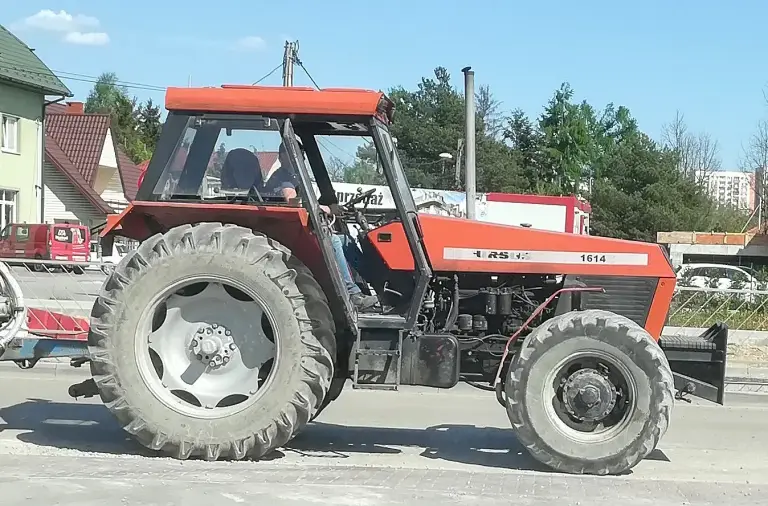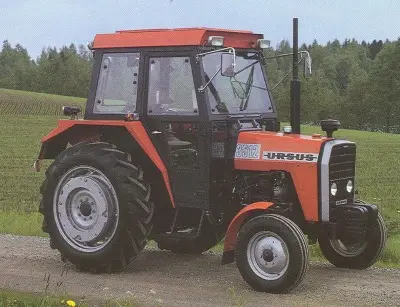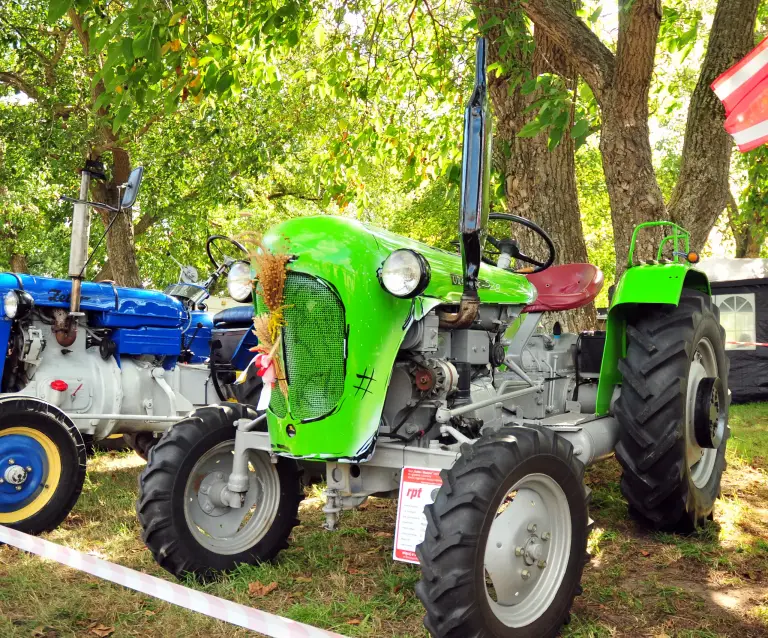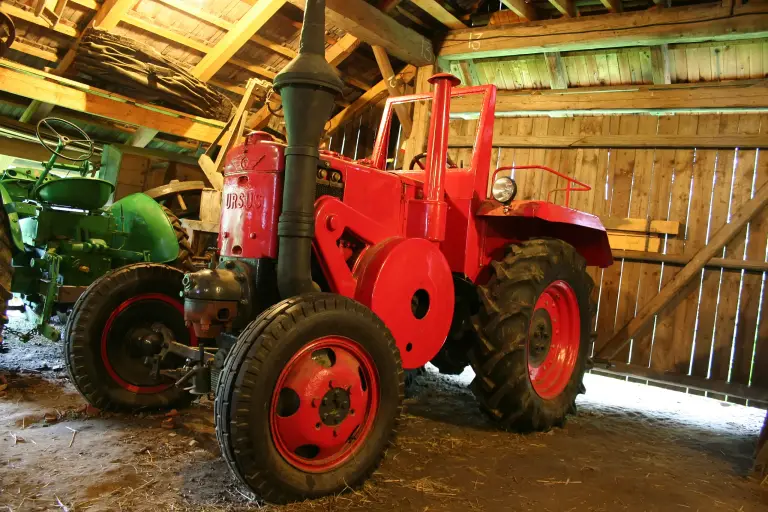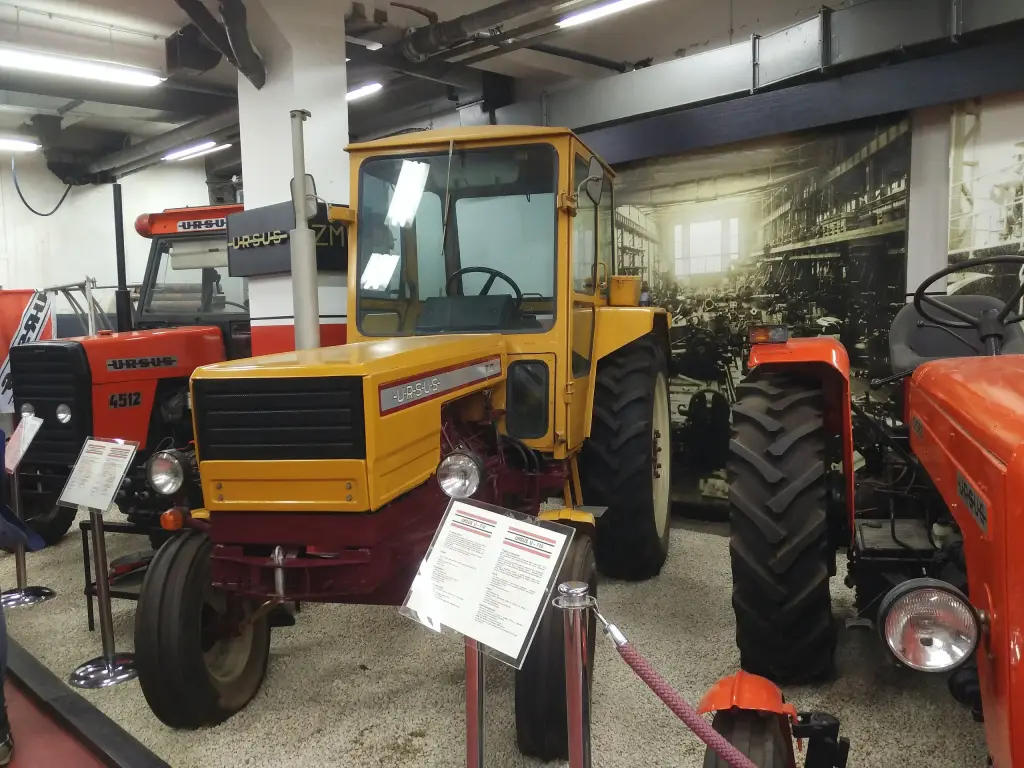
The Ursus U-710 was the heaviest member of the Ursus 500 and 700 family, a class 1.4 prototype worked on between 1968 and 1972. It never reached series production, but its 72 hp four-cylinder diesel, twelve-speed gearbox and hydrostatic steering show how far the Warsaw design office had come.
Ursus U-710 at a glance
| Maker | Ursus design office, Warsaw, Poland |
|---|---|
| Type | prototype |
| Developed | 1968–1972 |
| Tractor class | 1.4 |
| Family | Ursus 500 and 700, second generation 310, 510, 610, 710 |
| Cooperation | Renault designers, 1970–1971 |
| Engine | Ursus S-44, four-cylinder diesel |
| Displacement | 4,180 cc, bore/stroke 110/110 mm |
| Power | 53 kW (72 hp) at 2200 rpm |
| Torque | 26.2 kGm at 1500–1600 rpm |
| Gearbox | 12 forward / 4 reverse with reducer |
| Lift capacity | 1,480 kg |
| Status | not produced in series |
This page is based on one source, the Polish Wikipedia article on the Ursus 710 prototype.
History of the Ursus U-710
In the second quarter of 1969 work began on a unified family of light and medium tractors under the working names Ursus 500 and 700. For this family Professor Edward Habich developed a three-stage planetary transmission called Trimat, which allowed gear changes under load. Between 1970 and 1971, in cooperation with designers from Renault, an improved second generation of the family was developed: the Ursus 310, 510, 610 and 710.
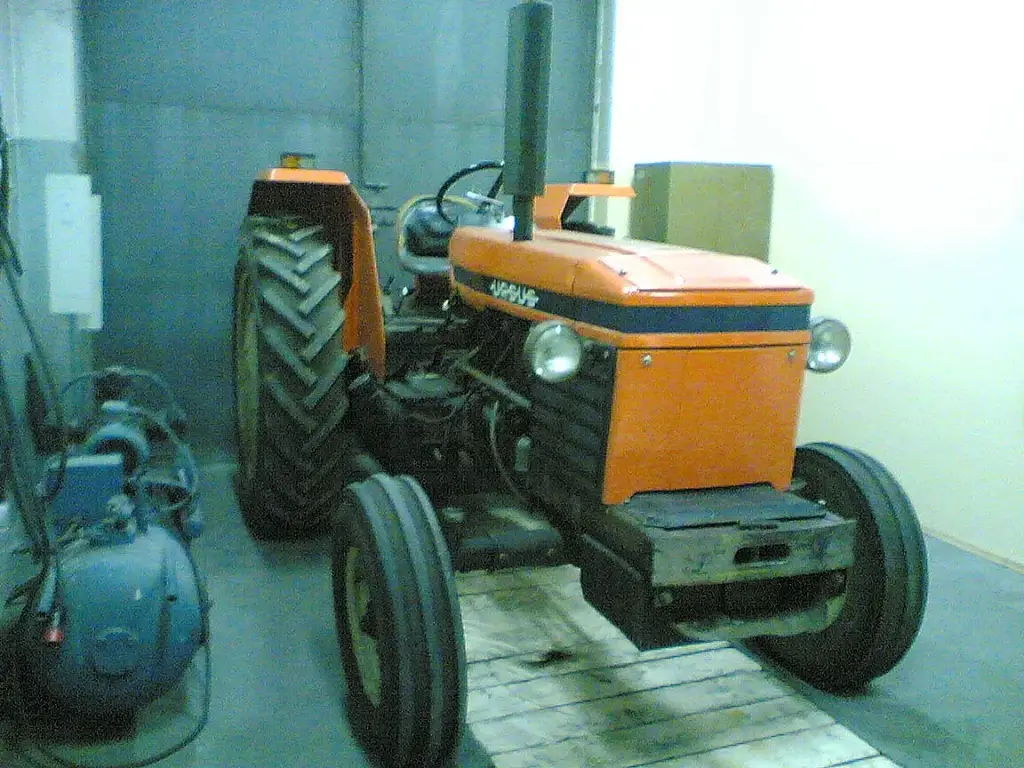
The U-710 was the largest of the four and had a maximum power comparable with the Ursus C-385. The team included Bogumil Bajdecki, Waclaw Bolimowski, Jerzy Dabrowski, Mieczyslaw Dziedzicki, Leszek Husak, Jerzy Kowalczyk, Edward Pawlikowski, Henryk Szczygiel, Jan Tarasik, Jerzy Wygladala, Wladyslaw Zawadzki and Janusz Zielinski. The construction of the tractors and their gearboxes was protected by provisional patent applications.
The engines of the family were meant to serve outside agriculture as well. The Institute of Mining Technology KOMAG used the Ursus S-44G engine, adapted for workings at risk of explosion, in a prototype locomotive designated Lds-70, and the Ursus S-34G engine, with a water-cooled exhaust manifold, in the KOCUR BM mining tractor.
The project ended for reasons of national policy rather than engineering. A government decision of 17 September 1971 approved a tractor production programme based either on designs from the farm tractor research centre or on purchased licences. A second decision, of 3 January 1973, directed the industry to develop by buying licences. The U-710 and its family were not built in series, and Poland went on to produce licensed designs such as the Massey Ferguson-based 2812 and 3512.
The U-710 had a four-cylinder Ursus S-44 diesel of 4,180 cc producing 53 kW at 2,200 rpm, a single dry clutch of 165 by 280 mm and a hydraulically operated wet multi-plate PTO clutch of 100 by 130 mm. The mechanical gearbox had twelve forward and four reverse speeds with a reducer, the final drive was an Oerlikon bevel gear of 6.375 ratio and the planetary reductions had a ratio of 5.4. Brakes were wet self-energising discs, steering was hydrostatic Orbitrol, and the category II linkage lifted 1,480 kg with a pump delivering 38 litres a minute at 1,900 rpm.
Design and features
- Trimat transmission: a three-stage planetary gearbox designed by Edward Habich for shifting under load.
- 72 hp S-44 diesel: 4,180 cc, direct injection, comparable in power to the C-385.
- Hydrostatic steering: Orbitrol system, advanced for a Polish tractor of the period.
- Modern brakes: wet disc brakes with self-energising action, independent on the rear wheels.
- Renault cooperation: the second generation of the family was developed with Renault designers.
Ursus U-710 versions
- Ursus 310: the smallest member of the second-generation family.
- Ursus 510 and 610: the middle models of the same family.
- Ursus 710: the class 1.4 model described here, the most powerful of the four.
- Mining derivatives: the S-44G engine in the Lds-70 locomotive and the S-34G in the KOCUR BM tractor.
The U-710 would have sat above the Ursus C-385 in power, and its production role was later filled by models such as the Ursus 912. More tractors are in the Ursus collection.
Sources
- Ursus 710, Polish Wikipedia: development, family, designers, engines, technical data, cancellation