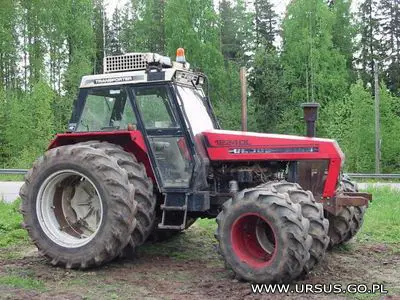
The Ursus C-385 was the heavy tractor created by the joint Polish-Czechoslovak research centre in Brno. Built in Warsaw from July 1969 with a Zetor engine and gearbox, it was the first of a family of seven heavy models, the ancestor of the 902 and 1614, and a close relative of the Zetor 8011.
Ursus C-385 at a glance
| Maker | Zaklady Mechaniczne Ursus, Warsaw, Poland |
|---|---|
| Cooperation | Polish-Czechoslovak centre in Brno, from 1963 |
| Names in the project | NUR in Poland, URII Crystal in Czechoslovakia |
| Serial production | from July 1969 |
| Built | 9,559 |
| Equivalent model | Zetor 8011 |
| Engine | Zetor Z-7501, later Z-8001, four-cylinder diesel |
| Displacement | 4,562 cc |
| Power | 55.8 kW (76 hp), later 60 kW (82 hp) |
| Torque | 260 Nm, later 268 Nm |
| Gearbox | 16 forward / 8 reverse with torque multiplier |
| Speed range | 2.37–24.68 km/h |
| Lift capacity | 1,700 kg, later 2,350 kg |
| Weight | 3,525 kg, later 4,040 kg with cab |
This page is based on one source, the Polish Wikipedia article on the Ursus C-385.
History of the Ursus C-385
Before the C-385, Ursus tractors were too small for large areas of land. In the first half of the 1960s the Polish and Czechoslovak governments agreed to build a heavy tractor together: the agreement was signed on 27 August 1963, and work began at the Polish-Czechoslovak Research and Development Centre for Tractors in Brno under Czeslaw Slawski and Jaroslav Zezula. The project was called NUR in Poland and URII Crystal in Czechoslovakia.
The sharp-edged exterior was designed by the Czech industrial designer Otakar Dibilik, and it gave the Czechoslovak version the Crystal name. The cab was mounted on rubber silentblocks to damp vibration and noise, said to be the first such solution in the world and patented, together with many other features: a driving half-shaft, an independent handbrake, a sprung front axle, the tractor body, disc brakes, a hydraulic control device, PTO drive, front weighting and a torque multiplier.
Production was a joint effort. Poland made the rear axle in hall 67 of the heavy tractor assembly at ZM Ursus, the hydraulic lift at Archimedes Wroclaw and the non-driven front axle, and sent them to Czechoslovakia, receiving in return the gearbox from the Praga works at Louny, the engine and ancillaries from Zetor Brno, the fuel tank and the driven front axle. Serial production began in July 1969, and the factory was visited by Wladyslaw Gomulka and the Bulgarian leader Todor Zhivkov. The 500th tractor was built on 2 November 1970 and the 1,000th on 15 March 1971.
In 1970 a prototype Ursus 1100 was built with a Leyland SW-400 engine under Andrychow licence. A major modernisation came in 1973 and reached series production in 1975: the Z 7501 engine was replaced by the Z 8001, raising power from 76 to 82 hp, and a gearbox able to take front drive was introduced, along with the C-385A with a front axle from Uzina Tractorul Brasov in Romania. Six-cylinder engines followed: the Perkins 6.354 in the C-3110 and the Zetor Z8601 in the 1201 and 1204. In 1976 came the turbocharged 100 hp C-385 turbo.
The factory built 9,559 of these tractors, mostly the basic version. The C-385 gave rise to a family of seven heavy models, four- and six-cylinder, naturally aspirated and turbocharged, with two- or four-wheel drive. At the beginning of the 1980s the basic C-385 was renamed Ursus 902.
Design and features
- Joint Polish-Czechoslovak design: developed in Brno and built from parts made in both countries.
- Rubber-mounted cab: patented silentblocks isolating vibration and noise.
- 16/8 transmission: unsynchronised gearbox with reducer and a two-stage torque multiplier.
- Strong hydraulics: 31 to 36 l/min and a lift rising from 1,700 to 2,350 kg.
- Basis of a family: seven heavy models, from the 902 to the 1614, grew out of it.
Ursus C-385 versions
- C-385 (1969–1975): original 76 hp version with the Z-7501 engine.
- C-385 (from 1975): 82 hp Z-8001 engine, stronger lift and a gearbox ready for front drive.
- C-385A: four-wheel-drive version with a Romanian Brasov front axle.
- C-385 turbo (1976): turbocharged engine of 100 hp.
- Ursus 1100 prototype (1970): one-off with a Leyland SW-400 engine.
- Ursus 902: the new name given to the basic model in the early 1980s.
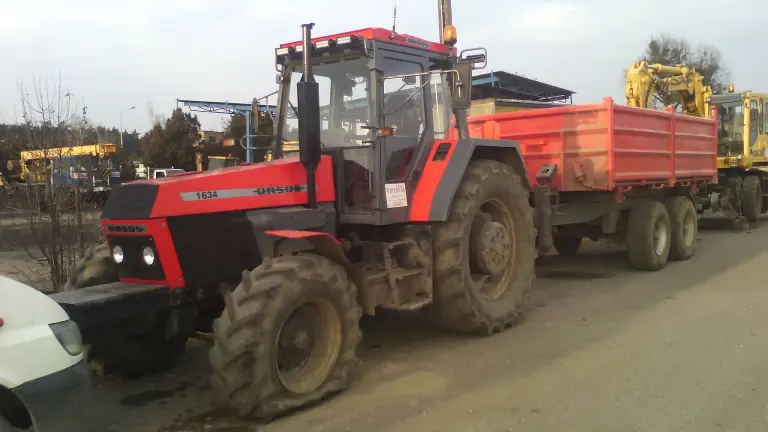
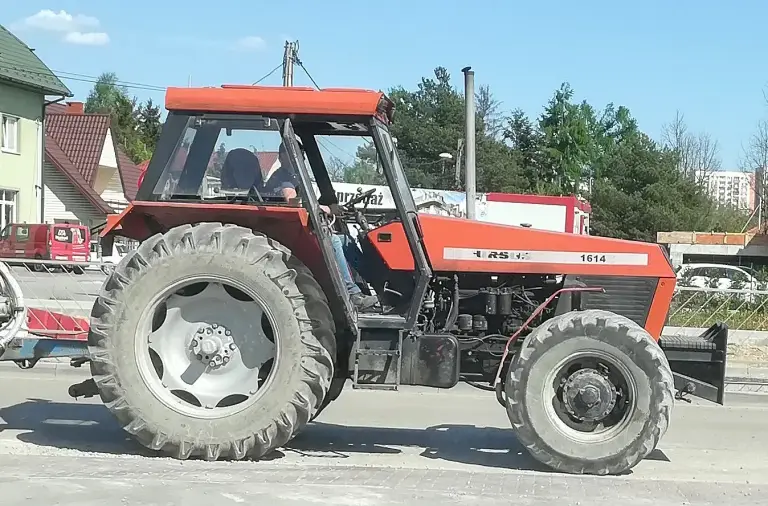
The C-385 was the ancestor of the heavy Ursus 1614 and shared its class with the Ursus 912. More tractors are in the Ursus collection.
Sources
- Ursus C-385, Polish Wikipedia: development, cooperation, production, modernisations, technical data