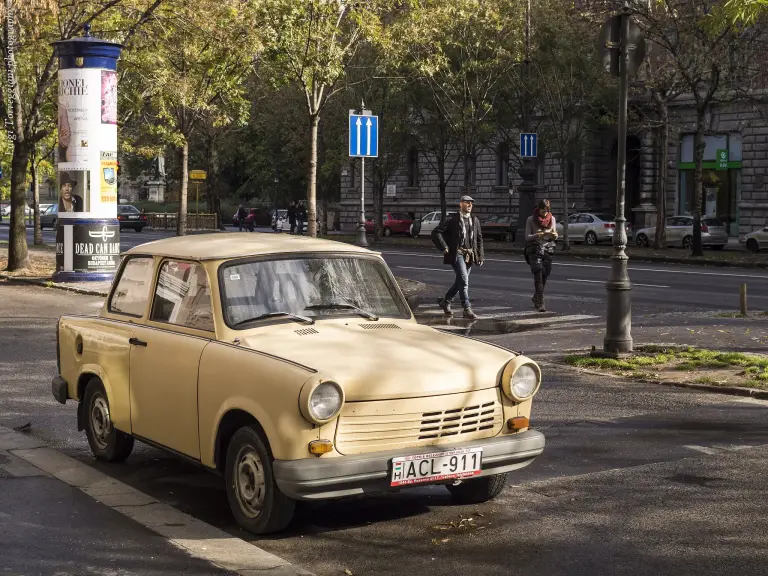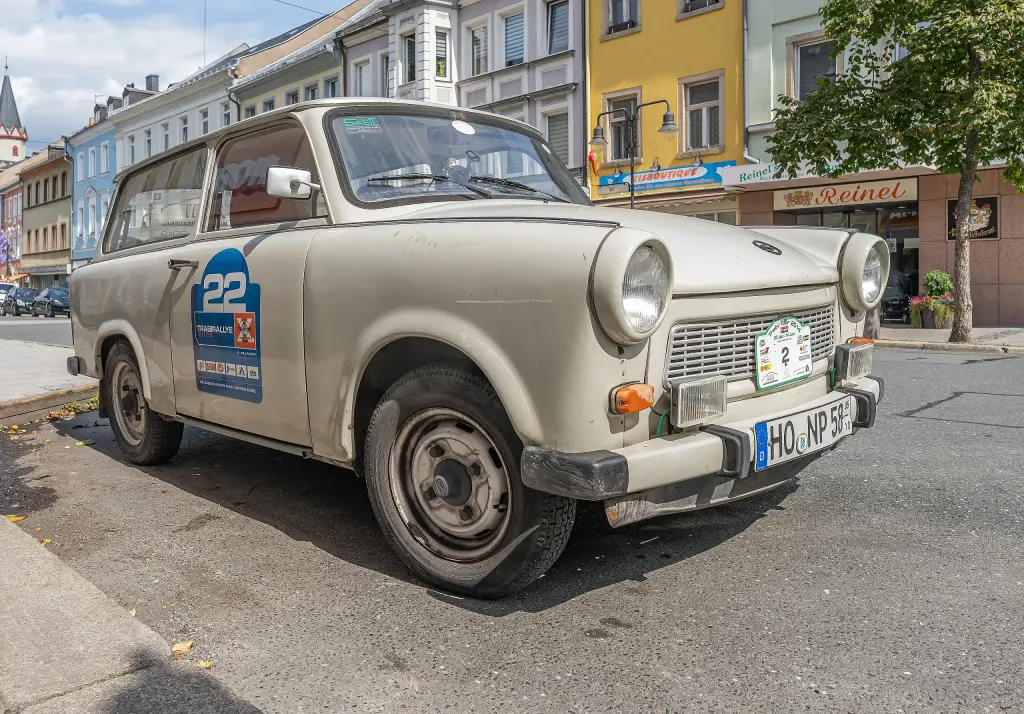
The Trabant 601, internally the P 601, was the third and longest-built Trabant. Made by VEB Sachsenring in Zwickau from 1964 to 1990, it became the best-known model of the marque and the most common car in East Germany. In all, 2,818,547 were built.
Trabant 601 at a glance
| Maker | VEB Sachsenring Automobilwerke Zwickau |
|---|---|
| Production | 1964–1990 |
| Built | 2,818,547 |
| Bodies | two-door saloon, Universal estate, Kübelwagen |
| Body material | duroplast panels on a steel skeleton |
| Engine | 600 cc air-cooled two-cylinder two-stroke |
| Power | 23 PS at first, 26 PS with the P 62 engine from 1969 |
| Top speed | 107 km/h after the 1984 changes |
| Gearbox | four-speed, column shift, with an overrunning clutch in fourth |
| Boot | 420 litres in the saloon |
| Drag coefficient | 0.47 saloon, 0.43 Universal |
| Price in 1985 | 8,500 Mark Standard, 9,700 Mark Universal S de Luxe |
History of the Trabant 601
Launch and early production (1963–1970)
The 601 was first shown to the public in early 1963 at the Klub der Jugend und Sportler during the sixth party congress of the SED, and to the international press on 1 March 1964. Production began with a pre-series in January 1964 and series manufacture followed in June that year, after about 150 pre-production cars. The body was a heavily reworked version of the P 50/P 60 shell, with a new front and roof, different tail lights and a higher boot loading edge. The new double-trapezoid styling was praised at the time. The changes were limited by the rules of the day: the floor pan, wheel arches, bulkhead, front wings and headlamps had to be carried over, so the 601 has been called an old car in a new wrapper. The engine was the P 60 unit of 23 PS, and in 1969 the P 62 version raised output to 26 PS.
Small steps through the decades
Production had been planned to run from 1967 to 1971 but continued until 1990. Updates were few: a two-stage carburettor in 1984 cut fuel consumption, a 12-volt electrical system and electronic ignition arrived, and bumpers gained plastic ends. A needle roller bearing in the connecting rod from 1974 allowed a 50:1 fuel-oil mixture. In 1985 a 601 Standard cost 8,500 Mark and the most expensive version, the 601 Universal S de Luxe, 9,700 Mark; options included a shelf under the instrument panel and intermittent wipers. Successors were studied as the P 602, P 603 and P 610, with larger engines and even Wankel units, but the East German government blocked them as unnecessary and too costly. Waiting lists of ten years or more were not unusual.
The end of the line
The 601 was also raced. The DDR ran a Trabant-only track racing category whose cars were known as Rennpappe, or cardboard racers, and the P 601 received FIA Group 1 certification in 1967, after which it was rallied abroad. By the end of its life the 601 was the last full-size passenger car in the world with a two-stroke engine. Its successor, the Trabant 1.1, kept the same body with a new grille, bumpers, tail lights and a squarer bonnet; production of the 601 ended in July 1990, and the 1.1 followed in 1991.
Design and features
- Duroplast body: cotton-and-phenol panels over a steel skeleton, the material that defined the Trabant.
- Two-stroke engine: a 600 cc air-cooled twin derived from a pre-war DKW design, simple to maintain but smoky and outdated.
- Modern layout at launch: front-wheel drive, a transverse engine, unitary construction, rack-and-pinion steering and independent suspension all round.
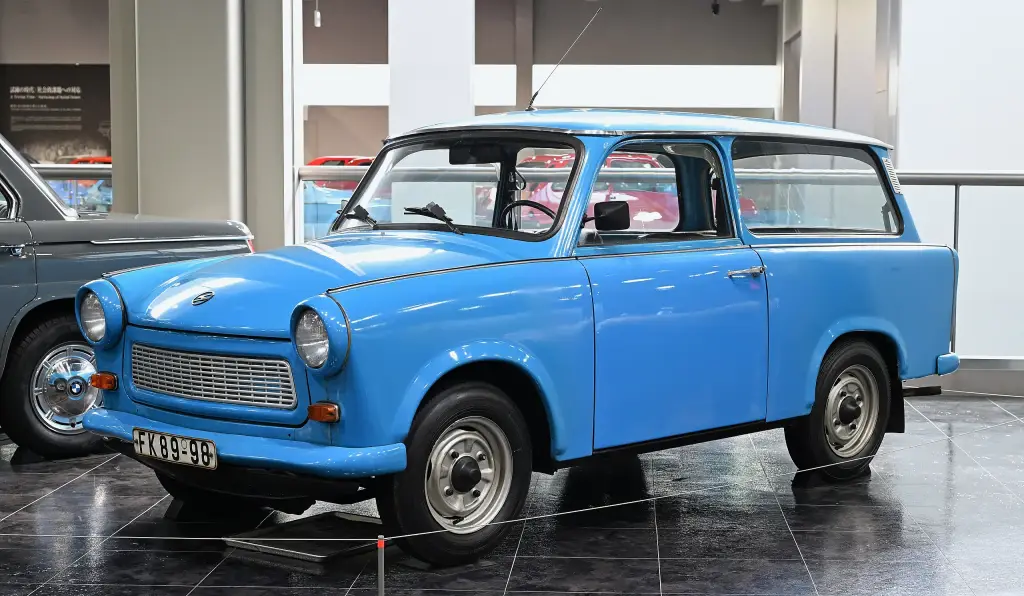
- Practical estate: the Universal had a lower drag coefficient than the saloon and a tailgate hinged at the top.
- Long-lived design: the shape changed little for 26 years, which made the car cheap to build and easy to repair.
Trabant 601 versions
- Limousine (1964–1990): the two-door saloon with a 420-litre boot.
- Universal (from 1965): the three-door estate, type P 601 K, with a top-hinged tailgate.
- Kübelwagen: the open military-style body built alongside the civilian cars.
- 601 S: the Sonderwunsch equipment line with extra trim and fittings.
- 601 Universal S de Luxe: the most expensive version in 1985 at 9,700 Mark.
- P 62 engine (from 1969): the 26 PS development of the original 23 PS unit.
The 601 followed the Trabant P 50 and Trabant 600, and was replaced by the four-stroke Trabant 1.1. More cars are in the Trabant collection.
Sources
- Trabant 601, English Wikipedia: launch, production, updates, prices, motorsport
- Trabant 601, German Wikipedia: development, body variants, production details