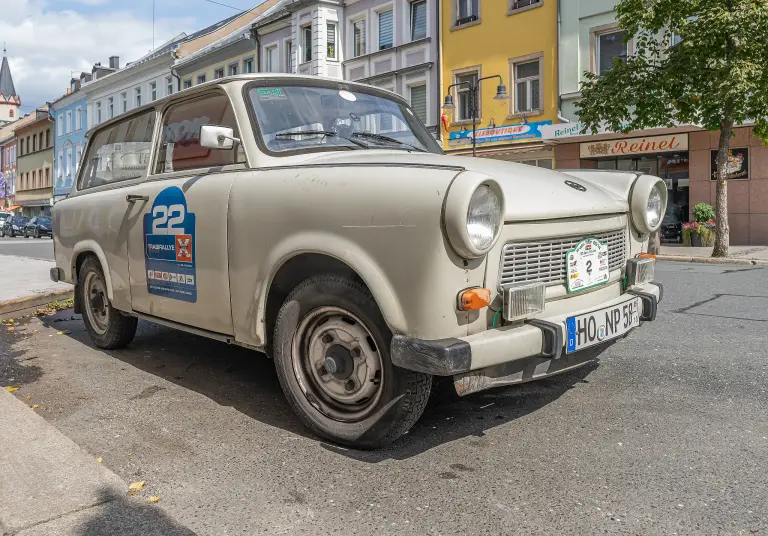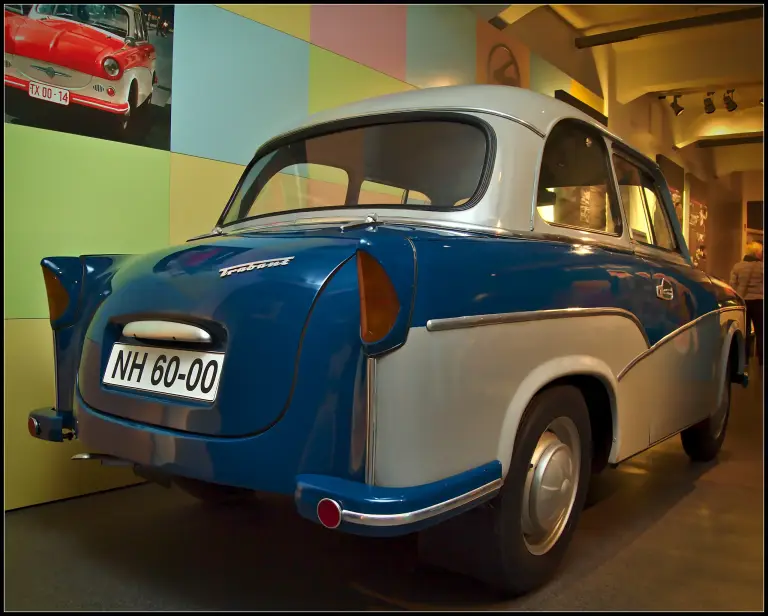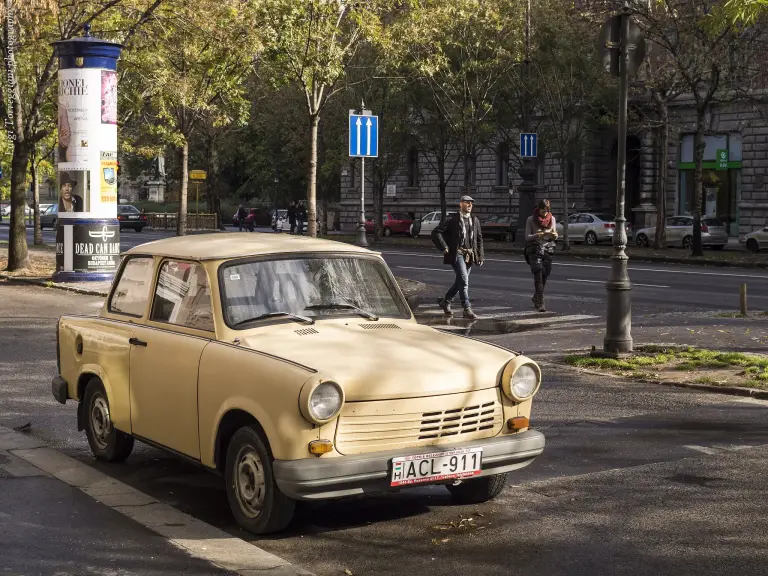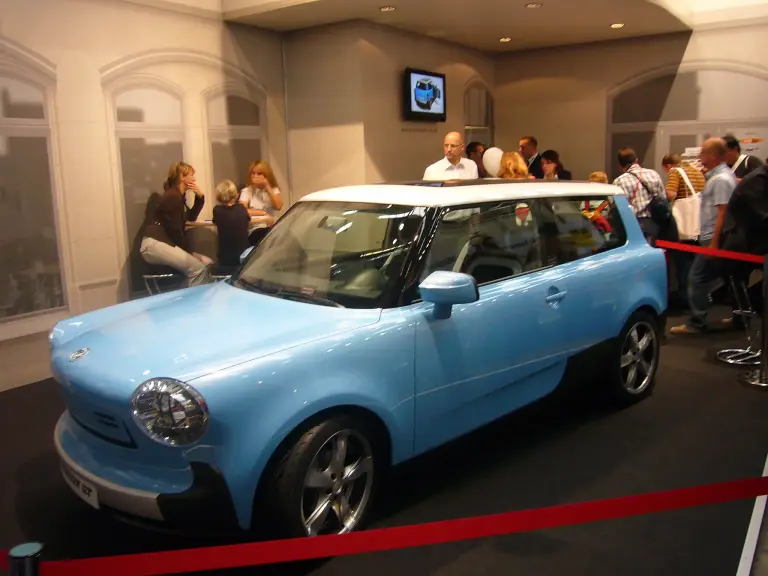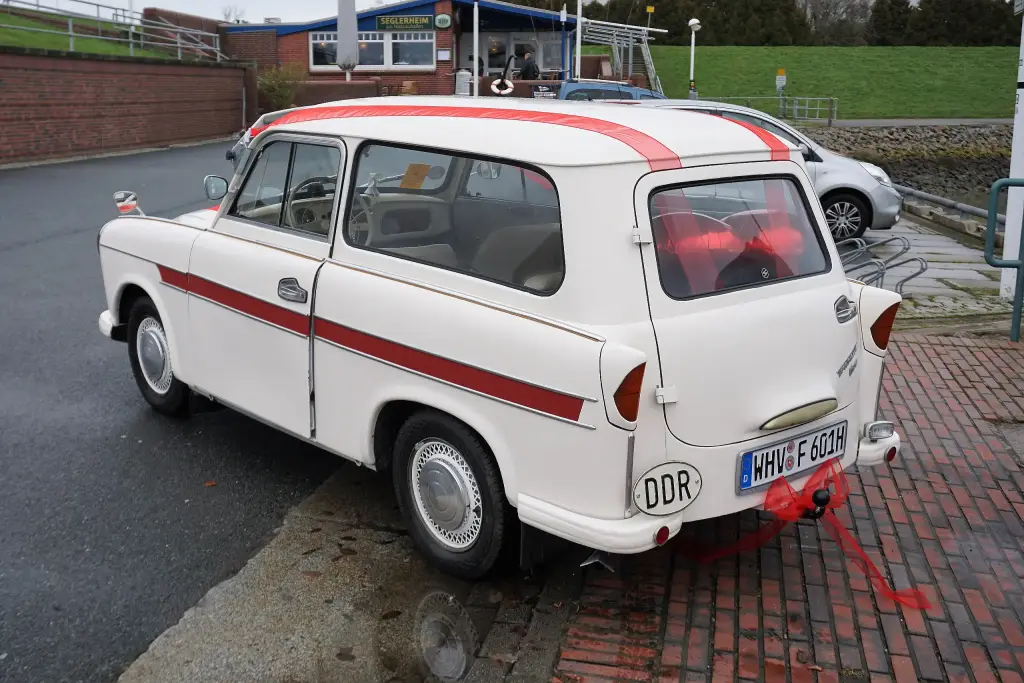
The Trabant 600, also known as the Trabant P 60, was the second series-production Trabant. Built from 1962 to 1965, it married the exterior of the P 50 to the technical design of the next generation, the 601. It was a short-lived intermediate model, and 106,117 were made.
Trabant 600 at a glance
| Maker | VEB Sachsenring Automobilwerke Zwickau |
|---|---|
| Production | 1962–1965 |
| Built | 106,117 (German Wikipedia gives 106,628) |
| Bodies | two-door saloon, three-door estate, Camping estate, panel van |
| Engine | 595 cc air-cooled two-cylinder two-stroke, 23 PS |
| Top speed | about 100 km/h; 103 km/h in a period road test |
| Fuel consumption | about 8.5 L/100 km; 6.8 L/100 km rated |
| Gearbox | four-speed manual, column shift, synchromesh on all gears |
| Brakes | 200 mm drum brakes on all four wheels |
| Wheels | 4J × 13 in |
| Price | 7,850 DM Standard, 8,840 DM Sonderwunsch |
| Estate De Luxe at the end | 9,775 Mark der Deutschen Notbank |
History of the Trabant 600
The second Trabant (1962)
The 600 replaced the P 50 in 1962. Its body was carried over from the P 50 almost unchanged: externally the new model could be told apart by the „600“ on the tail and by a different combination of paint and trim strips. Beneath the skin the P 60 engine grew to 595 cc and produced 23 PS (17 kW), with needle bearings in the connecting rods instead of the plain bearings of the P 50. Torque rose to 51 Nm, and acceleration from 0 to 80 km/h improved from 30.1 to 24 seconds. The gearchange and final drive were left alone, so the extra power went mainly into acceleration. The price rose by 200 DM over the P 50: a Standard saloon cost 7,850 DM and the Sonderwunsch version 8,840 DM.
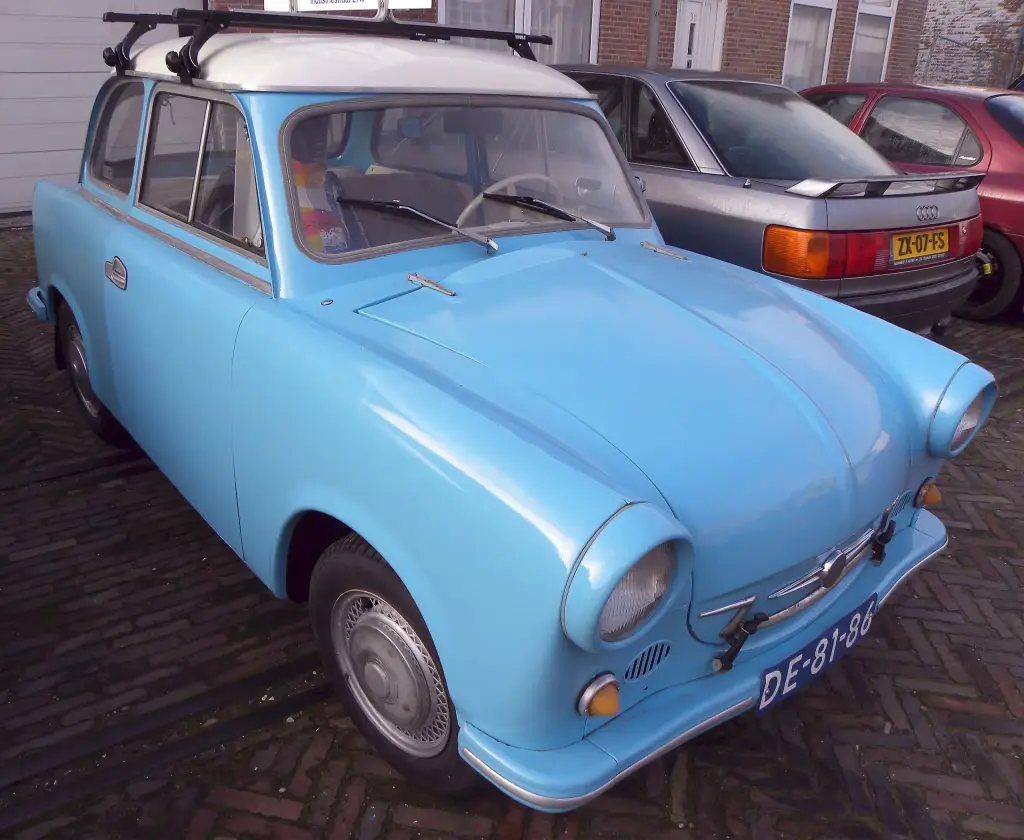
Models and body styles
Unlike the P 50, which was sold with factory options, the 600 came in three named models: Standard, De Luxe and Camping, the last only as an estate. VEB Karosseriewerk Meerane supplied the estate with a side-hinged rear door and also built a Camping version with reclining seats and a folding roof and a small panel van. In all, 36,729 estates, Campings and vans were built, of which only 85 were vans. The two-door saloon was made in Zwickau from 1962 to 1964. The 601 saloon took over in 1964, but the 600 estate and Camping were updated with detail changes, including a larger load area from altered rear seats, and continued until the end of 1965.
On the road and on the market
From 1963 the 600 had centrifugal ignition advance, which mainly improved cold starting. It kept the independent suspension of the P 50, with a swing-arm rear axle and single transverse leaf springs front and rear, rack-and-pinion steering, hydraulic drum brakes and 13-inch wheels; ground clearance was 150 mm and the turning circle 10 m. A period test over 5,000 km praised the very direct steering and good roadholding but noted the uncomfortable ride, and measured an average of 8.1 L/100 km and a mean top speed of 103 km/h. The car was exported widely: Hungary was an important customer, with 3,500 P 50 and P 60 cars sold there in 1962 alone, and in the Netherlands the 600 was seen as a capable alternative to the DAF 750. At home its rounded shape earned it nicknames such as Kugelblitz and Kugelporsche.
Design and features
- New dashboard: a dedicated instrument cluster and a slot for a radio replaced the simpler P 50 facia.
- Needle-bearing conrods: the P 60 engine’s connecting rods ran on needle bearings and the block had cast-on aluminium cooling fins.
- Freewheeling: a permanently engaged freewheel in the four-speed gearbox protected the two-stroke engine from over-revving on the overrun.
- Six paint schemes: customers could order the car in one of six different colour combinations.
- Rebuilt seats: the seats were redesigned to give rear passengers more leg room.
Trabant 600 versions
- Standard saloon: the base two-door at 7,850 DM.
- Sonderwunsch / De Luxe: trim strips, a sun visor over the windscreen and chrome bumper parts, 8,840 DM.
- Universal estate: three-door estate with a side-hinged rear door, built in Meerane.
- Camping: estate with reclining seats and a folding roof.
- Panel van: a windowless estate, only 85 built.
The 600 succeeded the Trabant P 50 and was replaced by the Trabant 601, whose mechanical layout it already anticipated. More cars are in the Trabant collection.
Sources
- Trabant 600, English Wikipedia: models, body, engine, drivetrain, suspension
- Trabant 600, German Wikipedia: prices, production split, road test, exports