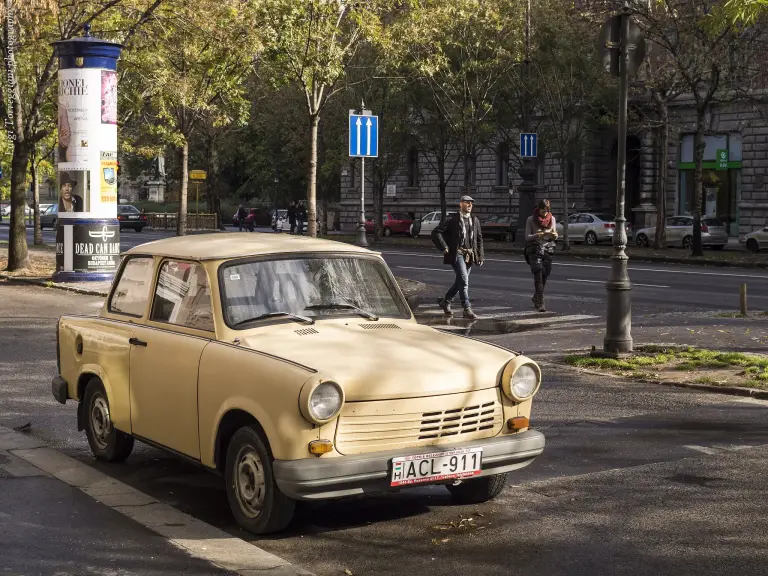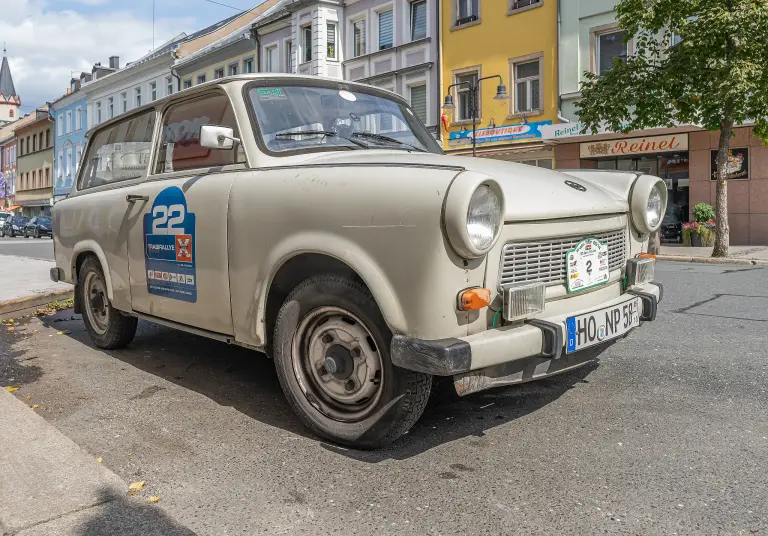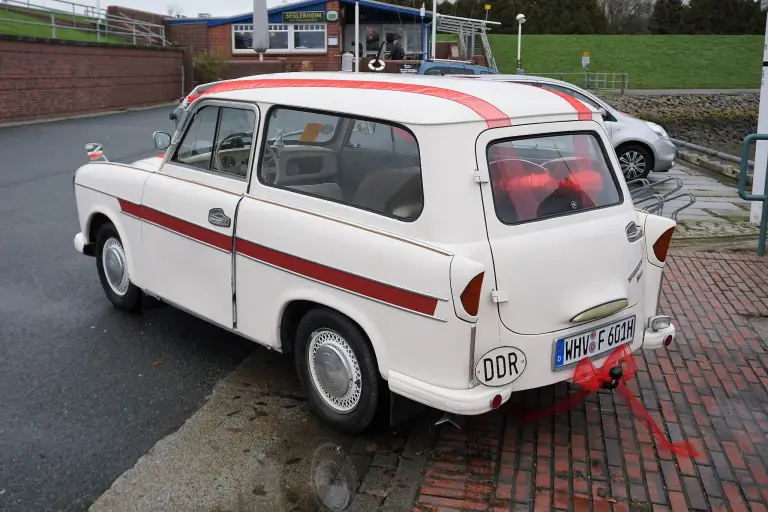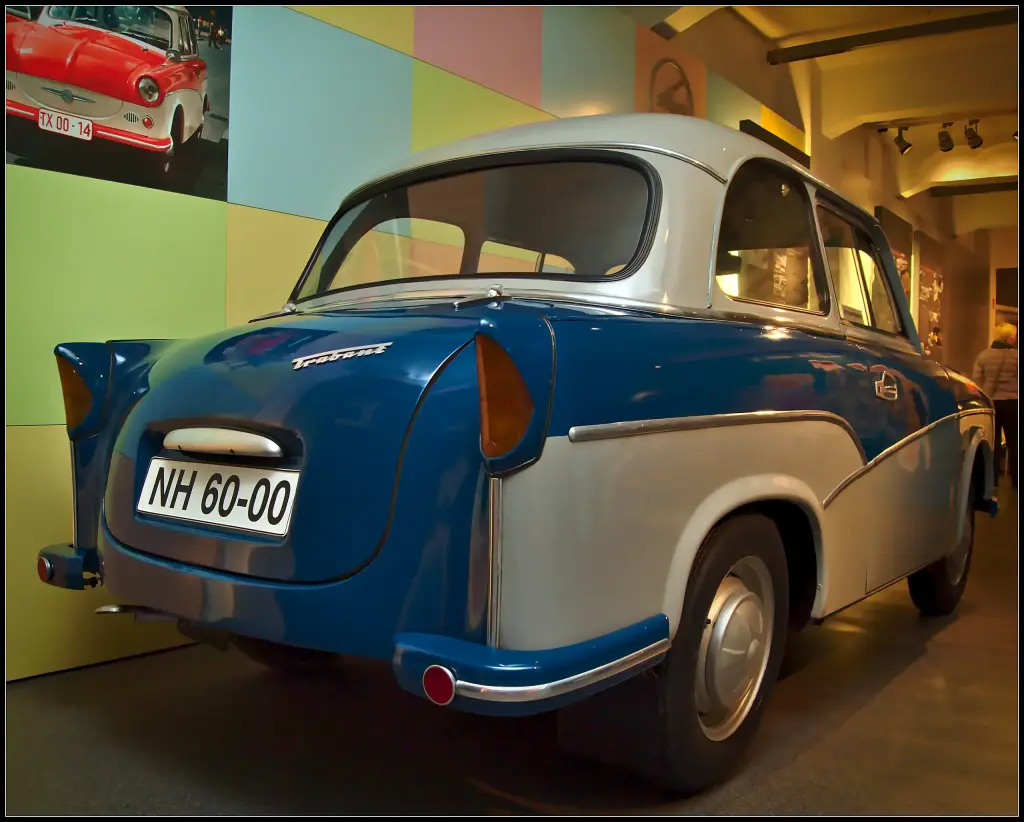
The Trabant P 50, also known as the Trabant 500, was the first series-production model of the East German Trabant line. It was built by VEB Sachsenring Automobilwerke Zwickau from 1957 to 1962, and 131,495 cars were made, including the pre-production batch. Its plastic body, front-wheel drive and transversely mounted two-stroke engine set the pattern that every later Trabant followed.
Trabant P50 at a glance
| Maker | VEB Sachsenring Automobilwerke Zwickau |
|---|---|
| Production | 1957–1962 |
| Built | 131,495 including pre-production cars |
| Bodies | two-door saloon, three-door estate, panel van, Camping estate |
| Engine | air-cooled two-cylinder two-stroke, 500 cc, transversely mounted |
| Drive | front-wheel drive |
| Body | steel skeleton with Duroplast panels |
| Boot | 415 litres in the saloon |
| Drag coefficient | 0.55–0.60 in the saloon |
| Gearbox | four-speed column shift; fully synchronised from summer 1962 |
| Price | 7,450 DM saloon, 8,900 DM estate, 9,500 DM Camping |
| Assembly time | 180 man-hours per car |
History of the Trabant P50
Development (1954–1957)
In January 1954 the Council of Ministers of East Germany decided that a small passenger car should be built for mass motorisation. The brief called for two proper seats and two smaller ones, a mass of no more than 600 kg, fuel consumption of no more than 5.5 L/100 km, a price of 4,000 Deutsche Mark der Deutschen Notbank and a body made of plastic. Steel sheet was on the Western embargo list and Soviet sheet proved unsuitable, so a plastic skin was a practical necessity as well as a political aim. Development began at the VEB Forschungs- und Entwicklungswerk Karl-Marx-Stadt and moved in 1955 to VEB Automobilwerk „Audi“ Zwickau. That works first built the intermediate AWZ P 70 to gain experience with duroplast. Work on the actual car, at first called the small car Typ 50, began in 1956; the first technical descriptions were released in late 1956, and the car was shown at the 1957 Leipzig Trade Fair under the name Trabant.
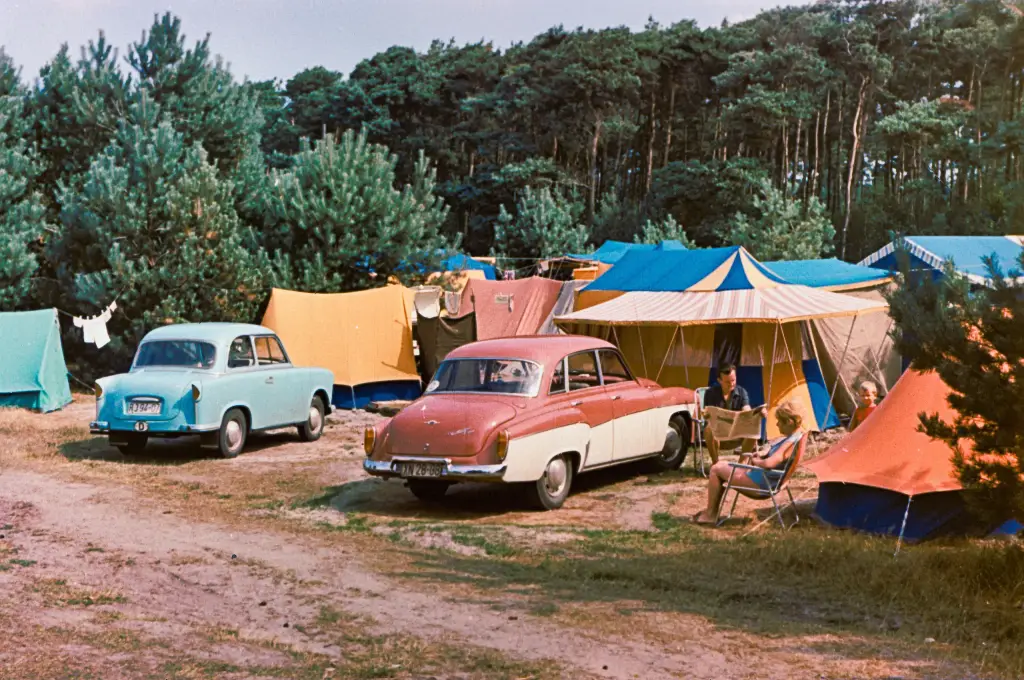
Into production (1957–1962)
Pre-series production started on 7 November 1957 with 50 cars, but the Trabant was not yet ready for series manufacture: the Zwickau plant lacked capacity and the P 50 engine still had problems. On 1 May 1958 VEB Automobilwerk „Audi“ Zwickau and VEB Sachsenring Kraftfahrzeug- und Motorenwerke Zwickau were merged into VEB Sachsenring Automobilwerke Zwickau to free capacity for the new car. Series production ran from August 1958 to September 1962. The P 50/Z engine arrived in October 1958 and the P 50/1 in August 1959; the estate followed in March 1960, pre-assembled in Zwickau and completed by VEB Karosseriewerk Meerane. A panel van without rear windows was added in 1961, sold only for export, and DDR buyers could order the Camping estate with flat-folding seats and a large folding sunroof. From summer 1962 the car had a fully synchronised gearbox. In October 1962 production switched to the Trabant 600.
Body and engine
The P 50 has a self-supporting steel skeleton with body panels of duroplast, a material made from cotton waste and phenol resins. Instead of a radiator grille it has small cooling vents below the headlamps, and the bonnet is bent around the front down to the bumper. The saloon had a drag coefficient of 0.55 to 0.60, a boot of 415 litres and a pastel paint finish as standard, with a three-colour scheme as a factory option; the pastel colour was chosen because it was easy to repaint. The engine was built by VEB Barkas-Werke in four versions: the original P 50, the P 50/Z, the P 50/1 and the P 50/2. All are air-cooled two-cylinder two-stroke units with a rotary intake valve, cross-flow scavenging, a three-bearing crankshaft, a horizontal draught carburettor and a bore of 66 mm. The block is grey cast iron, with iron cooling fins on the earliest engines and cast-on aluminium fins, the Alfer design, on the later ones. The rarest is the original P 50 engine with 2,530 built; the P 50/Z accounted for 13,733, the P 50/1 for 125,727 and the P 50/2 for 25,127.
Design and features
- Plastic body: duroplast panels over a steel skeleton avoided scarce steel sheet and gave the car its characteristic finish.
- Front-wheel drive: the engine sat transversely beside the gearbox, a layout still unusual in a 1950s small car.
- Four engine versions: the P 50, P 50/Z, P 50/1 and P 50/2 were fitted in turn as the design was developed.
- Estate and Camping: the range ran beyond the saloon to a three-door estate, a windowless van and a camping version with a large sunroof.
Trabant P50 versions
- Saloon (from 1958): the two-door base model at 7,450 DM.
- Universal estate (from March 1960): three-door estate with a side-hinged rear door, 8,900 DM.
- Panel van (from 1961): an estate with body panels instead of rear windows, not sold on the domestic market.
- Camping (from 1961): estate with flat-folding seats and a large folding sunroof, 9,500 DM.
- Engine versions: P 50, P 50/Z, P 50/1 and P 50/2, the last two making up most of production.
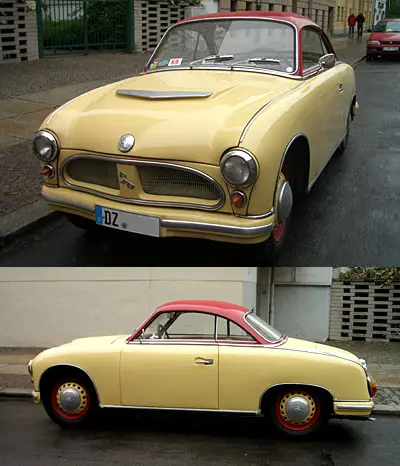
The P 50 was replaced by the Trabant 600 and followed in turn by the Trabant 601. Before it, Zwickau had built the AWZ P 70 to test the duroplast body. More cars are in the Trabant collection.
Sources
- Trabant P 50, English Wikipedia: development, production, bodies, engine versions, prices
- Trabant P 50, German Wikipedia: development history, duroplast process, boot volume