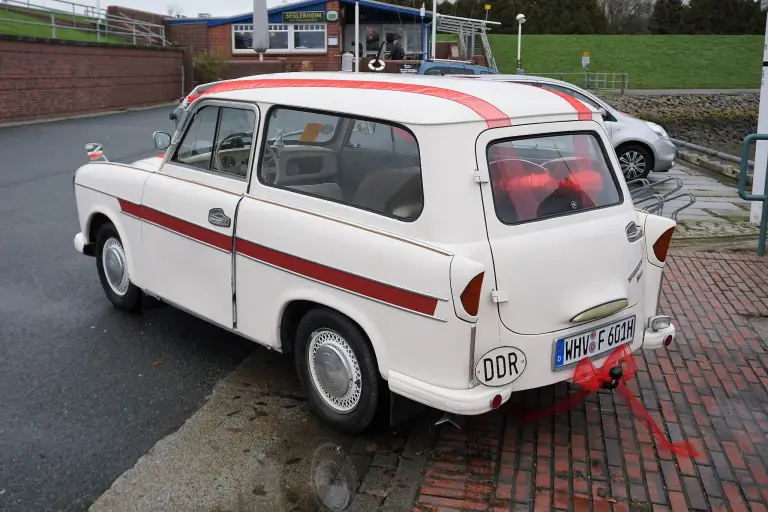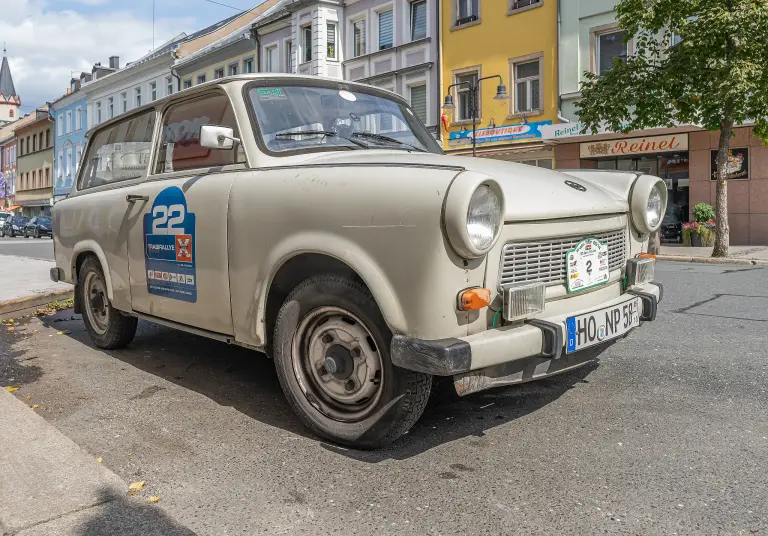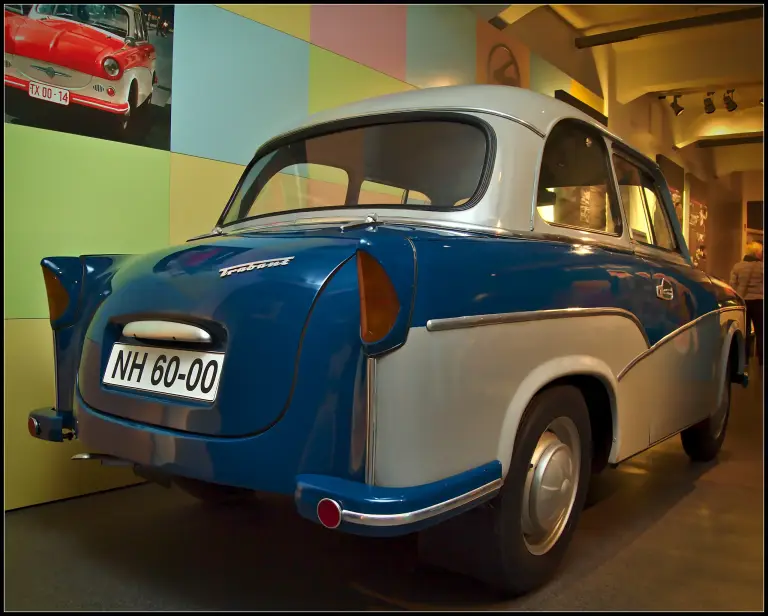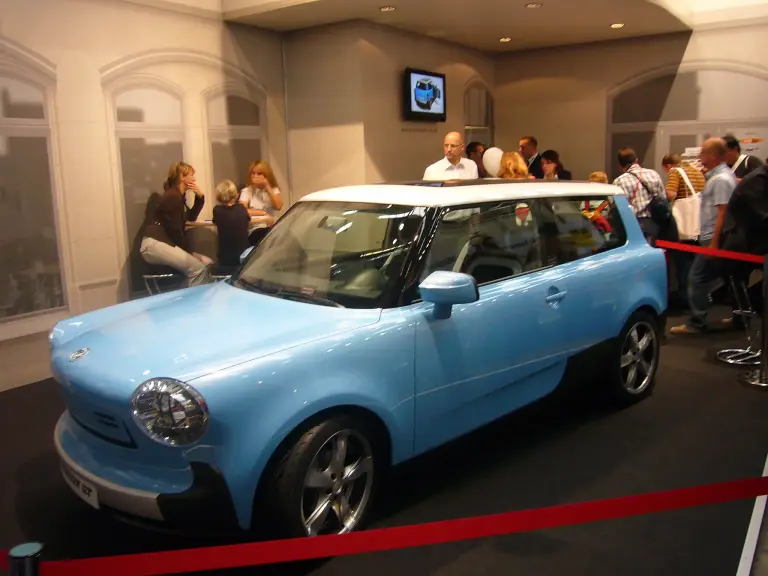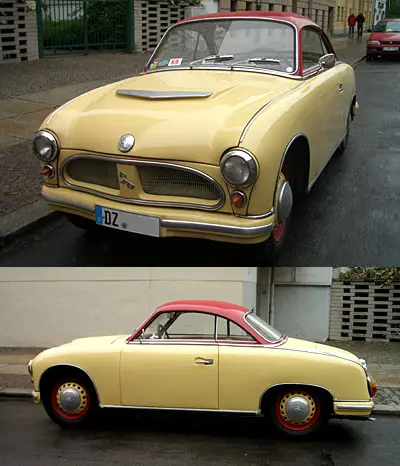
The AWZ P 70 was an intermediate model built by VEB Automobilwerk „Audi“ Zwickau from 1955 to 1959. It was not a Trabant itself, but it existed to give the works experience with duroplast, the plastic intended for the body of the future Trabant P 50. It used a water-cooled engine.
Trabant P70 at a glance
| Maker | VEB Automobilwerk „Audi“ Zwickau |
|---|---|
| Production | 1955–1959 |
| Role | intermediate model before the Trabant P 50 |
| Purpose | experience with duroplast body panels |
| Body | steel skeleton with plastic panels |
| Engine | water-cooled |
| Followed by | Trabant P 50, from 1957 |
| Name | AWZ = Automobilwerk Zwickau |
No Wikipedia page is devoted to the P 70: the material comes from passing references in the Trabant P 50 articles. The article is therefore short and based on one source.
History of the Trabant P70
An intermediate model
In January 1954 the Council of Ministers of East Germany called for a small car for mass motorisation, to weigh no more than 600 kg, use no more than 5.5 L/100 km, cost 4,000 Deutsche Mark der Deutschen Notbank and wear a plastic body. Development moved in 1955 from the VEB Forschungs- und Entwicklungswerk Karl-Marx-Stadt to VEB Automobilwerk „Audi“ Zwickau. Instead of starting the P 50 straight away, the Zwickau works built an intermediate model, the AWZ P 70, to gain experience with the car’s intended body material, duroplast. It was produced from 1955 to 1959 and had a water-cooled engine, unlike the air-cooled two-stroke that would power the Trabant. Work on the P 50 itself began in 1956. The intermediate type gave the works the large-series production experience it needed before the Trabant went into manufacture.
Why duroplast
The choice of plastic was forced by circumstances. Steel sheet was on the Western embargo list and therefore scarce and expensive in East Germany, while Soviet sheet proved unsuitable for deep drawing. The material developed instead was a phenol plastic reinforced with short cotton fibres, or linter, bought from the Soviet Union because the fibres were too short to spin. The linter was pressed into mats, impregnated with phenol resin distilled from domestic brown coal tar, cut roughly to shape and cured in heated moulds under pressure for about eight minutes at 180 degrees Celsius. Excess material was trimmed with band saws and grinders. In later years the panels were bonded to the steel skeleton with Buna rubber strips and screwed at highly stressed points. Because experience with the new material was limited, the first prototypes still had largely steel bodies, which is exactly why a separate intermediate model was thought necessary.
Design and features
- Duroplast experience: the P 70 was the works’ route to learning how to build bodies from the cotton-and-phenol plastic later used on every Trabant.
- Water-cooled engine: the intermediate model did not use the air-cooled two-stroke that became the Trabant trademark.
- Production training: building the P 70 in series gave Zwickau experience that was applied to the P 50 from 1956 onwards.
Trabant P70 versions
- AWZ P 70 (1955–1959): the intermediate model built at VEB Automobilwerk „Audi“ Zwickau.
- Duroplast development car: the P 70 was the model through which the works gained experience with the plastic body material.
- Water-cooled type: all P 70s used the water-cooled engine, in contrast to the later Trabant two-stroke.
The P 70 was followed by the Trabant P 50, the first series Trabant, and then by the Trabant 600. More cars are in the Trabant collection.
Video: AWZ P70
Video on YouTube.
Sources
- Trabant P 50, English Wikipedia: AWZ P 70 as intermediate model
- Trabant P 50, German Wikipedia: production years, water-cooled engine, duroplast process