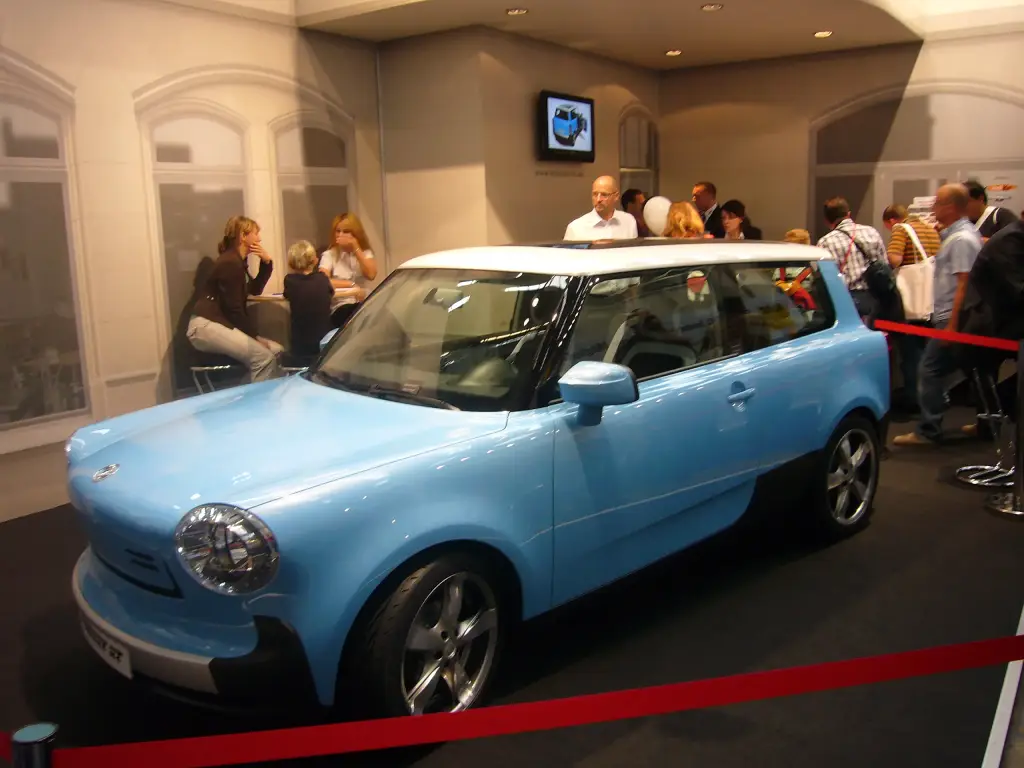
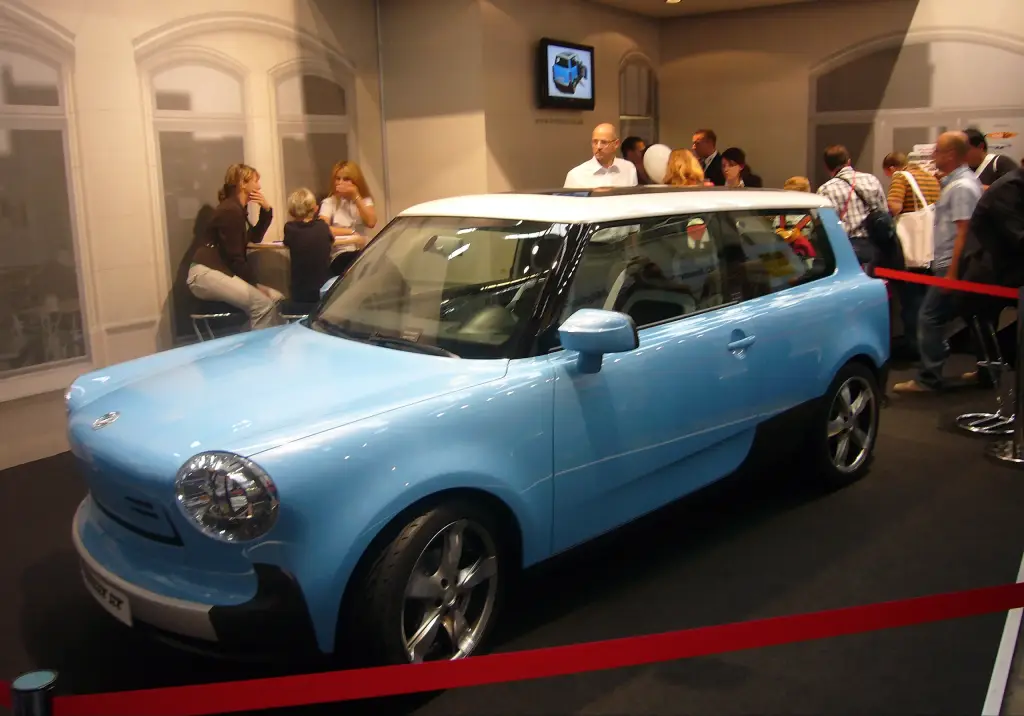
The Trabant nT was a German concept car unveiled at the 2009 IAA in Frankfurt. Its name stands for newTrabi, and it was meant as a modern, electric reinterpretation of the East German original, styled to recall the Trabant 601 Universal. A prototype was built, but the project never attracted enough investment for series production.
Trabant nT at a glance
| Show car | Trabant nT, IAA Frankfurt 2009 |
|---|---|
| Name | nT = newTrabi |
| Designer | Nils Poschwatta |
| Partners | Herpa, IndiKar Individuall Karosseriebau, IAV |
| Layout | electric, front-mounted motor |
| Power | 47 kW (64 hp) asynchronous motor |
| Battery | lithium-ion |
| Top speed | 130 km/h |
| Range | 250 km (English Wikipedia); 160 km (German Wikipedia) |
| Charging | about 8 hours at 230 V, about 2 hours at 400 V |
| Solar roof | 1.8 m², about 120 W |
| Seats | 4+1 |
History of the Trabant nT
From a model car to a concept
The project began at the model-car maker Herpa, which decided to mark the Trabant’s 50th birthday in 2007 by developing a 1:10 model of a new Trabant. The model was shown at the 2007 IAA as the newTrabi, together with a public survey in which 94 per cent of 12,000 respondents supported a modern reinterpretation of the car. Herpa had acquired the rights to the Trabant name. IndiKar Individuall Karosseriebau of Wilkau-Haßlau then developed a full concept with the designer Nils Poschwatta, shown at the 2009 Frankfurt Motor Show as the Trabant nT.
The car
The nT was styled to echo the Trabant 601 Universal while looking modern. It is 395 cm long, 169 cm wide and 150 cm high, on a 245 cm wheelbase, with a kerb weight of 1,050 kg. A central asynchronous motor of 47 kW (64 hp) drives the car through a lithium-ion battery; top speed is 130 km/h. The English Wikipedia article gives a range of 250 km, while the German article gives a maximum of 160 km. Charging takes about eight hours from a 230 V outlet and about two hours from 400 V. A solar roof of 1.8 m² generates about 120 W to support the ventilation and other auxiliary consumers. The car seats four adults plus one child in the middle of the rear bench, and has a payload of 400 kg.
No series production
The consortium behind the nT included Herpa, IndiKar and the automotive engineering company IAV. It looked for investment, design and production opportunities in Zwickau, the Trabant’s home city, but could not attract investors. The production version was planned as an electric car with a 45 kW asynchronous motor, but it was never built. In 2014 IndiKar’s managing director reported interest from foreign and non-automotive parties whose aims were too far from the company’s own, and in 2019 Herpa extended its rights to the Trabant name. The nT remained a show car.
Design and features
- Electric drive: a 47 kW asynchronous motor and a lithium-ion battery, with a top speed of 130 km/h.
- Solar roof: 1.8 m² of panels generating about 120 W for ventilation and auxiliary equipment.
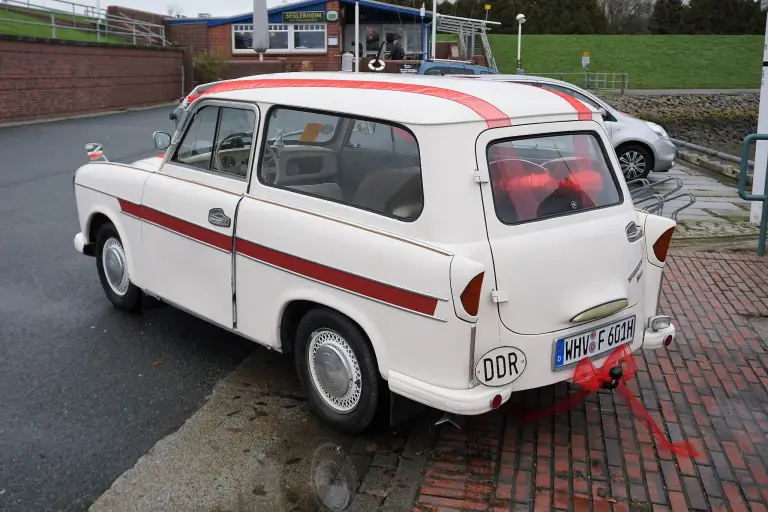
- 601 Universal cues: the design by Nils Poschwatta deliberately recalled the estate version of the 601.
- Flexible interior: seating for four adults plus a child in the middle of the rear bench, with 400 kg payload.
- Compact footprint: 395 cm long and 1,050 kg, close to the size of the original Trabant.
Trabant nT versions
- 2007 newTrabi: the 1:10 Herpa model shown at the IAA, which started the project.
- 2009 Trabant nT concept: the full-size show car presented in Frankfurt.
- Planned production car: an electric version with a 45 kW motor, never built.
- Name rights: held by Herpa, which extended them in 2019.
The nT looked back to the Trabant 601 and its Universal estate, and to the whole line that began with the Trabant P 50 and ended with the Trabant 1.1. More cars are in the Trabant collection.
Video: Trabant nT (newTrabi) in Zwickau
Video on YouTube.
Sources
- Trabant nT, English Wikipedia: history, consortium, technical data
- Trabant nT, German Wikipedia: project history, dimensions, design, investment search