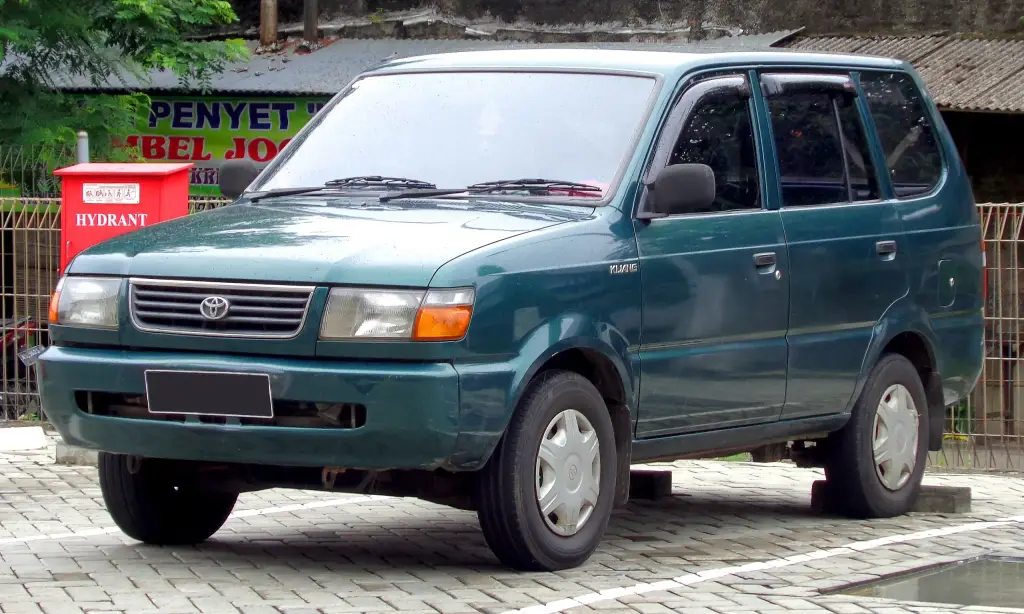
The Toyota Kijang is a series of pickups, station wagons and light commercial vehicles produced mainly for Southeast Asia, Taiwan, India and South Africa between 1976 and 2007. Kijang means muntjac or deer in Indonesian, and because the car carried so many different names Toyota called it the TUV, for Toyota Utility Vehicle.
Toyota Kijang at a glance
| Maker | Toyota |
|---|---|
| Production | December 1976 – 2007 |
| Markets | Indonesia, Philippines, India, Vietnam, Malaysia, Taiwan, South Africa |
| Class | Pickup, van and station wagon |
| Layout | Rear-wheel drive |
| First model | KF10 with the 1.2-litre 3K engine |
| Other names | Tamaraw, Qualis, Zace, Unser, Revo, Venture, Condor, Stallion |
| Internal name | TUV, Toyota Utility Vehicle |
| Assembly | CKD in almost every market where it was sold |
| Replaced by | Toyota Innova |
Based on one source: the English Wikipedia article on the Toyota Kijang.
History of the Toyota Kijang
First generation (F10; 1976)
The Kijang prototype was shown at the 1975 Jakarta Fair, and production began in the Philippines as the Toyota Tamaraw in December 1976, before the car reached Indonesia on 9 June 1977. Development was led by Osamu Ohta with Ohyama as chief engineer from 1972. The first Kijang was a compact, light pickup with a carburetted 1.2-litre 3K engine and a four-speed manual, sharing its engine with the 1972 Corolla. It had a boxy body with externally hinged half doors and plastic or canvas windows, and Indonesians nicknamed it Kijang Buaya, the crocodile Kijang, because the open bonnet looked like a crocodile’s mouth. The KF10 sold 26,806 units in four years. In the Philippines the Tamaraw was a three-quarter-ton high-side pickup with 56 PS, a basic utility vehicle simple enough that local assemblers copied it, and General Motors, Ford and Chrysler later built their own versions.
Second generation (F20/F30; 1981)
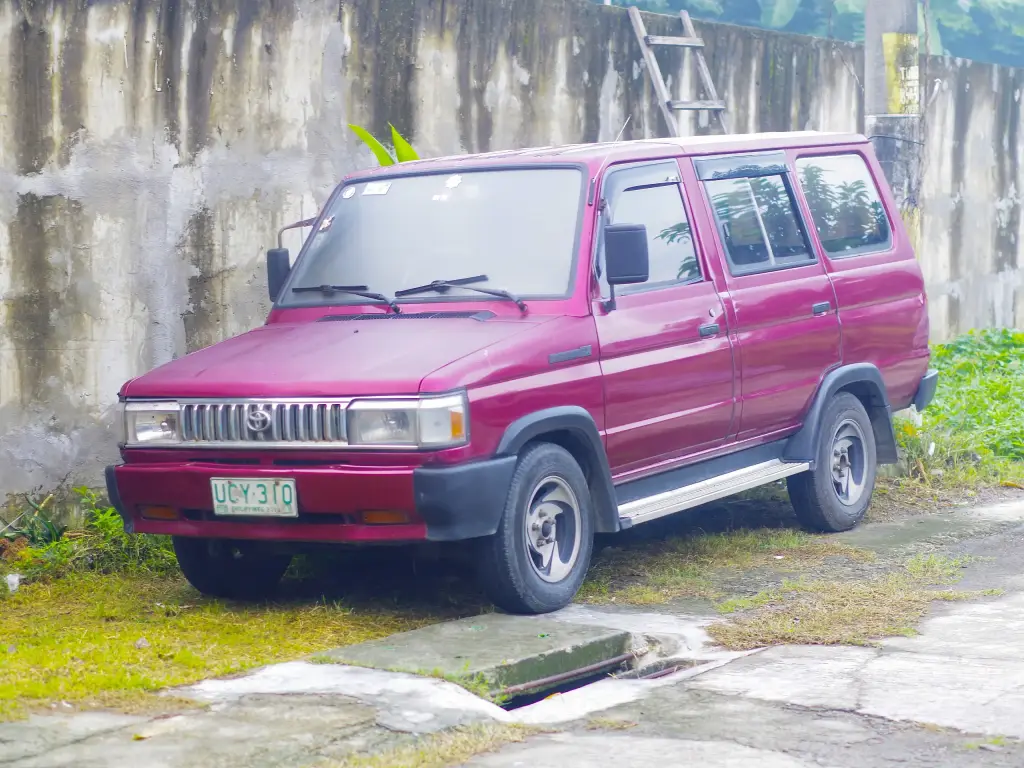
The second generation, the KF20, arrived in June 1981 with new body panels but the same boxy style, nicknamed Kijang Doyok in Indonesia. Its 1.3-litre 4K engine was replaced in December 1985 by a 1.5-litre 5K, raising power from 60 to 72 PS, and a redesigned grille with rectangular headlamps marked the 1986 model. Sales took off in 1983 and 1984, catching up with the Suzuki Super Carry and Daihatsu Hijet: the Kijang carried more and, with its engine in front, was safer than kei-truck rivals. The 100,000th Kijang left the line in February 1985. In the Philippines the long-wheelbase F30 Tamaraw was promoted as an alternative to the jeepney.
Why it worked, and its many names
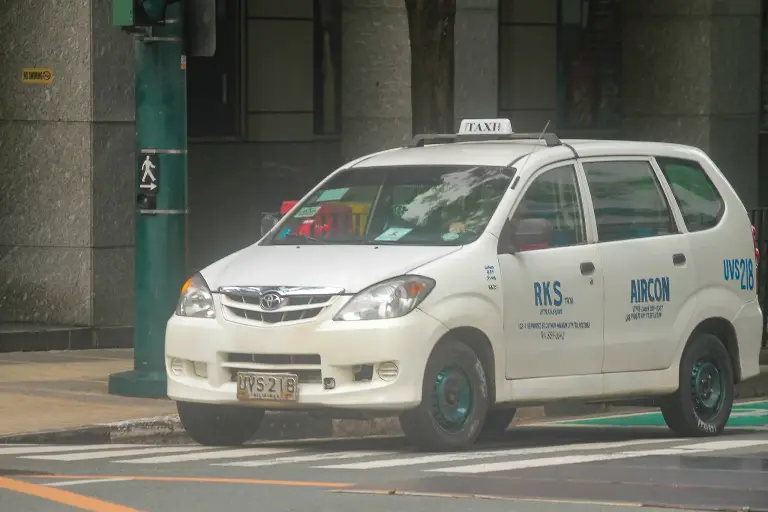
The Kijang was affordable next to four-wheel-drive vehicles, had high ground clearance, a rugged suspension and room for large families, exactly what buyers in regions with poor roads needed. It was designed for easy manufacture: in 1986 assembling a Kijang cost only 42 per cent of assembling the smaller E80 Corolla, and it was built as a complete knock-down kit in almost every market, using local parts. Different countries gave it different names: Qualis in India and Nepal, Zace in Vietnam and Taiwan, Unser in Malaysia, Revo in the Philippines, and Stallion, Venture and Condor in South Africa. Its station-wagon versions were replaced by the Innova from 2004.
Design and features
- Cheap to build: assembly cost 42 per cent of an E80 Corolla’s in 1986.
- Rugged and simple: rear-wheel drive, high clearance and basic mechanics.
- Local assembly: built from CKD kits with parts from each market.
- Many names: Tamaraw, Qualis, Zace, Unser, Revo, Venture, Condor and Stallion.
Toyota Kijang versions
- KF10 (1976): first generation with the 1.2-litre 3K engine.
- Tamaraw (1976): Philippine version, including the long-wheelbase F30.
- KF20 (1981): second generation with 4K and later 5K engines.
- Revo: fourth-generation name in the Philippines.
- Qualis, Zace, Unser: names used in India, Vietnam and Malaysia.
The Kijang was replaced by the Innova and sat below the Hilux; its basic utility role is now covered by the Avanza. More cars are in the Toyota collection.
Sources
- Toyota Kijang, English Wikipedia: generations, names, production