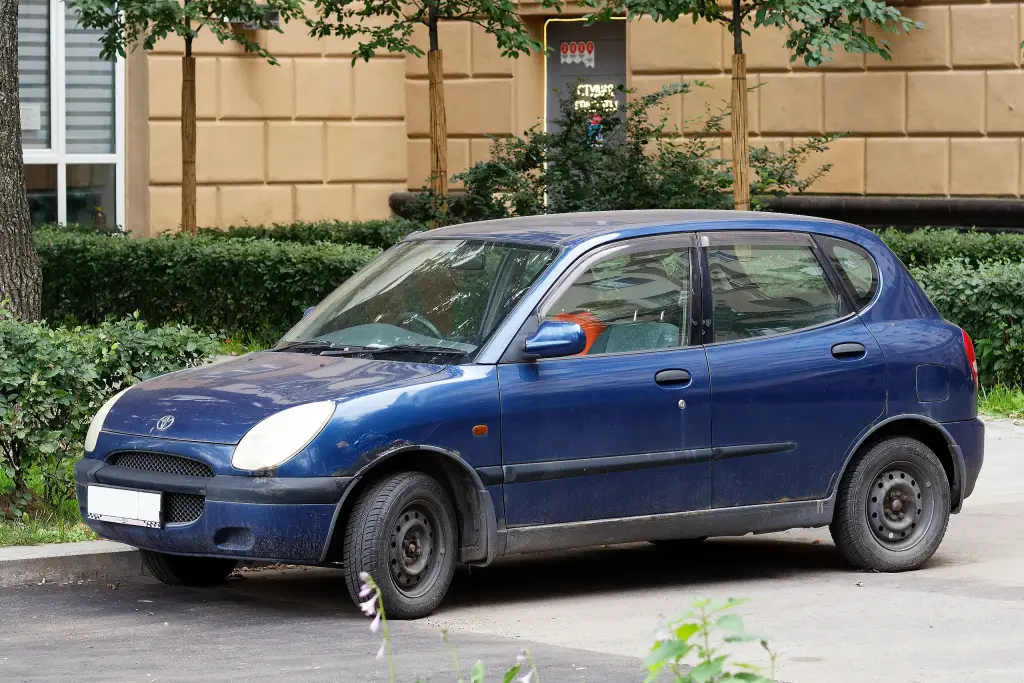
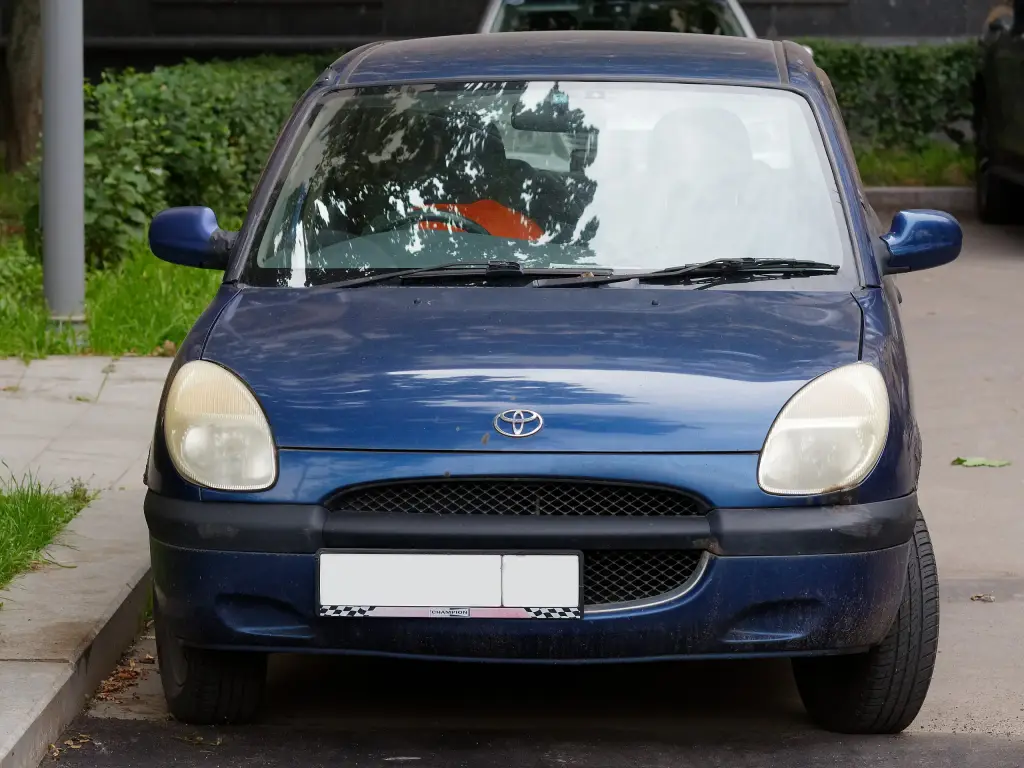
The Toyota Duet was a subcompact car sold in Japan from 1998 to 2005, a rebadged version of the Daihatsu Storia. It replaced the Corolla II in Toyota’s line-up, and abroad the same car was sold as the first-generation Daihatsu Sirion.
Toyota Duet at a glance
| Maker | Toyota, built by Daihatsu |
|---|---|
| Production | 1998–2005 |
| Market | Japan |
| Based on | Daihatsu Storia |
| Class | Subcompact car |
| Engines | 989 cc three-cylinder, 1.3-litre four |
| Power | 60 PS, later 87 and 102 hp versions |
| Gearboxes | Five-speed manual or four-speed automatic |
| Export name | Daihatsu Sirion |
| Replaced | Toyota Corolla II |
| Successor | Daihatsu Boon and Toyota Passo |
The Duet is a rebadged Daihatsu Storia and is described in the English Wikipedia article on the Storia; this page uses its Duet and Sirion details.
History of the Toyota Duet
Origins
The Storia, and with it the Duet, was previewed as the NCX concept car at the Tokyo Motor Show in 1997 and confirmed for production the following year. It had a retro-inspired design with chrome details, and its name is Italian for “story” or “history”. It effectively replaced the similar-sized Charade, which was built alongside it for a year.
Engines and changes
The 1998 Storia and Duet came with two multi-point fuel-injected petrol engines: a 989 cc three-cylinder of 60 PS and, from 2000, a 1.3-litre four-cylinder of 87 PS, both with a five-speed manual or four-speed automatic. The first change came in 2000 with new DVVT engines, including the 1.3, minor restyling with new tail and reverse lights, a revised grille and interior changes; this updated car reached Japan in May 2000. In December 2001 the Storia, Sirion and Duet were facelifted with a sportier grille and bumper and a redesigned dashboard with more storage and better trim, and in Australia the Sirion was released in March 2002. The 1.3-litre models from 2001 had 103 PS, reaching 100 km/h in 9.6 seconds and 179 km/h, with average fuel consumption of 21.1 km/l.
Other versions
The European Sirion came as the standard model and the Sirion+, which added air conditioning and central locking. Britain received Rally 2 and Rally 4 versions, the latter with four-wheel drive, with 110 PS and a 0–100 km/h time of 8.1 seconds, or 8.9 for the Rally 4. A 4Track or 4WD version of the 1.3-litre car was offered, and the F-Speed was an automatic with push-button sequential changes on the steering wheel. For racing in Japan Daihatsu built the Storia X4, with four-wheel drive, front and rear limited-slip differentials and a 713 cc turbocharged engine of 118 hp, sized to meet the one-litre racing class rules. The Storia and Duet were replaced by the Daihatsu Boon and its Toyota twin, the Passo.
Design and features
- Daihatsu twin: the same car as the Daihatsu Storia and the export Sirion.
- Retro design: chrome details inspired by the NCX concept of 1997.
- Small engines: a 989 cc three-cylinder and a 1.3-litre four.
- Rally versions: British Rally 2 and four-wheel-drive Rally 4 models.
Toyota Duet versions
- Duet (1998): 989 cc three-cylinder with manual or automatic.
- 1.3-litre (2000): four-cylinder engine with DVVT.
- 2001 facelift: sportier front end and redesigned interior.
- Sirion Rally 4: four-wheel-drive version sold in Britain.
- Storia X4: racing version with a 713 cc turbo engine.
The Duet replaced the Corolla II line and shared its Daihatsu parentage with the Passo, its successor. More cars are in the Toyota collection.
Sources
- Daihatsu Storia, English Wikipedia: history, engines, versions