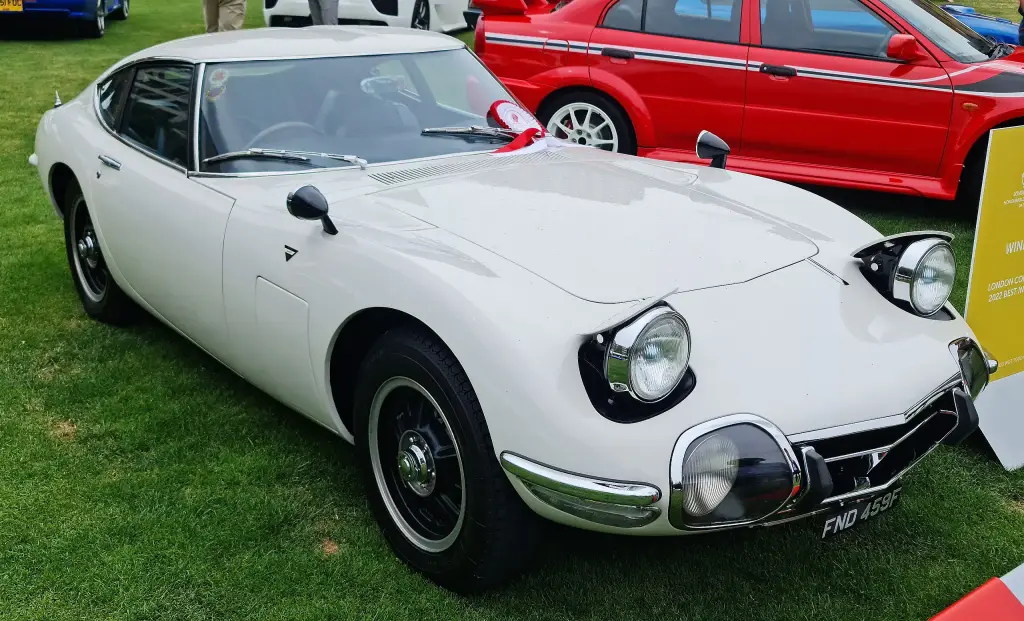
The Toyota 2000GT was shown for the first time at the Tokyo Motor Show in 1965 and built under contract by Yamaha from 1967 to 1970. It was a limited-production, front mid-engined, rear-wheel-drive two-seater with a 2.0-litre straight-six, and it gave Toyota a halo car to rival the best European grand tourers.
Toyota 2000GT at a glance
| Maker | Toyota, built by Yamaha |
|---|---|
| Production | 1967–1970 |
| Body | Two-door fastback coupe, two seats |
| Layout | Front mid-engine, rear-wheel drive |
| Engine | 1,988 cc 3M straight-six, DOHC, 150 PS |
| Torque | 175 N·m at 5,000 rpm |
| Gearbox | Five-speed manual |
| Brakes | Power-assisted discs all round, a first for Japan |
| Steering | Rack and pinion, a first for Toyota |
| Height | 116 cm |
| Wheels | 15-inch magnesium alloy |
| Special version | Nine MF-12 cars with the 2.3-litre 2M-B engine |
Based on one source: the English Wikipedia article on the Toyota 2000GT.
History of the Toyota 2000GT
Why Toyota needed a halo car
By the early 1960s every major manufacturer had a flagship sports car or grand tourer to draw customers into showrooms: the Ford Thunderbird, the Chevrolet Corvette, the Mercedes-Benz 300SL, the Jaguar E-Type and the Ferrari 250 GT among them. Toyota had the small Sports 800, but its engine was too small to count as a world-class sports car. Yamaha, which had built its own YX30 prototype and lost a similar project with Nissan, proposed its design to Toyota; Toyota accepted but used its own styling by Satoru Nozaki, inspired by the E-Type.
The car
The 2000GT was extremely low, just 116 cm to the highest point of the roof, with pop-up headlights above plexiglass-covered driving lamps. The engine was the 1,988 cc 3M straight-six from the Crown, converted by Yamaha with a new DOHC head and three Mikuni-Solex carburettors to produce 150 PS at 6,600 rpm. A five-speed manual drove the rear wheels. It was the first Japanese car with power-assisted disc brakes on all four wheels, and the first Toyota with rack-and-pinion steering. The interior used walnut or rosewood veneer made in Yamaha’s instrument workshops, an electric clock and a stopwatch.
Reception and changes
Road & Track called a pre-production car “one of the most exciting and enjoyable cars we’ve driven” and compared it favourably with the Porsche 911. In August 1969 the front was modified with smaller driving lamps and reshaped indicators, the rear indicators were enlarged and the interior was updated; the last cars could be ordered with air conditioning and an automatic gearbox. A one-off open car was built for the James Bond film You Only Live Twice, but Toyota never offered a factory convertible. The 2000GT is now regarded as the first seriously collectible Japanese car, and one sold at auction for US$1,200,000 in 2013.
Design and features
- Yamaha-tuned straight-six: a 2.0-litre 3M with a twin-cam head and three twin-choke carburettors, 150 PS.
- Four-wheel disc brakes: power-assisted, the first such system in a Japanese car.
- Rack-and-pinion steering: the first Toyota so equipped.
- Low fastback body: 116 cm tall, with pop-up headlights and covered driving lamps.
- Luxury cabin: Yamaha-made wood veneer, electric clock, stopwatch and an auto-signal-seeking radio.
Toyota 2000GT versions
- 2000GT (1967–1970): the standard 2.0-litre coupe with a five-speed manual.
- MF-12 (1969): nine cars with the larger 2.3-litre SOHC 2M-B engine, 140 PS and 201 N·m.
- 1969 facelift: smaller driving lamps, larger rear indicators, revised interior.
- Late cars: optional air conditioning and automatic transmission.
- Bond roadster: a custom open-top car for You Only Live Twice, never sold to the public.
The 2000GT was the larger brother of the Sports 800, and it paved the way for later Toyota coupes such as the Supra. More cars are in the Toyota collection.
Sources
- Toyota 2000GT, English Wikipedia: design, engine, equipment, reception