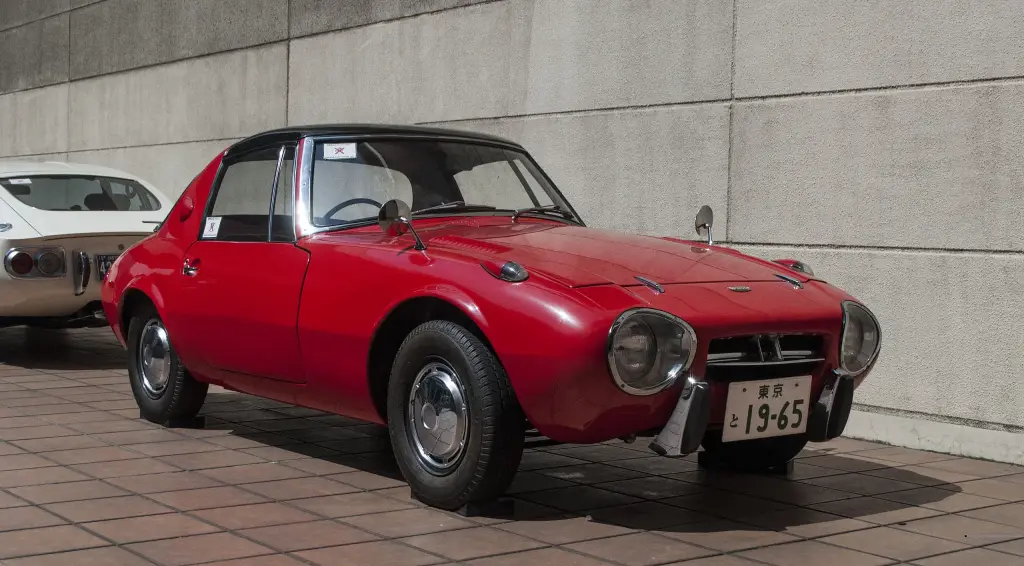
The Toyota Sports 800 is Toyota’s first production sports car. Its prototype, the Publica Sports, debuted at the 1962 Tokyo Auto Show with a sliding canopy and the 28 PS engine of the Publica 700, and the production car went on sale in 1965 with an 800 cc engine and a lift-out roof panel.
Toyota Sports 800 at a glance
| Maker | Toyota, built by Kanto Auto Works |
|---|---|
| Production | 1965–1969 |
| Class | Two-seat sports car |
| Engine | 790 cc air-cooled flat-twin, 45 PS |
| Layout | Front engine, rear-wheel drive |
| Roof | Lift-out aluminium targa panel |
| Body | Aluminium panels on a thin-steel unitary body |
| Weight | Light, with aluminium seat frames in early cars |
| Built | About 3,131 cars |
| Nickname | Yota-Hachi, “Toyota 8” |
Based on one source: the English Wikipedia article on the Toyota Sports 800.
History of the Toyota Sports 800
Origins
The prototype, called the Publica Sports, appeared at the 1962 Tokyo Auto Show with a space-age sliding canopy and the 21 kW powertrain of the Publica 700. The production car arrived in 1965 with chassis code UP15, the engine enlarged from 700 to 800 cc and fitted with twin carburettors, raising power from 28 to 45 PS. That was enough for about 70 km/h around town and around 160 km/h on a race track. In Japan the car was sold only through Toyota Publica Store, alongside the Publica, and it joined a market that already included the Honda S500, Datsun Fairlady and Daihatsu Compagno.
Design
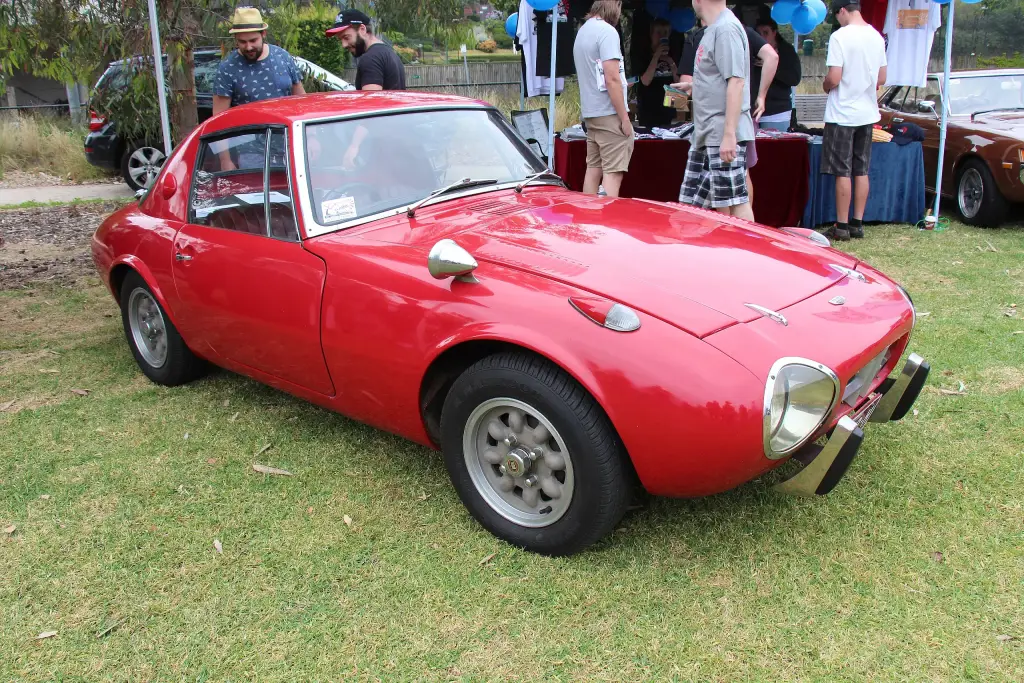
The aerodynamic styling was by Shozo Sato, a designer on loan from Datsun, and Toyota engineer Tatsuo Hasegawa, who had been an aircraft designer during the Second World War; the result was a light and agile car. It was one of the first production cars with a lift-out roof panel, a targa top that predated the Porsche Targa, and the aluminium panel could be stored in the boot. Weight was kept down with aluminium on selected body panels, thin steel in the unitary structure and, for the first few years, aluminium seat frames. The basic body design stayed unchanged, though 1967 brought a synchronised first gear, 1968 a new grille and bumperettes, and 1969 side marker lights.
Production and legacy
About 3,131 cars were built by Toyota subcontractor Kanto Auto Works between 1965 and 1969: 1,235 in 1965, 703 in 1966, 538 in 1967, 440 in 1968 and 215 in 1969. Only about ten per cent are known to survive, most of them in Japan. The vast majority were right-hand drive, but about 300 left-hand-drive cars were built mainly for Okinawa, which drove on the right under American administration; a few left-hand-drive cars were used for Toyota’s American test drives, and when dealers decided not to import the model, Toyota let them keep about 40 cars. The Sports 800 was offered in Seminole Red, Zircon Blue and Amethyst Silver. A one-off Sports 800 Gas Turbine Hybrid appeared at the 1979 Tokyo Motor Show, and the body inspired the Sports EV concepts of 2010.
Design and features
- First Toyota sports car: the company’s first production model of its kind.
- Air-cooled flat-twin: 790 cc with twin carburettors and 45 PS.
- Targa top: a lift-out aluminium panel that predated the Porsche Targa.
- Lightweight: aluminium body panels and, early on, aluminium seat frames.
Toyota Sports 800 versions
- Publica Sports (1962): the concept with a sliding canopy.
- UP15 (1965): production car with the 800 cc engine.
- 1967 update: synchronised first gear.
- 1968 update: new grille and bumperettes.
- 1969 update: side marker lights.
The Sports 800 grew out of the Publica and was the smaller predecessor of the 2000GT. Its engine also served the Starlet’s family, and more cars are in the Toyota collection.
Sources
- Toyota Sports 800, English Wikipedia: history, design, production